E-Paper



Baku’s billion-dollar question: Can COP29 set a new climate target?
There is a lot of money talk at Baku, but there’s a huge difference of opinion on what the numbers and the composition, and who the contributors should be


“Show me the money”.
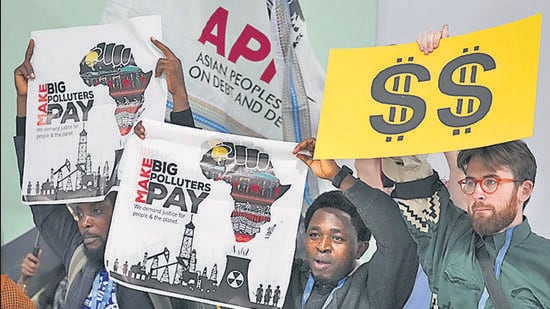
That immortal line from Jerry Maguire may well decide whether or not the COP29 climate talks at Baku, Azerbaijan, arrive at the New Collective Quantified Goal (NCQG).
NCQG is simply the new climate funding target, the money that the developed world will give to the developing world to support their climate actions after 2025. It is meant to build on the $100 billion a year funding that the developed world agreed to give the developing world in the Copenhagen climate conference in 2009, but which it met only in 2022 (and that too, only conditionally).
There is a lot of money talk at Baku, but there’s a huge difference of opinion on what the numbers and the composition, and who the contributors should be.
First, the numbers.
The number doing the round at Baku Stadium, the venue for the talks, on Tuesday was around $ 200- 300 billion as the core public finance goal (to be delivered from developed to developing countries) with the rest being mobilised through various sources including private finance and investments. There is no formal discussion of this number, but people familiar with the matter said it is the one that the e EU is likely to put forward.
The problem? It is far removed from the expectation of developing countries and they are unlikely to accept it. Developing nations expect at least $600 billion in grants.
Observers at COP29 -- observers are basically UN agencies, inter-governmental organisations and non governmental organisations -- discussed a so-called “COP29 Finance Staircase” , based on data from the Independent High-Level Expert Group (IHLEG) on Climate Finance co-chaired by Vera Songwe and Nicholas Stern, with Amar Bhattacharya as Executive Secretary.
IHLEG said on November 14 that COP29 should deliver a commitment to mobilise $ 1 trillion per year by 2030 in external finance from all sources for the investments necessary by emerging market and developing countries (EMDCs) other than China to be able to meet the Paris Agreement goals. The number should be $1.3 trillion by 2035, IHLEG added. Any shortfall in investment before 2030 will put added pressure on the years that follow, creating a steeper and potentially more costly path to climate stability.
“It is very clear for developing countries that the goal is $1.3 trillion per year and at least $600 billion to be provided in grants through public finance. That is the minimum we expect to have in NCQG. Otherwise it means that developed countries have tried to move away from their legal obligation of providing finance. We will stick to this demand. It is our historical demand. Developed countries now need to show political will in this critical situation in the context of climate crisis,” said Diego Pacheco, spokesperson for Like Minded Developing countres, a coalition which includes India.
Rich countries also argue that their designation as the “rich world”, which dates back to the Kyoto protocol in 1994, no longer applies, and that countries such as China, now the world’s second largest economy, and Saudi Arabia, a G20 state, should also be contributing to the core of climate finance.
“We need to see the differentiation between current contributors and new contributors (developing countries) and that needs to be reflected if nobody wants to reformulate the Paris Agreement in anyway,” said Linda Kalcher, executive director, Strategic Perspectives, an EU based think tank on strategic matters.
Multilateral development banks believe they can deliver $120 billion a year by 2030 to low and middle income countries, including $42 billion for adaptation (plus $65 billion from the private sector) according to a note issued by World Bank.
There have been some off-the-wall proposals on financing to meet the $1.3 trillion target: A l global levy of 0.1% on stock-market trades as suggested by French President Emmanuel Macron, and Barbados Prime Minister Mia Mottley that could raise up to $418 billion per year; a levy of $100 per ton of carbon dioxide emitted in the shipping industry that could raise $80 billion per year; and $250bn a year from a G20 wealth tax proposed by economist Gabriel Zucman.
Organisation for Economic Co-operation and Development (OECD) countries claimed earlier this year that they provided and mobilised $115.9 billion in climate finance for developing countries in 2022, exceeding the annual $100 billion goal for the first time and reaching a level that had not been expected before 2025. The claim was immediately contested by experts who believe the number to be an overestimate as a bulk of the amount mobilised is likely to have been loans leading to increased debt burden among developing countries.
In 2022, as in previous years, developed countries’ public climate finance provided bilaterally and through multilateral channels mainly took the form of loans (69% or $ 63.6 billion) and, to a lesser extent, grants (28% or $25.6 billion), the “Climate Finance Provided and Mobilised by Developed Countries in 2013-2022” report said.