
 E-Paper



Chinese President Xi Jinping meets Imran Khan, calls for improvement of Indo-Pak relations
India skipped the meeting for the second time, protesting over the CPEC which is being laid through Pakistan-occupied Kashmir (PoK).

 Prefer HTon Google


Chinese President Xi Jinping met Prime Minister Imran Khan on Sunday and expressed hope that Pakistan and India can meet each other halfway to improve their strained relations following the Pulwama terror attack by a JeM suicide bomber.
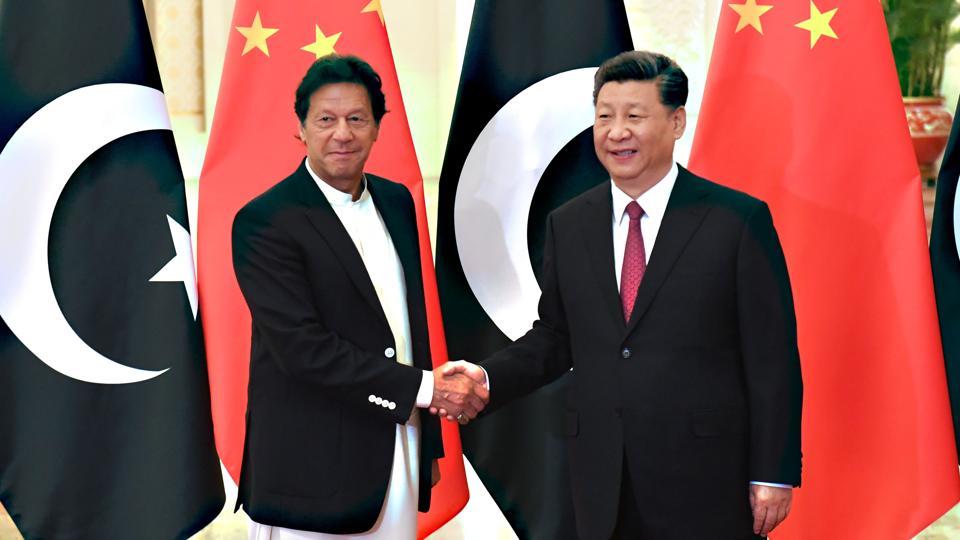
Both leaders also exchanged views on the situations in South Asia, an official Chinese statement here said about the meeting between Xi and Khan.
The India-Pakistan relations reportedly figured prominently in the meeting. Xi expressed hope that Pakistan and India can meet each other halfway and promote the stabilisation and improvement of India-Pakistan relations, it said.
Khan arrived in China on April 25 and attended China’s 2nd Belt and Road Forum (BRF) held on April 26-27.
The BRF meeting was held to highlight the achievement of the trillion-dollar Belt and Road Initiative (BRI) started by Xi in 2013 in which USD 60 billion China-Pakistan Economic Corridor (CPEC) is an important component.
India skipped the meeting for the second time, protesting over the CPEC which is being laid through Pakistan-occupied Kashmir (PoK).
The Sunday’s meeting between Xi and Khan was regarded significant as it was held in the backdrop of heightened tensions between India and Pakistan following the February 14 Pulwama terror attack carried out by Pakistan-based terror group Jaish-e-Muhammad (JeM) which killed 40 Indian CRPF soldiers.
China had sent its Vice Foreign Minister Kong Xuanyou to visit Pakistan in March as part of its efforts to ease the tensions.
Khan’s meeting with Xi took place when China is under pressure at the United Nations over its repeated attempts to block efforts to declare Pakistan-based JeM leader Masood Azhar as a global terrorist.
Last month, China put a technical hold on a resolution put forth by the US, the UK and France at the UN’s 1267 counter terrorism committee to declare Azhar as a global terrorist.
The US later took the issue to the UN Security Council (UNSC) in a bid to pressure China to take a public stance on Azhar’s issue instead of just putting up blocks at the 1267 committee.
China had expressed its firm opposition to the issue being taken to the UNSC, saying that the matter headed for settlement and blamed the US for scuttling it.
While there is no word here whether the Azhar issue figured in Xi’s talks with Khan, officials say there is a sense of wariness on the part of Beijing to block India, the US and other countries’ efforts to blacklist him at the UN on behalf of Pakistan.
Officials hoped that the issue could be resolved in the coming weeks following Khan’s visit to China.
Prior to his meeting with Xi, Khan called on Chinese Premier Li Keqiang during which the two countries signed a number of agreements. Earlier, he met Chinese Vice President Wang Qishan.
During Sunday’s meeting, Xi expressed China’s firm support to Pakistan to further the bilateral ties between the all-weather allies.
“Pakistan is China’s all-weather strategic cooperative partner. China and Pakistan are ‘iron friends’ and have always firmly supported each other on issues concerning each other’s core interests.” Xi said.
China takes Pakistan as a priority in its diplomacy, he said.
“No matter how international and regional situations change, China firmly supports Pakistan in safeguarding its sovereignty and national dignity, choosing its own development path suited to its national conditions, combating terrorist and extremist forces, striving for a sound external security environment, and playing a constructive role in international and regional affairs,” Xi said.
He said major progress had been made in bilateral cooperation in the construction of the CPEC, especially in areas such as finance, trade and other aspects, the statement said.
“In the next stage, China and Pakistan should make more efforts to advance the all-weather strategic cooperation,” Xi said.
He called on both sides to deepen high-level contacts and mutual support, strengthen strategic communication and promote high-quality cooperation in production capacity, infrastructure construction, people’s livelihood and trade within the framework of the BRI.
Khan said the CPEC had played an important role in Pakistan’s economic development and the improvement of people’s lives.
He said he believed more and more countries will support and participate in the cooperation under the BRI.
Pakistan is willing to consolidate its traditional friendship with China, deepen pragmatic cooperation and enhance communication and coordination with China in multilateral affairs, Khan was quoted as saying in the statement.
During his meeting, Khan spoke a few times about India-Pakistan relations and the prospects of peace between the two countries.
Addressing Pakistan and China Investment Forum in Beijing on Sunday, he expressed hope that the relations between the two neighbours will improve after the Indian general elections.
“We want to build a civilized relationship with our Eastern neighbour and there is a possibility that if we can resolve the Kashmir issue through dialogue, things can improve,” he was quoted by state-run Radio Pakistan as saying.
(This story has been published from a wire agency feed without modifications to the text.)


