
Sign in

Economic indicators before and after regime change: What IMF data reveals about South Asia

While some indicators have improved, the data shows that economic recovery has been uneven across the South Asia region.

Updated on: Oct 21, 2026, 11:56:54 IST
Share
Share via
  • facebook
  • twitter
  • linkedin
Copy link
  • copy link

Economic indicators in South Asian countries have shown signs of a gradual improvement following major political changes, but the economies have yet to fully recover, with GDP growth, inflation and trade figures reflecting persistent challenges.
Data compiled from the International Monetary Fund’s (IMF) World Economic Outlook 2026 and World Trade Organization (WTO) trade statistics tracks economic performance around leadership changes in five countries. (Unsplash/Representational Image)

Data compiled from the International Monetary Fund’s (IMF) World Economic Outlook 2026 and World Trade Organization (WTO) trade statistics tracks economic performance around leadership changes in Pakistan, Bangladesh, Nepal, Sri Lanka and the Maldives. These include Imran Khan’s removal as Pakistan’s prime minister in April 2022, Sheikh Hasina’s ouster in Bangladesh in August 2024 and political transitions in Nepal, Sri Lanka and the Maldives.

While some indicators have improved, the data shows that economic recovery has been uneven across the region. The figures cover different periods for each country and do not, by themselves, establish that political changes caused the observed economic trends.

Pakistan: GDP growth recovered after contracting in 2023

Pakistan's economic indicators showed a sharp slowdown after former prime minister Imran Khan was removed through a no-confidence vote in April 2022. GDP growth, which stood at 6.2% in 2022, contracted to -0.2% in 2023 before recovering to 2.6% in 2024 and 3.2% in 2025, according to the data. Inflation rose from 8.9% in 2021 to 29.2% in 2023, before easing to 23.4% in 2024. Trade figures also showed a contraction, with exports declining 7.9% in 2023 and imports falling 29.2%.
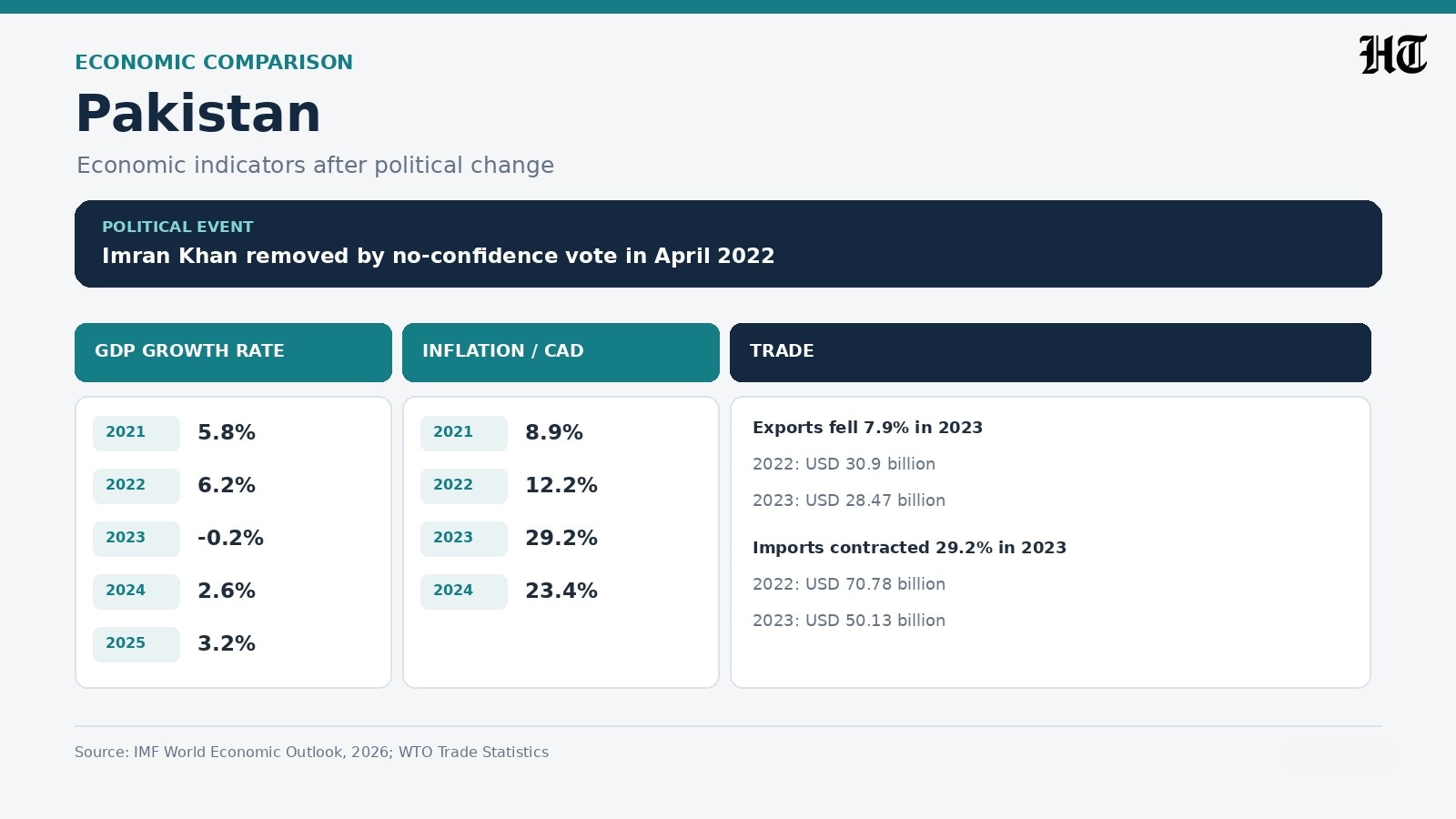
Pakistan's economic indicators showed a sharp slowdown after former prime minister Imran Khan was removed.

Bangladesh: Growth slowed after Sheikh Hasina’s removal

Bangladesh recorded GDP growth of 4.2% in 2024 and 3.5% in 2025 following the removal of former prime minister Sheikh Hasina in August 2024. Inflation increased from 9.7% in 2024 to 10% in 2025. Merchandise exports, however, registered a 1.9% increase in 2025, rising from $47.25 billion to $48.17 billion, according to the figures.
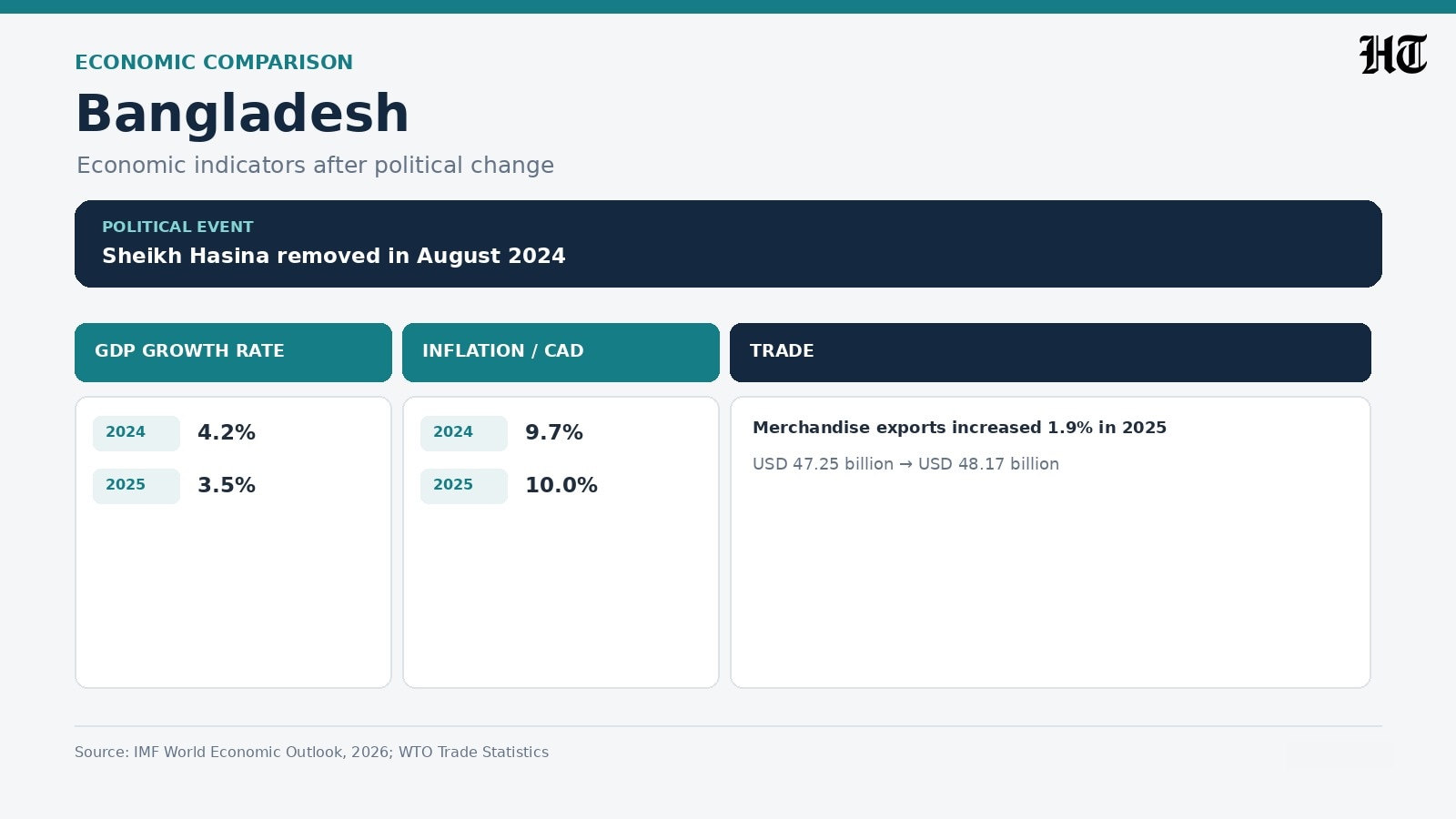
Bangladesh recorded GDP growth of 4.2% in 2024 and 3.5% in 2025 following the removal of Sheikh Hasina.

Nepal: Merchandise exports rose in 2025

Nepal saw a political transition in September 2025, when KP Sharma Oli resigned, followed by Balendra Shah becoming prime minister in March 2026. The available data records GDP growth of 4.4% and inflation of 4.1% in 2025. Merchandise exports increased 75.6% during the year, from $1.32 billion to $2.31 billion. The figures provided do not include a longer series of economic indicators to compare performance before and after the change in government.
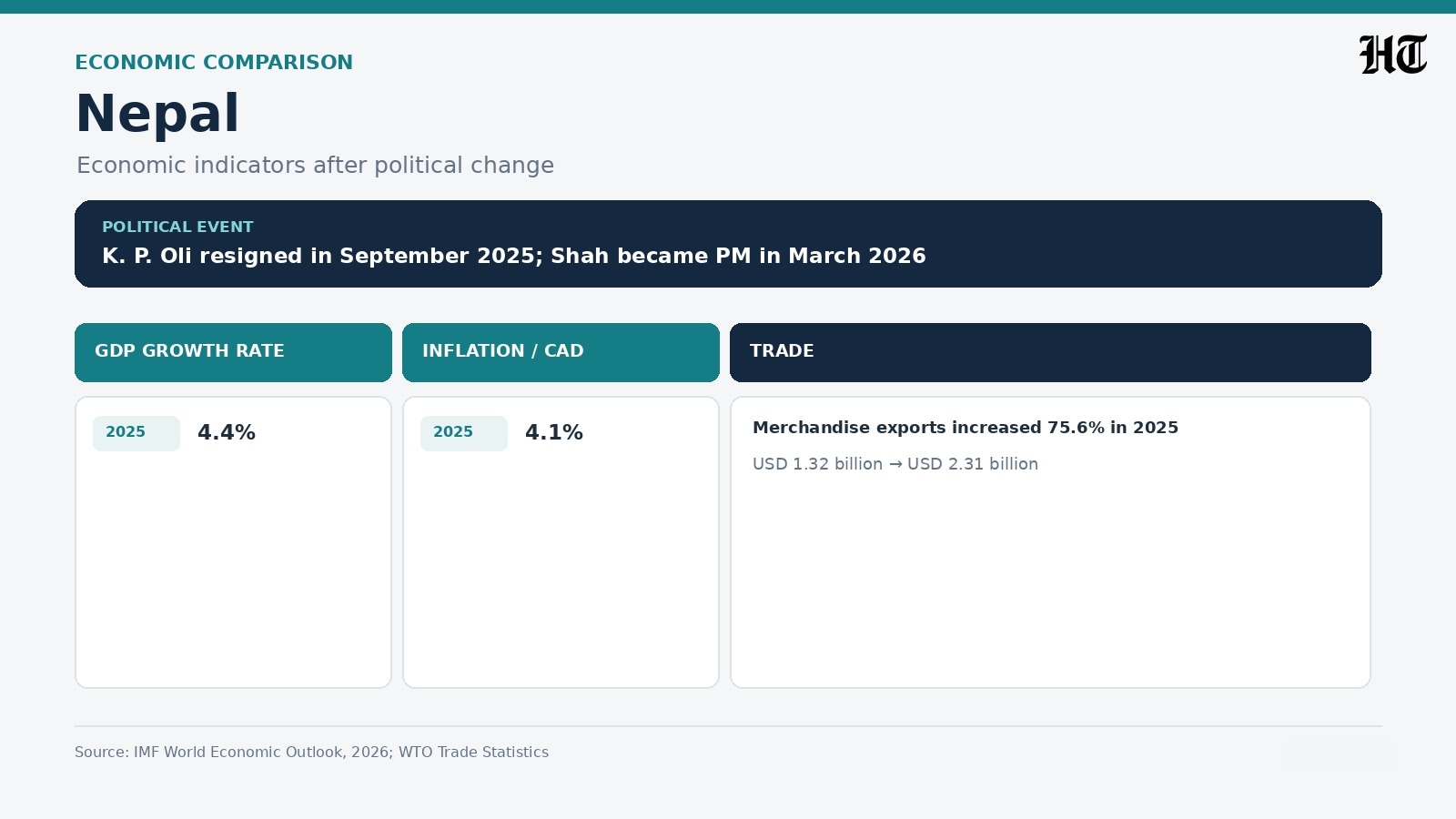
Nepal saw a political transition in September 2025, when KP Sharma Oli resigned, followed by Balendra Shah becoming the PM.

Sri Lanka: Growth returned after a deep economic contraction

Sri Lanka experienced a severe economic contraction in 2022, the year former president Gotabaya Rajapaksa resigned in July amid an economic crisis. GDP contracted 7.3% in 2022 and 2% in 2023 before growing 5% in each of 2024 and 2025. Inflation, which stood at 45.2% in 2022, fell to 17.4% in 2023 and 1.2% in 2024. The data records inflation at -0.5% in 2025. Merchandise exports declined from $13.11 billion in 2022 to $11.91 billion in 2023. Anura Kumara Dissanayake became president in September 2024.
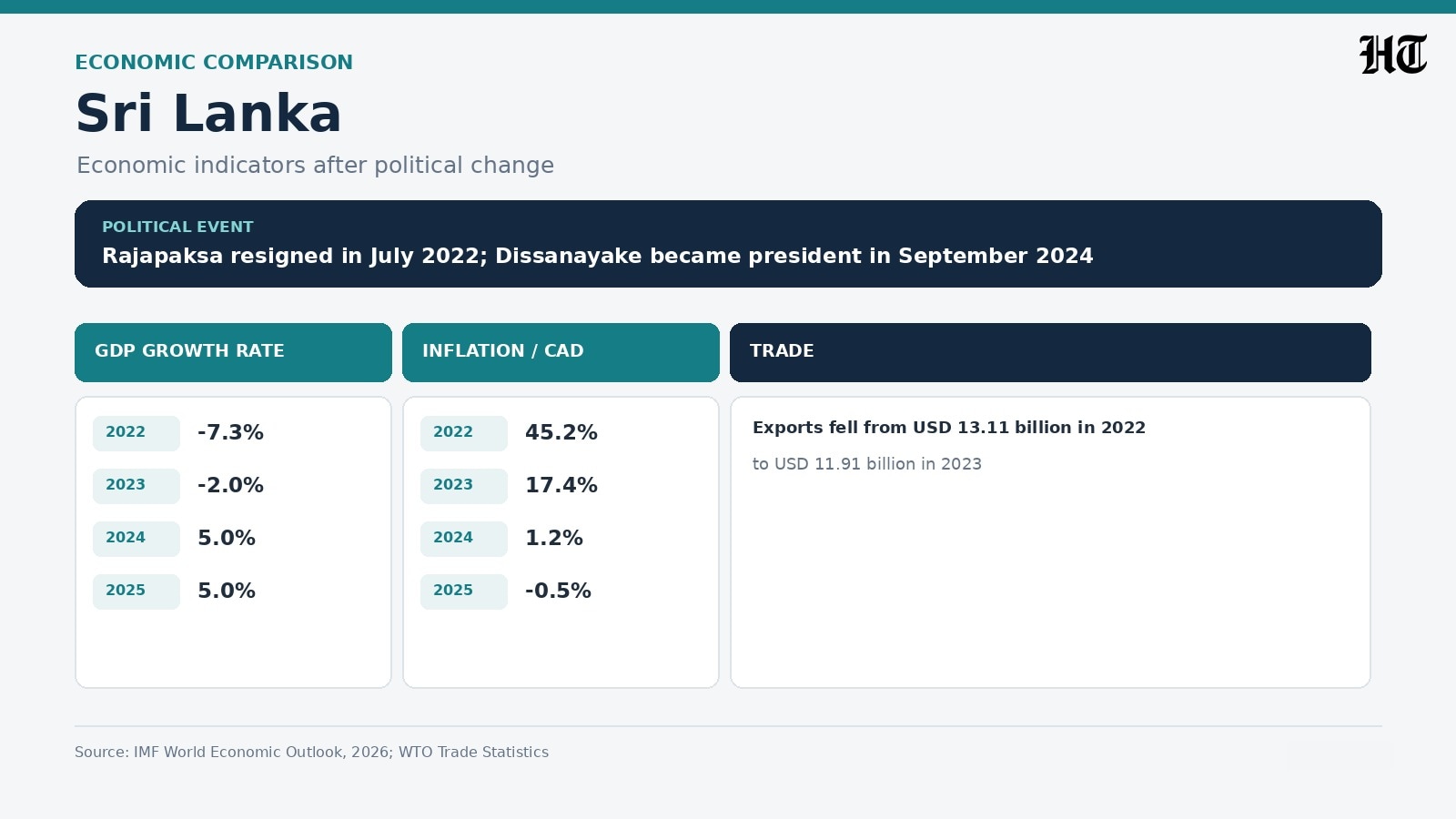
Sri Lanka experienced a severe economic contraction in 2022, the year former president Gotabaya Rajapaksa resigned in July.

Maldives: GDP growth fluctuated as current account deficit persisted

Mohamed Muizzu became president of the Maldives in November 2023. The data shows GDP growth at 5.1% in 2023, slowing to 3.3% in 2024 before rising to 6.3% in 2025. The country’s current account deficit stood at 16.9% in 2022, widened to 21.2% in 2023, and narrowed to 17.8% in 2024 and 6.1% in 2025. Merchandise exports declined by about 9% in 2024, while services exports increased by 12%. The figures also note the Maldives’ heavy dependence on services exports.

The Maldives also repaid a $150 million loan from India in September by clearing the final tranche of treasury bills subscribed to by the State Bank of India (SBI). The repayment came even as the Indian Ocean archipelago faces pressing economic challenges.
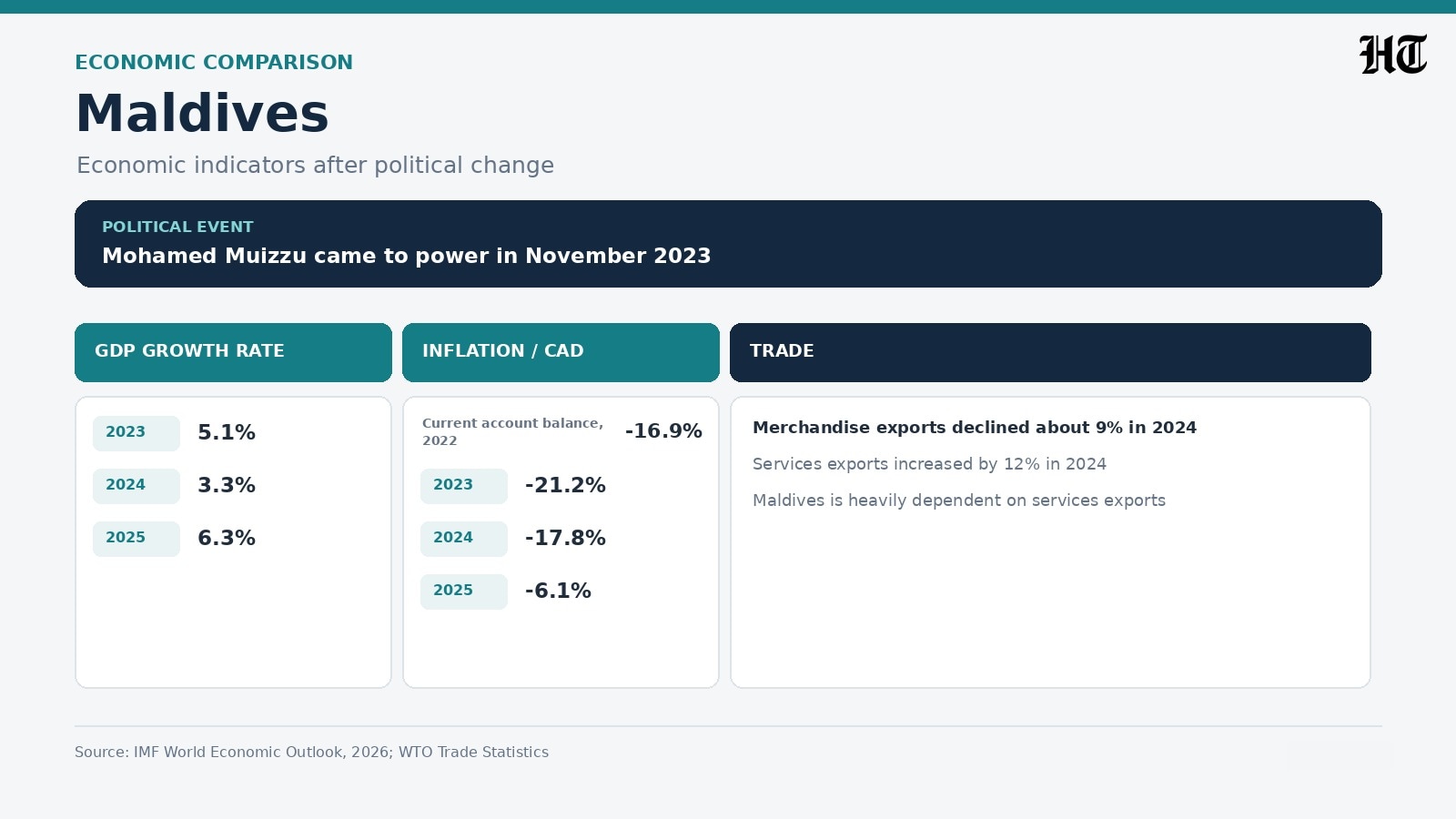
The data shows GDP growth at 5.1% in 2023, slowing to 3.3% in 2024 before rising to 6.3% in 2025.
  • Shishir Gupta
    ABOUT THE AUTHOR
    Shishir Gupta

    Shishir Gupta is Executive Editor at Hindustan Times and one of India's top journalists covering national security, strategic affairs, foreign policy and geopolitics. Over the past three decades, he has extensively reported on India's military, diplomatic and security landscape, covering every major conflict and national security challenge, from the 1999 Kargil War and the 2020 East Ladakh standoff to Operation Sindoor in 2025. He has also covered major terror attacks, including the IC-814 hijacking, the 26/11 Mumbai attacks and the 2025 Pahalgam terror strike, along with numerous Pakistan-backed terrorist incidents in the Kashmir Valley and across India. He has reported on national and state elections for more than three decades. A recognised authority on strategic affairs, Gupta has covered India's nuclear programme since the Pokhran-II (Shakti series) tests in May 1998 and has written extensively on global nuclear issues, Indian diplomacy and the country's expanding global outreach. He has also reported widely on international conflicts and terrorism, with a special focus on the Indian subcontinent. Gupta has interviewed Prime Minister Narendra Modi more than four times, including Modi's first interview with the print media after becoming Prime Minister in May 2014. His other interviews include three with the Dalai Lama, as well as conversations with Benjamin Netanyahu, Amit Shah, Yogi Adityanath, S. Jaishankar, Nirmala Sitharaman and Piyush Goyal. He is the author of Indian Mujahideen: The Enemy Within (Hachette, 2011) and Himalayan Face-off: Chinese Assertion and Indian Riposte (Hachette, 2014). He was awarded the Chevening-Wolfson Joint Scholarship at Wolfson College, University of Cambridge, UK, in 1998 and participated in the International Visitor Leadership Program (IVLP) of the US State Department in 2006. He received the Ben Gurion Prize from Israel in 2011 and the K. Subrahmanyam Prize for Strategic Studies in 2015 from the Manohar Parrikar Institute for Defence Studies and Analyses (MP-IDSA). Since 2024, he has hosted Point Blank, Hindustan Times' weekly YouTube show on global geopolitics.Read More

Get the latest World News, breaking headlines and global updates from the US, UK, Pakistan, Bangladesh, Russia and other countries. Follow major international events on Hindustan Times.