
 E-Paper



France responds to Netanyahu's letter to Macron: ‘No lesson’ needed on antisemitism
French President Emmanuel Macron had declared last month that France would formally recognise a Palestinian state during the UNGA session in September.

 Prefer HTon Google


France on Tuesday responded to Israeli Prime Minister Benjamin Netanyahu's letter to President Emmanuel Macron over the latter's move to recognise a Palestinian state, saying that the country has "no lessons to learn in the fight against antisemitism".
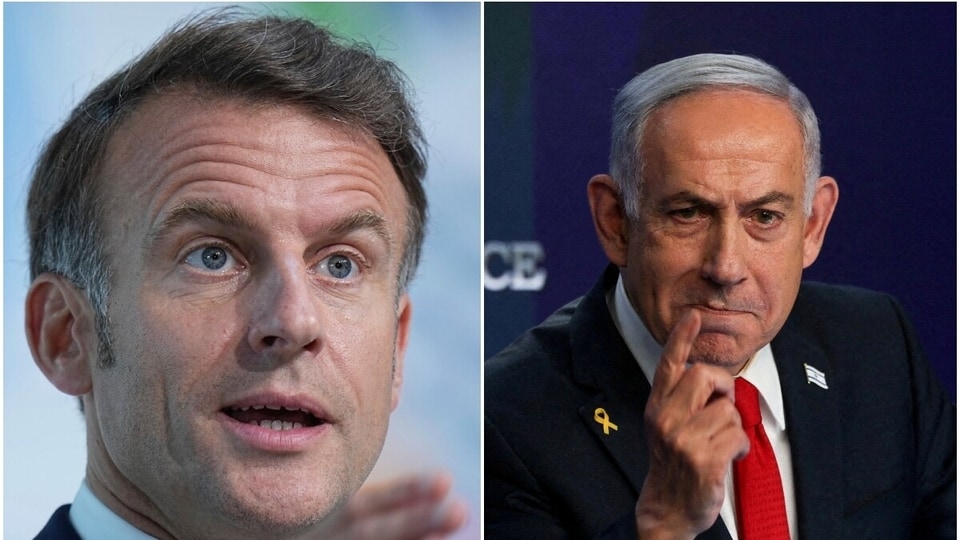
Earlier, Netanyahu had sent a letter to Macron and said that antisemitism had "surged" in France after Macron's decision on Palestine, news agency AFP reported.
"Your call for a Palestinian state pours fuel on this antisemitic fire. It is not diplomacy, it is appeasement. It rewards Hamas terror, hardens Hamas's refusal to free the hostages, emboldens those who menace French Jews and encourages the Jew-hatred now stalking your streets," the Israeli PM's letter read.
ALSO READ | After UK and France, Canada considering Palestine recognition
Netanyahu further called on Macron to confront antisemitism in France, insisting that the French President must "replace weakness with action, appeasement with resolve, and to do so by a clear date: the Jewish New Year, September 23".
Benjamin Haddad, France's minister for Europe, responded to Netanyahu's letter and said the country has "no lessons to learn in the fight against antisemitism".
"I would like to say very clearly and very firmly that this issue of antisemitism, which is poisoning our European societies... cannot be exploited," Haddad told broadcaster BFMTV.
‘Abject, erroneous’ accusations: Macron's office
President Macron's office termed the Israeli PM's accusation as "abject" and "erroneous", adding that France "protects and will always protect its Jewish citizens".
The letter from Netanyahu "will not go unanswered", said Macron's office.
"This is a time for seriousness and responsibility, not for conflation and manipulation," the French presidency added. It further said that the (French) Jewish community is "intolerable".
"That is why, beyond criminal convictions, the president has systematically required all his governments since 2017 -- and even more so since the terrorist attacks of October 7, 2023 -- to show the strongest action against perpetrators of antisemitic acts," it added.
On July 24, French President Macron declared that France will formally recognise the state of Palestine in September during the UN General Assembly. “In keeping with its historic commitment to a just and lasting peace in the Middle East, I have decided that France will recognise the State of Palestine,” he had said.
France is among at least 145 of the 193 UN members that now recognise or have moved to recognise the Palestinian state, AFP reported.
Israel vs Australia
Earlier this month, Australia joined the list, alongside France, the United Kingdom and Canada, among others.
Netanyahu also slammed Australian Prime Minister Anthony Albanese, describing him as a weak politician who betrayed Israel and abandoned Australia's Jews", the Israeli PM's office posted on X.
His remarks came amid an ongoing diplomatic spat between Israel and Australia, which began after Albanese's government cancelled the visa of a far-right Israeli politician, Simcha Rothman, on Monday.
Rothman's ultranationalist party is part of Netanyahu's governing coalition. He was scheduled to speak at events organised by the Australian Jewish Association.
Hours after this cancellation of Rothman's visa, Israeli foreign minister Gideon Saar said he had revoked the visas of Australian representatives to the Palestinian Authority.
Australia's foreign minister, Penny Wong, termed the revocation an "unjustified reaction" by Israel, saying that Netanyahu's government was "isolating Israel and undermining international efforts towards peace and a two-state solution".


