E-Paper


In 1986, biologists captured the last 18 black-footed ferrets; breeding efforts have returned over 2,600 to the wild
Once thought extinct, black-footed ferrets were saved after 18 were captured in Wyoming. More than 4,500 have since been released, but only about 300 remain.

 Prefer HTon Google


For a species once thought lost, the road back began with a very small population. The black-footed ferret, a nocturnal predator of North America's grasslands, disappeared from much of its historic range as prairie habitat was lost. By the 1970s, it was widely believed to be extinct in the wild.

According to the Smithsonian's National Zoo and Conservation Biology Institute, the last 18 known wild black-footed ferrets were brought into human care between 1985 and 1987 after disease devastated the remaining population in Wyoming. They became the foundation of a conservation breeding program.
A species rescued at the last moment
Since reintroductions began, more than 10,500 ferret kits have been born in human care, while the U.S. Fish and Wildlife Service estimates that about 300 currently live at reintroduction sites. Black-footed ferrets (Mustela nigripes) once ranged across the Great Plains and intermountain grasslands of North America. Their fortunes were closely tied to prairie dogs, which provide both their principal food and the underground burrows where ferrets live and raise their young.
Deep Dive

As grasslands were converted for agriculture and prairie dogs were deliberately removed from large areas, the ferrets lost both food and shelter. Disease made the situation even worse. The species was listed as endangered in 1967 and was thought to have vanished from the wild by the 1970s. Then, in 1981, a small population was discovered near Meeteetse, Wyoming, giving conservationists an unexpected chance to intervene.
Beginning in 1985, canine distemper and sylvatic plague hit the Meeteetse population. Wildlife managers eventually decided that leaving the remaining animals in the wild risked losing the species altogether. The final wild ferrets were captured by 1987. Just 18 animals, seven males and 11 females, remained in human care. A study in the Journal of Heredity later found that only seven of those animals ultimately contributed genetically to the surviving population, making the recovery effort an example of conservation from an extremely narrow genetic base.
From 18 founders to thousands of releases
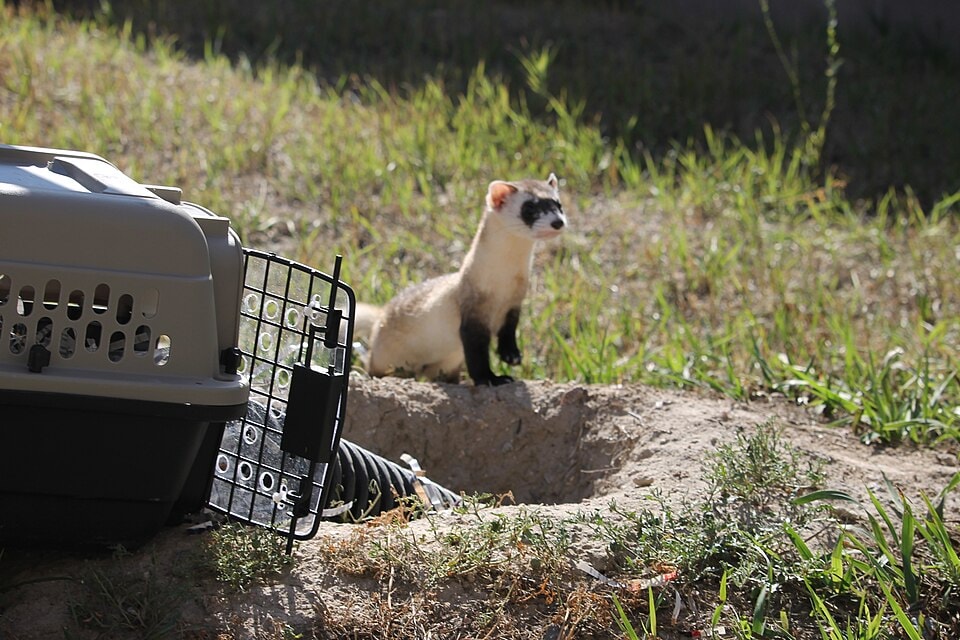
The captive program had to solve a basic problem: how could an animal that spends much of its life underground be bred, raised, and eventually prepared for life on the prairie? The solution combined managed breeding with pre-release conditioning. Young ferrets were introduced to prairie dogburrows and exposed to conditions they will encounter after release. The U.S. Fish and Wildlife Service says animals that undergo this preparation have survived at about three times the rate of ferrets released without exposure to live prairie dogs.
The Smithsonian joined the cooperative breeding effort in 1988 and was the first institution outside Wyoming to receive offspring from the founders. Its conservation center in Virginia has since produced more than 1,000 ferret kits, including animals born through artificial insemination.
The recovery program expanded from Wyoming to sites across the western Great Plains and beyond. Ferrets have been released in states including Arizona, Colorado, Kansas, Montana, New Mexico, South Dakota, Utah, and Wyoming, as well as in Canada and Mexico. The animals are returned to areas with suitable prairie dog colonies, rather than simply being placed wherever grassland remains.
A comeback that remains fragile
The recovery remains fragile despite those gains. More than 4,500 captive-bred ferrets have been reintroduced into the wild by 2022, according to the Smithsonian, yet only about 300 are currently estimated to be living at reintroduction sites. That gap reflects the difficulty of establishing self-sustaining populations. Black-footed ferrets remain heavily dependent on prairie dog colonies, and the same disease that contributed to their historic decline continues to threaten both predators and prey.
The sylvatic plague is an especially serious condition. The flea-borne bacterial infection can kill prairie dogs and ferrets. With a colony of prairie dogs dying out, ferrets risk losing both their source of food and the habitat for shelter in the form of burrows. Besides that, predators, and low genetic diversity are other factors that threaten black-footed ferrets. Therefore, conservation efforts include more than simply adding new animals to the population.
Nevertheless, the story marks a major turn of events. In the 1980s, there were just 18 members of the species left alive, all of them kept in captivity. Now, the offspring of those founder animals are again roaming the prairie dog towns in part of their native range. The species has not yet fully recovered and is still considered endangered. The progress from 18 living members of the species to thousands of releases highlights the scale of the recovery effort.