
 E-Paper



In joint statement, Biden, Modi and Albanese hail Abe’s role in founding Quad
He was the architect of the idea of Indo-Pacific as a common geopolitical space and Quad as a mechanism to ensure a rules-based order in the region.

 Prefer HTon Google


The leaders of India, US and Australia in a joint statement on Friday hailed former Japanese prime minister Shinzo Abe’s role in founding the Quad, credited him for deepening Japan’s ties with each of their countries, and committed themselves to redoubling the effort towards a free, open, peaceful and prosperous Indo-Pacific.
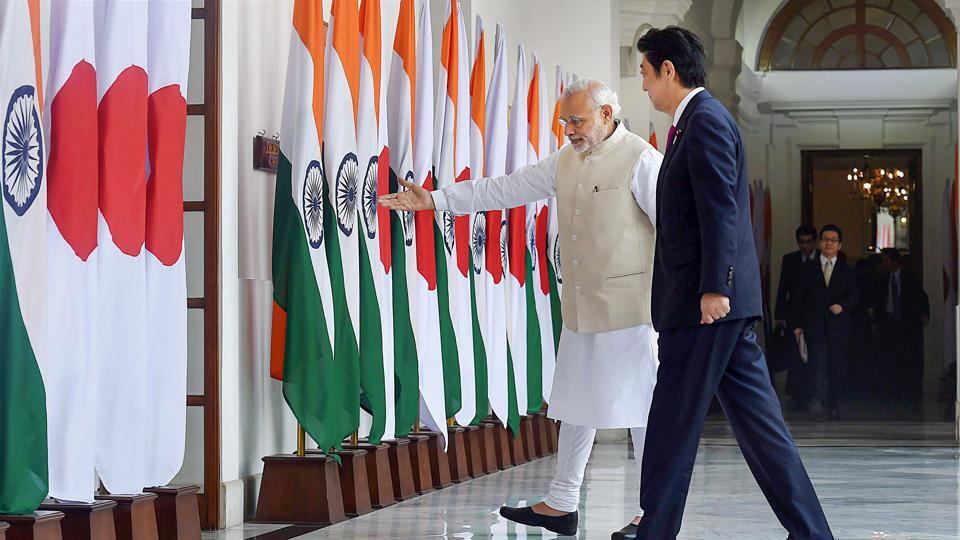
Prime Minister Narendra Modi, US President Joe Biden, and Australian PM Anthony Albanese — leaders of the three countries that constitute the Quad along with Japan — said they were shocked at Abe’s tragic assassination.
Abe -- Japan’s longest serving PM over two stints in 2006-07 and 2012-2020 -- was delivering a speech in Nara on Friday ahead of upper house elections when he was shot. He was airlifted to a local hospital but died of blood loss despite emergency treatment including massive blood transfusions.
He was the architect of the idea of Indo-Pacific as a common geopolitical space and Quad as a mechanism to ensure a rules-based order in the region.
“Prime Minister Abe was a transformative leader for Japan and for Japanese relations with each one of our countries. He also played a formative role in the founding of the Quad partnership, and worked tirelessly to advance a shared vision for a free and open Indo-Pacific,” the joint statement added.
The three leaders said their hearts were with the people of Japan — and Prime Minister Fumio Kishida, their fourth colleague in the Quad — in this moment of grief.
“We will [honour] Prime Minister Abe’s memory by redoubling our work towards a peaceful and prosperous region.”
Despite it never being officially written down, the Quad has been driven by a shared concern among member countries about China’s increasing belligerence and power projection in the region. In its earlier iteration in 2007, when pushed by Abe, Quad was unable to sustain as an institutional mechanism — primarily because of what was seen as Australia’s desire to balance ties with China. But the seeds were sown, and a decade later, in Manila, officials from all four countries met in what marked the revival of Quad. This was followed by a ministerial-level meeting in New York and other subsequent engagements.
In 2021, after Joe Biden took over as president, he convened the first virtual leaders-level Quad summit in March, which was followed by an in-person leaders summit in Washington DC in September. While Quad foreign ministers met in Melbourne in February this year, leaders of Quad have already meet twice since the war in Ukraine began — virtually in March, and then for their second in-person summit in Tokyo in May.
Despite differences on Ukraine — India has not condemned Russian aggression or participated in sanctions against Russia , while the other three members have actively done so— the Quad has continued to deepen its imprint.
To allay concerns in the region, particularly among the Asean (Association of Southeast Asian Nations) countries - who have deep economic ties with China and don’t wish to be seen as choosing between Washington and Beijing - and to counter China’s criticism of the grouping as a destabilising bloc directed against it, Quad has focused on delivery of public goods such as vaccines; enhanced collaboration on climate; deepened the partnership on emerging and critical technologies, which are seen as the new frontier of the competition with China; and provided scholarships to students from all four countries, among other steps.
At the same time, it has reiterated its commitment to a free and open Indo-Pacific and taken initiatives on maritime security. Quad members have stepped up joint military exercises.
Abe, who stepped down as Japan’s PM in 2020 for health reasons, played a key role in pushing the intellectual and political frontiers to recognise emerging threats in the region and need for a mechanism to preserve the peace across both seas. This took the form of first convincing and leading his own country that has been wedded to pacifism since the Second World War, and then working with the other three members of Quad. The unprecedented statement by Biden, Modi and Albanese was a tribute to this element of Shinzo Abe’s legacy.


