
 E-Paper



'Rainbow island' to 'missile city': After US attack on Iran’s Kharg, key territories in war focus
Described as Iran’s “crown jewel,” Kharg handles nearly 90% of Iran’s crude oil exports.

 Prefer HTon Google


The US and Israel have moved their crosshairs from Iran’s land-based military sites to the Persian Gulf’s vital maritime nodes. Early Tuesday, explosions tore through Kharg Island as a series of targeted strikes hit Iran’s primary oil export terminal.
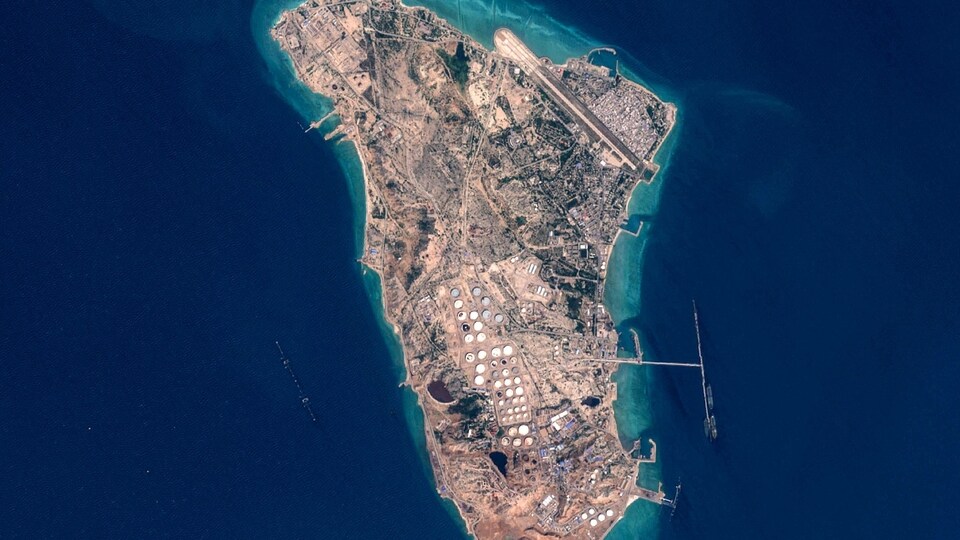
The attack came 12 hours ahead of the 48-hour deadline (to expire on 5:30 am IST, April 8) set by Donald Trump for the Islamic Republic. Reopen the Strait of Hormuz or face “complete obliteration” of Iran’s energy and transport infrastructure, the US President had warned.
Described as Iran’s “crown jewel,” Kharg handles nearly 90% of the country’s crude oil exports. There were multiple hits on the island’s loading jetties and storage tanks, which reportedly held an estimated 18 million barrels of oil.
“Restraint is over,” Iran’s Islamic Revolutionary Guard Corps (IRGC) said in response to the attack.
The US-Israeli war on Iran has entered its second month. With the closure of the Strait of Hormuz, global oil prices have surged past $100 a barrel.
Kharg Island
Kharg Island, 30 km off Iran’s coast is central to both Tehran and global energy markets. With storage for 30 million barrels, pipelines from inland oilfields, and specialised loading terminals, it is tightly controlled by the IRGC and often called the “Forbidden Island".
Its proximity to US military bases makes it highly vulnerable. Kharg has been attacked before, during the Iran-Iraq War in the 80s.
If Kharg is the economic heart, these islands are the military tollbooths of the country.
Hormuz
Hormuz Island, located at the mouth of the Strait of Hormuz, has long been a maritime hub, historically ruled by Persian, Portuguese, and British powers.
It is known today as the “Rainbow Island” for its red, pink, and golden landscapes. Control of the island helps Iran monitor shipping through the crucial entry to the Gulf.
The Strait of Hormuz is a narrow waterway carrying roughly 20% of the world’s oil and LNG. Amid the ongoing war, Iran has restricted passage.
Qeshm
Qeshm Island, the Gulf’s largest, spans over 1,400 sq km and lies near the port city of Bandar Abbas. Home to around 1.5 lakh people, it functions as both a free trade zone and a naval hub.
The IRGC has reportedly constructed a secret underground “missile city” there, housing submarines, attack boats and coastal defences. In March, Iran accused the US of attacking a desalination plant on Qeshm, though Washington and Tel Aviv denied involvement.
Larak
Located east of Qeshm and south of Hormuz, Larak Island allows Iran to control shipping lanes through the strait.
Fortified with bunkers and attack craft, it has recently been used to create a “safe corridor” for non-enemy vessels. It reportedly charges as much as $2 million to pass.
Abu Musa
Abu Musa, the largest of three islands claimed by the UAE, sits at the northern edge of the Strait of Hormuz. Home to about 2,000 people, it has been a flashpoint for decades.
Iran took control in 1971, shortly before the UAE’s independence, leading to a longstanding territorial dispute.
Today, Abu Musa is a frontline outpost in Iran’s maritime strategy. The Pentagon has reportedly been considering potentially seizing it to weaken Iran’s blockade capabilities.
Greater and Lesser Tunbs
The Greater and Lesser Tunbs are small islands near the strait, also claimed by the UAE. Greater Tunb is 4 sq km, Lesser Tunb less than 1 sq km, but both are militarised with missiles, drones, and mine-laying equipment.
Iran’s control of these islands gives it an outsized influence over one of the world’s most important shipping corridors, despite their tiny size.
Hengam
Hengam, a 36 sq km island near Qeshm, is home to a few hundred families and a historic community of veiled fisherwomen unique in the Gulf. It is small and less militarised than other islands.
Kish
Kish Island, Iran’s most popular resort destination, attracts millions of tourists each year. It operates as a visa-free free trade zone, but the island has not escaped the war.
Early in the conflict, footage showed smoke rising from a reported Israeli-US strike.


