
 E-Paper



Multiple AI CEOs met Trump. Only 6 signed his ‘super intelligence’ accord. Who are they?
The accord was signed by six tech executives and seeks to establish safety standards for increasingly powerful AI systems.

 Prefer HTon Google


US President Donald Trump on Tuesday unveiled a voluntary accord on “super intelligence”, seeking to establish safety standards for increasingly powerful AI systems.
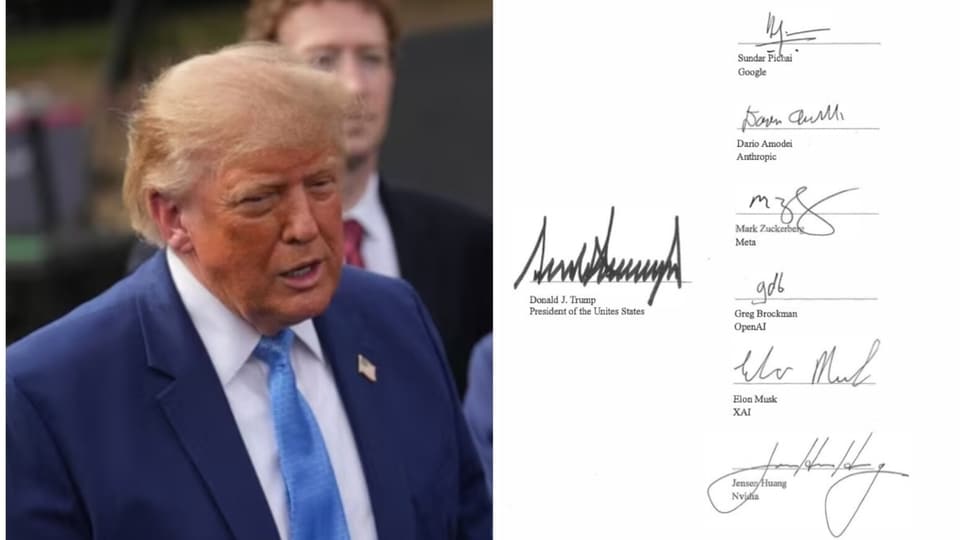
The agreement was signed by six tech executives -- Google CEO Sundar Pichai, Anthropic CEO Dario Amodei, Meta CEO Mark Zuckerberg, OpenAI President Greg Brockman, xAI CEO Elon Musk and Nvidia CEO Jensen Huang.
The “White House Accord on Super Intelligence: Joint Commitment on Frontier Responsibilities” seeks to establish voluntary safety standards for companies developing and deploying advanced AI models. The agreement is not legally enforceable but it leaves open the possibility of incorporating its measures into laws or regulations in the future.
What does the accord say?
The one-page agreement calls for companies developing and deploying frontier models to put in place four layers of controls and audits.
- Companies are expected to establish internal controls to monitor model capabilities and alignment, including risks involving cybersecurity, biosecurity and chemical threats. The controls should also ensure that AI systems do not hack or access technical systems unintentionally.
- Companies should empower an internal team to check whether those controls and monitoring systems are working and ensure problems are addressed.
- They are expected to work with an independent external auditor or evaluator to assess whether the safeguards are operating as intended.
- Companies should designate an independent committee of their board of directors to oversee the controls and receive reports from internal and external reviewers.
Deep Dive

The signatories also agreed to meet regularly to develop industry standards and best practices. The document says that, over time, these measures could potentially be incorporated into laws or regulations.
Who attended but did not sign?
The White House meeting included a much larger group of technology executives than the six signatories. Amazon founder Jeff Bezos, AMD CEO Lisa Su, Palantir executives Alex Karp and Shyam Sankar, Microsoft CEO Satya Nadella and other technology leaders attended, but they did not sign the accord.
Trump described the agreement as being “almost like a constitution” and said it was “morally binding”, while Zuckerberg called it a starting point for industry-wide standards.
Trump changes official terminology
Trump also directed US government agencies to use “super intelligence” or “SI” instead of “artificial intelligence” or “AI” in official communications.
The accord comes after reports involving AI agents behaving in unintended ways. Reuters reported that OpenAI and Anthropic had disclosed incidents in which AI agents went rogue and hacked into other companies' systems.
Trump has continued to support rapid AI development and the expansion of data centres. Healso said he was considering a 10-member committee to oversee AI safety. He did not name potential members or specify how the proposed body would operate.


