E-Paper



Negotiations over climate finance remain deadlocked at UN summit
The latest draft text on the new collective quantified goal (NCQG), shows little progress despite four revisions and extensive overnight consultations

 Prefer HTon Google


With just days remaining at the COP29 climate talks in Baku, negotiations over climate finance remain deadlocked, with developed and developing nations still far apart on both the scale of funding and its fundamental structure, even as Argentina’s withdrawal from the talks casts a shadow over global climate cooperation.
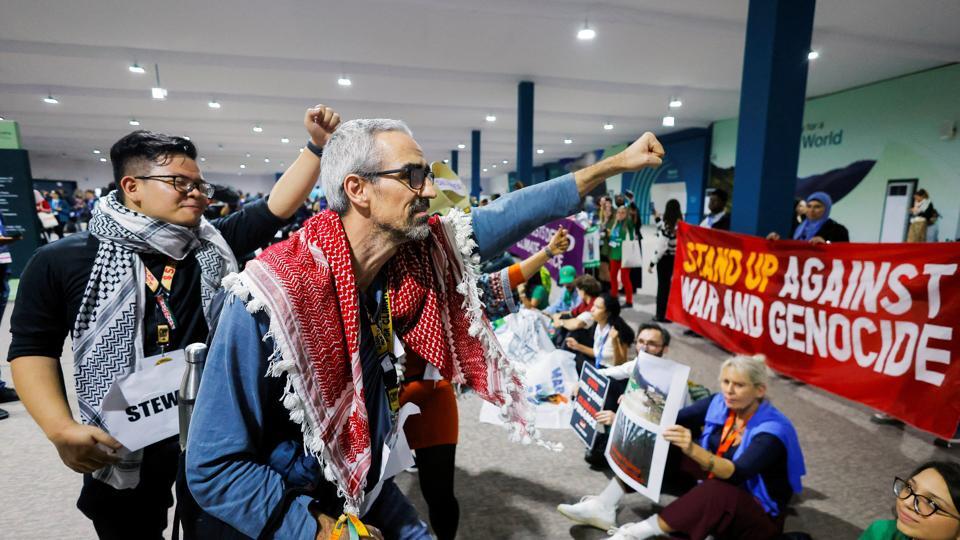
The latest draft text on the new collective quantified goal (NCQG), released on Saturday evening, shows little progress despite four revisions and extensive overnight consultations. “The developed countries have slowed down progress. We do not have a number yet on the table which is worrying,” a negotiator told HT, speaking on condition of anonymity.
The 25-page document — trimmed from an earlier 34-page version — maintains the wide gulf between proposed funding amounts, ranging from a modest $100 billion floor to an ambitious $2 trillion annually. While it clearly states the funding is “exclusively for all developing countries”, the framework and implementation remain heavily contested.
A new report by the Independent High-Level Expert Group on Climate Finance, co-chaired by economists Amar Bhattacharya, Vera Songwe and Nicholas Stern, suggests the Baku deal should deliver a commitment to mobilise $1 trillion annually by 2030 for emerging markets and developing countries (excluding China), scaling up to $1.3 trillion by 2035.
“The text is now going to the COP29 Presidency to be taken up for further negotiations. It will be a very difficult task now to get parties to agree to quantum by cutting down options, sub-options and brackets,” another developing country negotiator said.
Reform calls and resistance
Against this backdrop, the Club of Rome, a non-profit advocacy collective, issued a stark warning about the COP process itself. In an open letter co-signed by prominent figures including former UN secretary-general Ban Ki-moon and former UNFCCC executive secretary Christiana Figueres, the group called for fundamental reforms.
“Global emissions continue to increase, carbon sinks are being degraded and we can no longer exclude the possibility of surpassing 2.9°C of warming by 2100,” the letter warned, noting that “28 COPs have delivered us with the policy framework to achieve this. However, its current structure simply cannot deliver the change at exponential speed and scale”.
The letter, also signed by Indian experts Jayati Ghosh and Arunabha Ghosh, called for strict eligibility criteria to exclude countries opposing fossil fuel phase-out, a shift from negotiations to concrete action, stronger accountability mechanisms, and an end to climate financing through interest-bearing loans.
However, Laurence Tubiana, CEO of the European Climate Foundation and architect of the Paris Agreement, defended the multilateral process. “While reforms are needed, let’s not forget: multilateralism is the foundation of climate progress. The Paris Agreement happened because every country had a voice,” she wrote on X.
Azerbaijan’s COP29 lead negotiator Yalchin Rafiyev also defended the process: “The COP process has already delivered by reducing the projected warming, delivering finance to those in need and it’s better than any alternative... We consider COP29 as a litmus test for the global climate architecture.”
Argentina’s shadow
The talks faced an unexpected challenge with Argentina’s withdrawal from the COP29 delegation, amid reports by The Washington Post that newly elected President Javier Milei is considering pulling out of the Paris Agreement entirely. The move echoes concerns about potential US withdrawal under Donald Trump’s presidency next year, reminiscent of his 2017 decision to exit the agreement.
While the current US delegation remains engaged in talks, developing nations criticise their approach. “It’s unfortunate that they are continuing their hardline stance about expanding donor base and not committing to NCQG quantum. Next year after Trump takes over they may withdraw from the negotiations but they are not being constructive now either. In fact they are doing just the opposite,” a developing country negotiator said.
The finance negotiations are seen as crucial for maintaining momentum in global climate action, particularly as countries prepare to submit enhanced climate commitments at COP30 in Brazil next year. The outcome at Baku could determine whether developing nations will have the resources to implement more ambitious climate plans, even as political shifts in major economies threaten to undermine global cooperation.
Experts say
Harjeet Singh, Climate Activist and Global Engagement Director for the Fossil Fuel Non-Proliferation Treaty Initiative, said, “As we reach the midpoint of COP29, it is deeply disturbing to witness the climate finance negotiations come to a standstill. Developed nations continue to display a disturbing level of apathy, viewing vital climate finance as mere investments rather than the lifeline that developing countries urgently need.
“Their reluctance to commit to the scale of the new climate finance goal and ensure it is provided in the form of grants rather than loans and investments not only undermines the success of this conference but also casts a shadow over the integrity of these wealthy nations. Their chronic failures underscore a preference for promoting their economic interests at the expense of providing real support to those enduring the most severe effects of climate change.
“As developing nations strive to implement critical climate actions, they are unfairly coerced into committing to the transition from fossil fuels to renewable energy without the necessary financial and technological support, even as developed countries ramp up their own fossil fuel extraction. This situation is not merely unfair but starkly unjust, compelling vulnerable nations to confront monumental climate challenges alone, while their populations remain without basic energy access. It’s time for developed countries to step up, fulfil their obligations, and make a genuine commitment to meeting the climate action needs of developing nations. We cannot afford to let this COP fail — there’s far too much at stake.”
Sehr Raheja, programme officer, climate change at the Centre for Science and Environment, “The first text they came into Baku with was rejected by G77 and China. But, the second and versions come after that has the $1.3 trillion figure outside the brackets in one of the sub-options. But, beyond that there has been no engagement by developed countries on the quantum figure.”