E-Paper



Number Theory: What African Union's inclusion means for G20
The 18th G20 leaders’ summit, under India’s presidency, decided to include the African Union as a permanent member of the multilateral body
Published on: Sep 10, 2023, 09:40:10 IST


Share via


Copy link

The African Union (AU) is a continental body consisting of the 55 member states that make up the countries of the African Continent. It was officially launched in 2002 as a successor to the Organisation of African Unity (OAU, 1963-1999).

What does the move mean for the group and India? Here are four charts which explain this in detail:
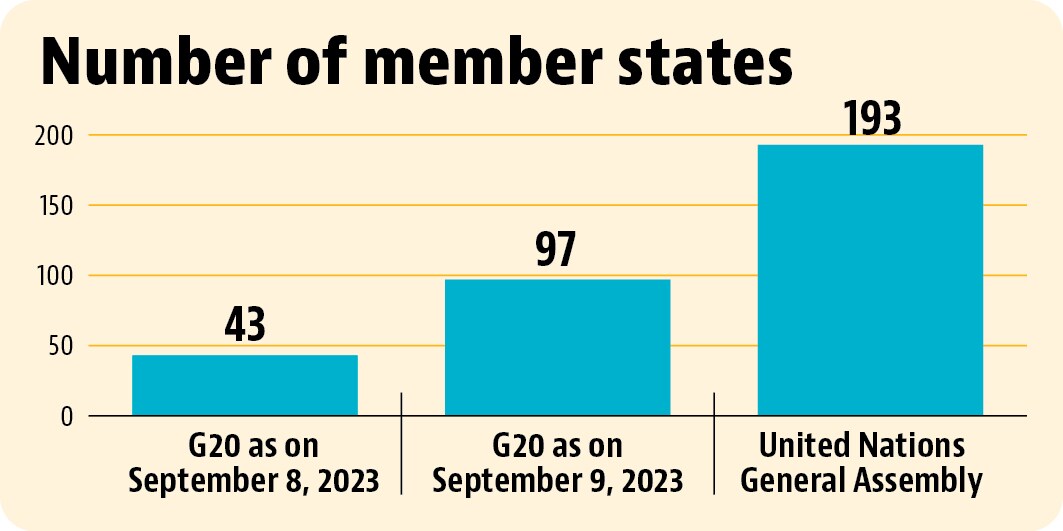
 AU’s inclusion will add to the G20’s weight and representativenessPrior to the AU’s inclusion, the G20 comprised 19 countries and the European Union (EU). To be sure, France, Germany, and Italy out of the 27 EU members are also a part of the G20 in their individual capacity. The G20, either individually or through larger groups, comprised 43 of the 193 countries in the United Nations’ General Assembly (UNGA). Out of the 55 countries which are a part of the AU, only South Africa was previously included in the G20. Adding the remaining 54 to the list now makes the G20 a representative body of 96 (UN considers Western Sahara a non-self-governing territory) out of the 193 countries represented in UNGA. This pretty much makes the G20 the largest multilateral body in the world (other than the UN itself).
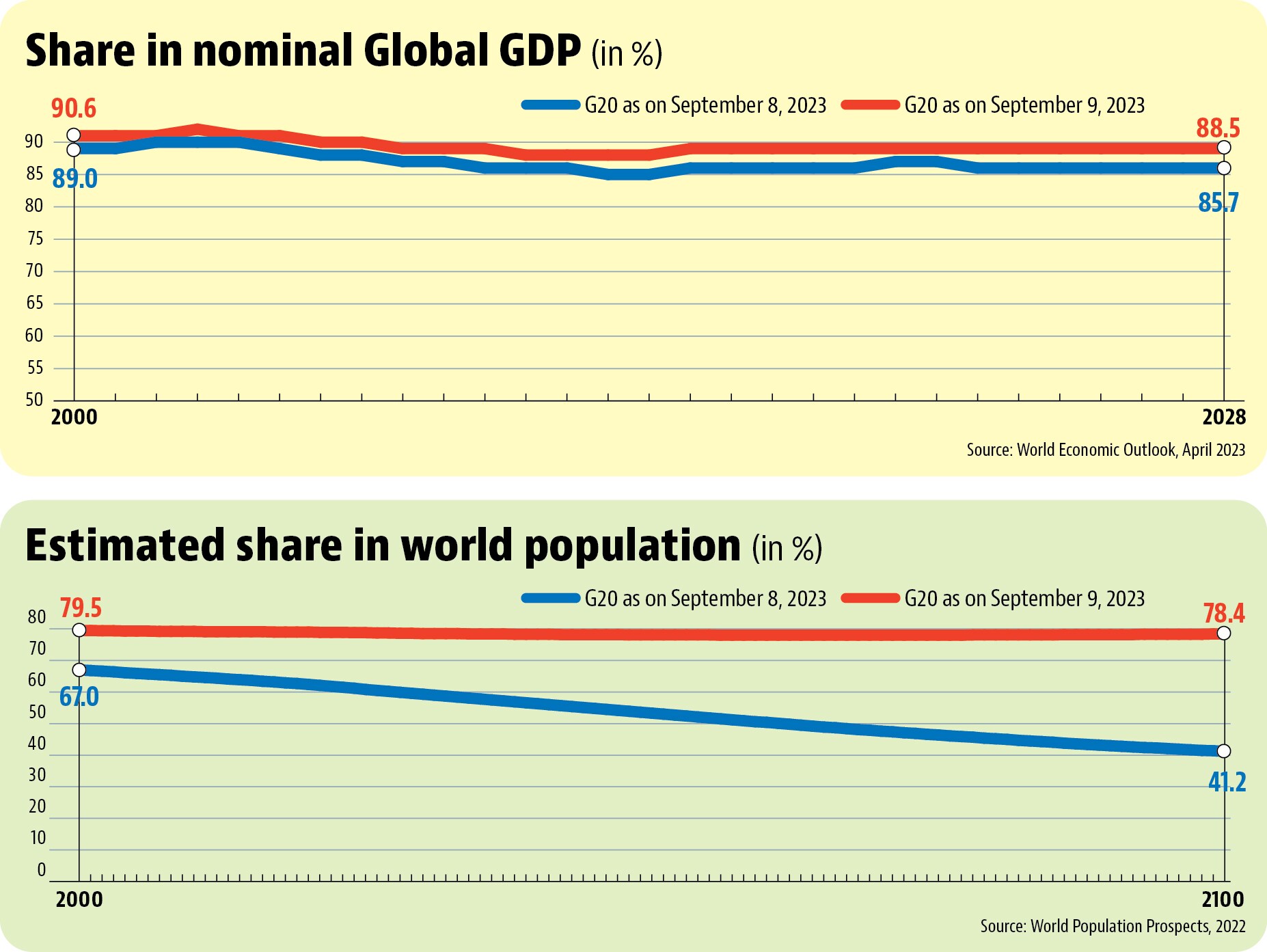
- How does this change the G20’s share in terms of GDP and population?When the G20 had its first leaders’ summit in London, its member countries and groups had a share of 86.8% in the total nominal GDP of the world. This number has largely been unchanged if one were to use the 2023 GDP projections by the IMF. Inclusion of the AU will not change this number significantly. If one were to add the GDP share of AU countries which are currently not in the G20, the group’s global GDP share will increase to just 88.9%. However, things will change significantly when it comes to the G20’s population share in the world. While the existing G20 had a share of 61.5% of the world’s population, this number will increase to 78.9% if one takes into account the population in countries which are part of the AU. What is even more interesting is the fact that had the G20 not included the AU, its population share in the world would have continued on a falling trajectory at an even greater pace. Inclusion of the AU in the G20, if the UN population projections are to be believed, will keep its population share at more than three fourth of the world’s total population until at least 2100.
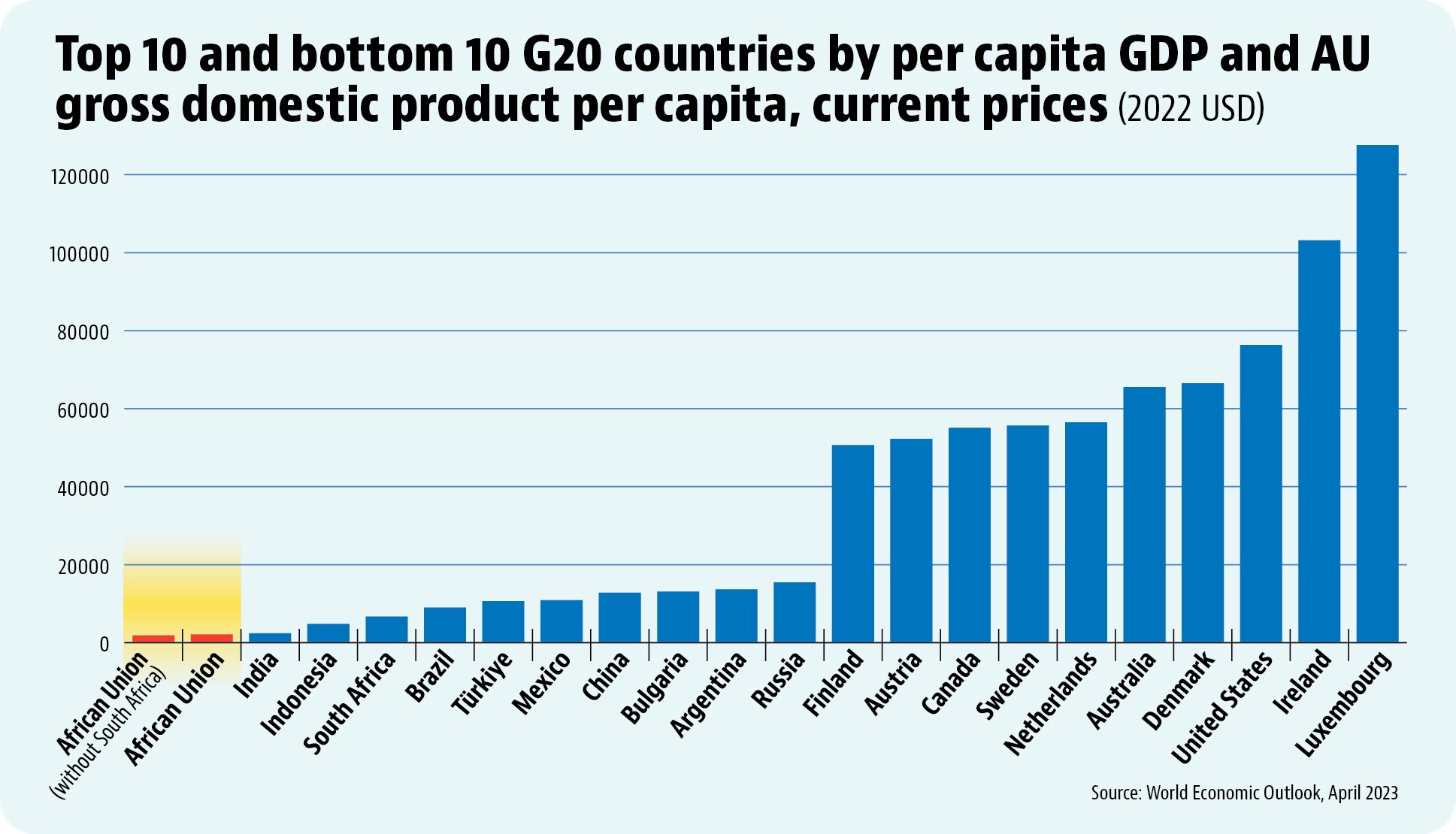
- Inclusion of the AU also strengthens the voice of the Global South in the G20While the G20 has traditionally been seen as the club of world’s largest economies in terms of GDP, the countries vary significantly in terms of per capita incomes. The latter is what matters when it comes to standard of living for the masses. Prior to the inclusion of AU, India’s per capita GDP ($2,379 in nominal terms in 2022) was the lowest in the G20 group, even though it is the fifth largest economy in the world in terms of GDP. The asymmetry between India’s per capita GDP and overall GDP is a manifestation of the challenge to improve mass incomes standards which is far more acute in many countries of the Global South. India’s own challenge on this count has often made it a powerful voice for the concerns of the Global South in multilateral forums. With a per capita GDP of just $ 2,092.5 in nominal dollars in 2022 — this number decreases to $1,886 if South Africa is excluded — the AU will now bring to the table voices of a large number of low income countries in the world. At a time when most multilateral regimes such as the WTO are mired in a deep crisis, this is a welcome move towards creating an important plurilateral body that is more representative to the concerns of the Global South. In addition to these facts, the inclusion of the AU in the G20 also offers a strategic window for India in Africa. China has invested a lot of physical capital, especially in infrastructure projects in Africa. 50 out of the 55 AU members are part of the Belt and Road initiative. Given India’s own infrastructure finance requirements, it is difficult for it to compete with China on this front. Where India can hope to make a big impact in Africa is by exploiting its significant advantage in the Digital Public Infrastructure (DPI) arena to improve financial inclusion or buttress state capacity in these countries. Given the fact that most of the DPI push will be in the realm of common knowledge and non-coercive (unlike a lot of Chinese lending), it could potentially generate a lot of goodwill for India in Africa unlike opaque Chinese debt that usually comes with strings attached.