E-Paper



Number Theory: What does 1.48°C warming in 2023 mean?
While there is still some distance to go before the 1.5°C target is breached, 2023 is the biggest step towards that target in the 10-year and 30-year averages
Updated on: Jan 10, 2024, 16:46:46 IST


Share via


Copy link

2023 was the warmest year on record — and by a bit. It also almost breached the 1.5°C warming threshold compared to the 1850-1900 baseline, according to data released on 9 January by the Copernicus Climate Change Service (C3S) of the European Centre for Medium-Range Weather Forecasts (ECMWF). To be sure, as HT reported on January 10, this does not mean that the world is close to breaching the limit for climate change set by the Paris Agreement of 2015. What does the number released by ECMWF mean then? Here are four charts that explain this.

What does 1.48°C warming in 2023 mean?
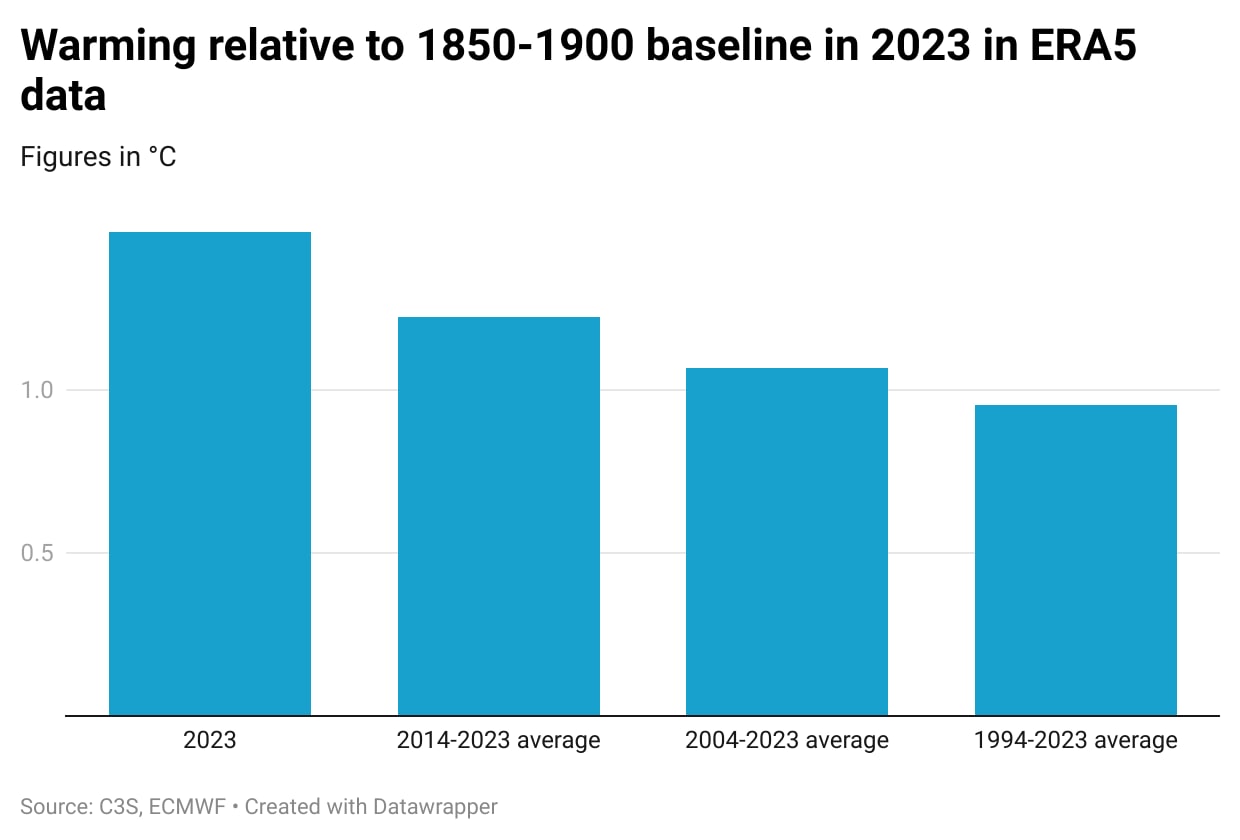
 How far are we from breaching the 1.5°C threshold?Scientists debate almost each word of the “limit the temperature increase to 1.5°C above pre-industrial levels” target set by the Paris Agreement. This is because they disagree on whether 1850-1900 average should be considered the pre-industrial baseline ; they disagree on what the average global temperature for 1850-1900 period is (because mathematical approximations were required to create a global average for this period); and they disagree because they’d like to decouple the part of warming that is human-induced when talking about the Paris Agreement (because some warming or cooling in any year is just natural variation). However, there is a general consensus that the target is meant for long-term climate, not the warming in any particular year. This means that nobody yet thinks that the 1.48°C warming seen in the ERA5 data (the fifth generation of ECMWF Re-Analysis) released on January 9 amounts to a near-breach of the Paris Agreement. However, the world has undoubtedly come closer to that limit. For example, using the 1850-1900 baseline, the ERA5 data shows 1.22°C warming in the 10-year average of global temperature in 2023, 1.06°C warming in the 20-year average, and 0.95°C warming in the 30-year average. These averages are 0.28°C, 0.44°C, and 0.55°C away from the 1.5°C mark.
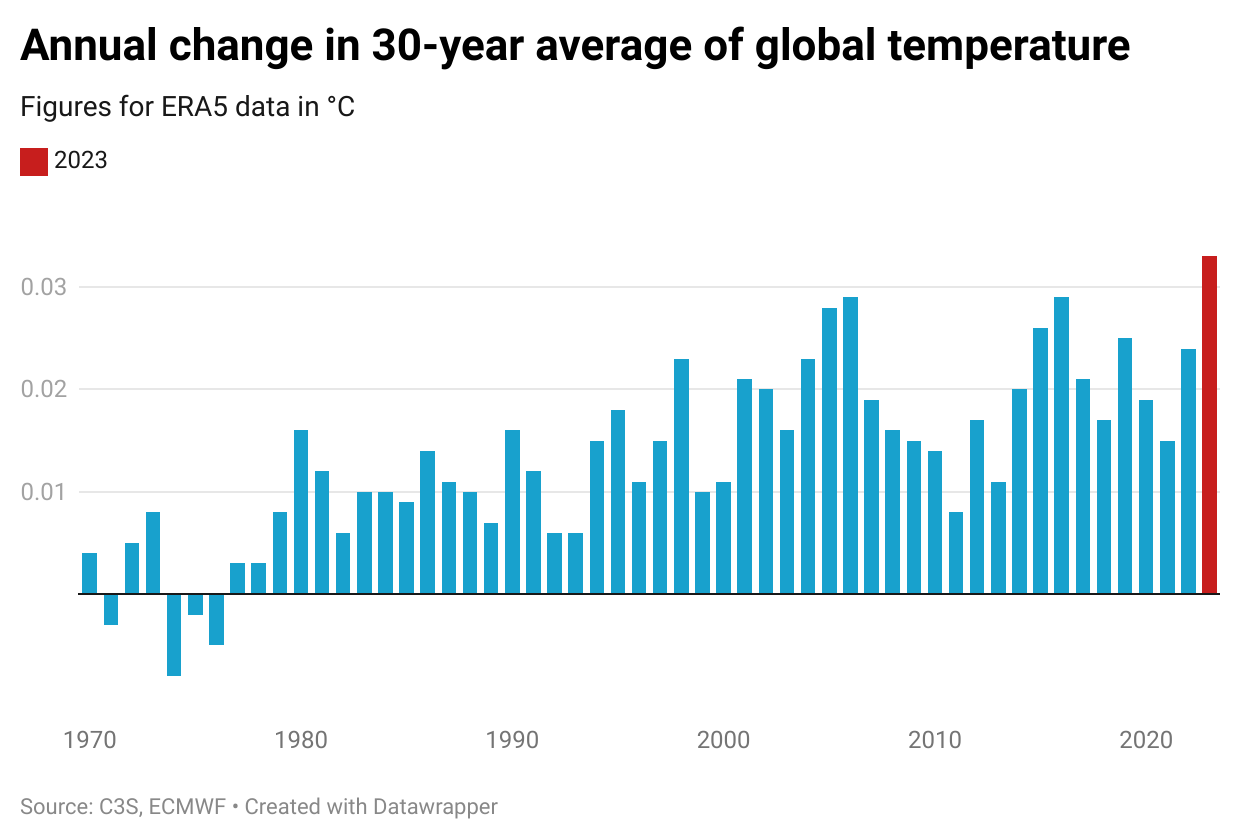
- Irrespective of the distance to the 1.5°C target, 2023 is the biggest leap towards itWhile there is still some distance to go before the 1.5°C target is breached, 2023 is the biggest step towards that target in the 10-year and 30-year averages, and the fifth biggest in the 20-year average of the ERA5 data. This has happened because 2023’s average temperature was far ahead of previous records. 2023’s temperature is 0.16°C ahead of 2016, the second warmest year. In comparison, 2016 and 2017 (the fifth warmest year) are separated by just 0.06°C. Similarly, 2016 and 2010 (the 10th warmest year) are separated by 0.31°C. This means that the warming in 2023 was more than half the warming in the next nine warmest years.
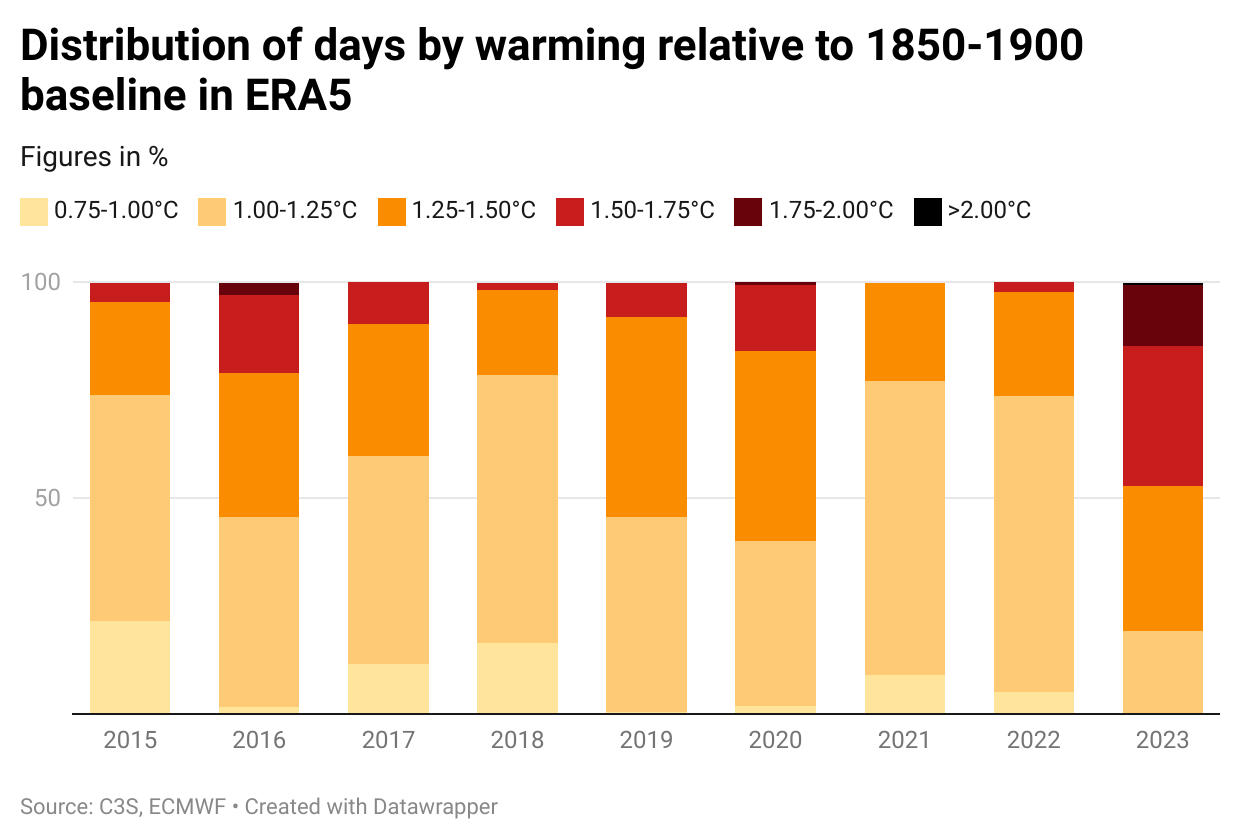
- Individual days were far more extreme in 2023 than ever beforeThis is not unexpected for the warmest year on record. However, numbers show just how much of an outlier 2023 was. The first year when a day was warmer by 1.5°C in the ERA5 data was recorded in 2015. Only 16 days in the year (4.4%) breached that threshold that year. Similarly, 77 or 21% days breached that threshold in 2016, the second-warmest year. This was also the record for daily breaches so far. In 2023, 172 of 47% days breached that threshold, which is more than double the figure in 2016. 2023 has also broken previous records in another way. No day in the year saw warming less than the 1°C compared to the 1850-1900 baseline, a feat not achieved by any year on record so far. The previous record on this metric was held by 2019 (the fourth warmest year), when only two days had warming under 1°C. However, 2019 had far fewer days (7.9% or 29 days) that breached the 1.5°C threshold.
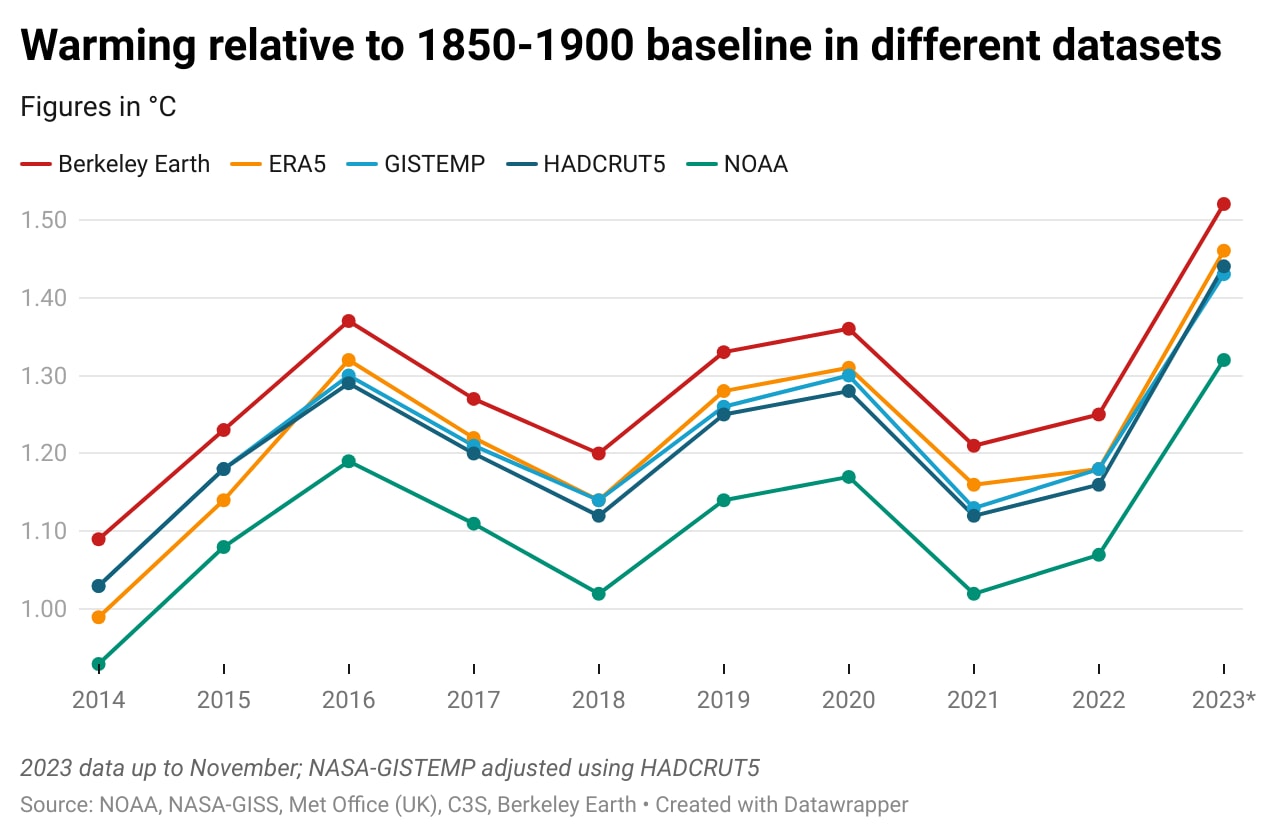
- Different datasets will show different levels of warming in 2023, but all are certain to find 2023 the warmest year on recordERA5 is not the only available global temperature dataset. This is just a global temperature dataset available earlier than others. It is also one of the datasets that generally shows a higher degree of warming than most others. For example, among five prominent datasets (GISTEMP, NOAA, Berkeley Earth, HADCRUT5, and ERA5), ERA5 has consistently shown the second highest warming every year from 2016 to 2023 (up to November), just behind the figures recorded by Berkeley Earth. This means that Berkeley Earth will likely show a higher degree of warming (relative to the 1850-1900 baseline) than even ERA5 and others will show a smaller degree of warming when their data is released later this month. However, as HT explained earlier, these differences are largely because of how they adjust their numbers to the 1850-1900 baseline. In all datasets, 2023 is likely to be the warmest year and by a big margin.