
 E-Paper



Russia’s war to slow global growth, cause inflation: IMF
The Fund estimates India will grow at 8.2% in 2022, a 0.8 percentage point dip from its January assessment, when IMF had expected India’s growth rate for the year to be 9%

 Prefer HTon Google


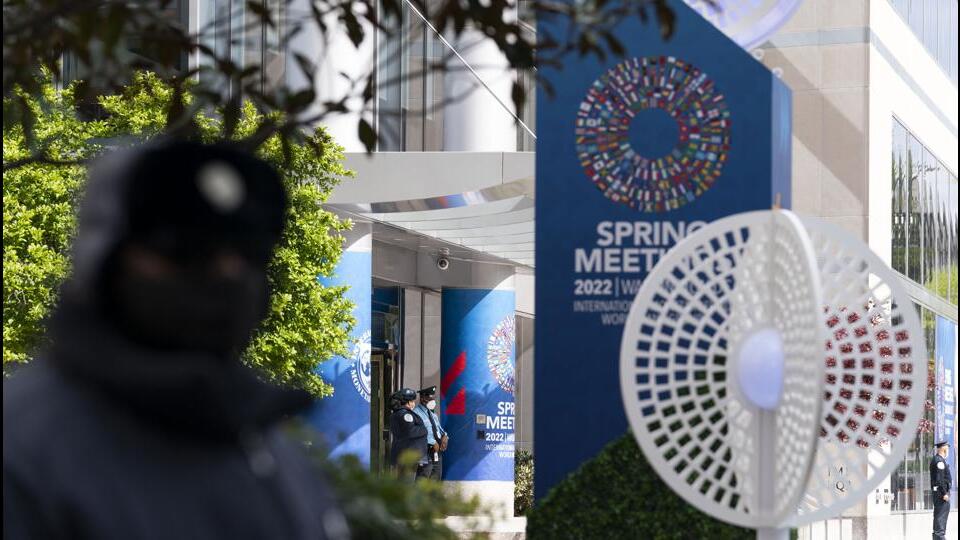
The IMF in a report released on Tuesday concluded that Russia’s war in Ukraine will severely set back global economic recovery, slow growth, increase inflation, cause grave risks to the financial system, and potentially permanently fragment the world economy into geopolitical blocs, and as a result revised its global growth projection for 2022 from 4.4% to 3.6%. For 2023, it revised its growth projections from 3.8% to 3.6%.
“The economic effects of the war are spreading far and wide — like seismic waves that emanate from the epicenter of an earthquake — mainly through commodity markets, trade and financial linkages,” IMF said its World Economic Report (WEO), released on Tuesday. The current and anticipated decline in supply of oil, gas and metals (exported by Russia), and wheat and corn (exported by Ukraine) have already driven up prices, with food and fuel prices set to hit lower income households globally.
The Fund estimates India will grow at 8.2% in 2022, a 0.8 percentage point dip from its January assessment, when IMF had expected India’s growth rate for the year to be 9%. In 2023, India’s growth projection is pegged at 6.9%, a dip from the 7.1% estimation in IMF’s January outlook.
In its Asia subsection, the report said that notable downgrades included Japan (which is projected to see a 0.9 percentage point dip) and India, “reflecting in part weaker domestic demand — as higher oil prices are expected to weigh on private consumption and investment — and a drag from lower net exports”.
Last week, the World Bank had slashed its projection for India’s growth from 8.7% to 8% for the current fiscal year.
In a separate global financial stability report (GFSR), released simultaneously, IMF said that the sharp rise in commodity prices with prolonged supply disruptions have exacerbated existing inflationary pressures and led to a rise in inflation expectations.
“Central banks face heightened challenges in bringing inflation to target while safeguarding economic recovery,” the report noted. The April outlook projects inflation at 5.7% in advanced economies and 8.7% in emerging markets and developing economies – 1.8 and 2.8 percentage points more than estimated in January.
In addition, the war’s repercussions will test the resilience of the financial system through various potential amplification channels. These, according to GFSR, include “direct and indirect exposure of banks and nonbanks, market disruptions in commodity markets and increased counterparty risk; poor market liquidity and funding strains; acceleration of cryptoization in emerging markets; and possible cyber-related events”.
Besides the war in Ukraine and monetary tightening, the Fund, in its April outlook, has flagged three other variables as shaping the near-term outlook for the global economy. These include fiscal withdrawal as emergency measures to cushion the economy during the pandemic are wound down; China’s slowdown where the combination of more transmissible variants and a zero-Covid strategy entail the prospect of more frequent lockdowns; subdued real estate investment; and pandemic and vaccine access with most countries not expected to attain the target of 70% full vaccination by the end of 2022.
IMF has also warned of a “more permanent fragmentation” of the world economy into geopolitical blocs “with distinct technology standards, cross-border payment standards and reserve currencies.
“Such a tectonic shift would entail high adjustment costs and long-run efficiency losses as supply chains and production networks are reconfigured. It also represents a major challenge to the rules-based framework that has governed international and economic relations for the last 70 years,” the report said.
In terms of financial stability, the Fund recommends that central banks should act decisively to prevent inflation pressure from becoming entrenched.To avoid volatility in financial markets, it has asked central banks in advanced economies to provide clear guidance about the normalisation process while remaining data-dependent.
In emerging markets, the Fund suggests that further rate increases or policy normalisation taken with respect to measures during the pandemic should continue as warranted according to country specific inflation and economic outlook “to anchor inflation expectations and preserve policy credibility”.


