
 E-Paper



Satellite to track rising seas as climate warms
The payload will be hoisted into a low-Earth 1,300-kilometre (800-mile) orbit by a Space X Falcon 9 rocket, with lift-off from Vandenberg Air Force Base in California

 Prefer HTon Google


An Earth-observation satellite developed by European and US space agencies set to lift off Saturday will measure sea level rise, tracking changes threatening to disrupt tens of millions of lives within a generation.
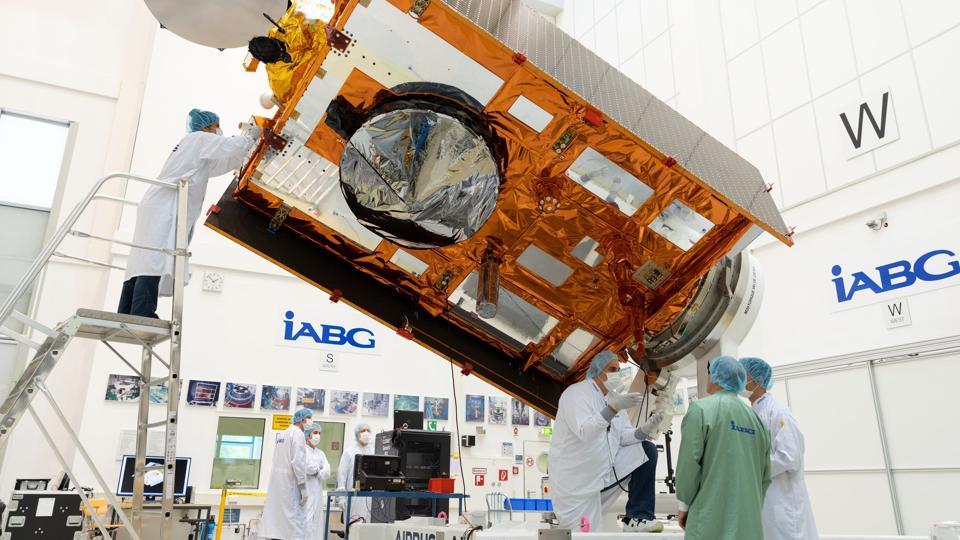
If all goes according to plan, the payload will be hoisted into a low-Earth 1,300-kilometre (800-mile) orbit by a Space X Falcon 9 rocket, with lift-off from Vandenberg Air Force Base in California at 17:17 GMT.
Sentinel-6a will be the first of two identical satellites -- the second to be launched in five years -- that will provide measurements of unprecedented precision until at least 2030.
Each Sentinel-6 probe carries a radar altimeter, which measures the time it takes for radar pulses to travel to Earth’s surface and back again.
The satellites will circle the planet in the same orbit as earlier missions that supplied sea-surface height data over the last three decades, mapping 95 percent of Earth’s ice-free ocean every ten days.
Accelerating sea level rise is arguably the climate change impact that will affect the largest number of people over the next three decades.
Nearly 800 million people live within five metres of sea level, and even an increase in sea level of a few centimetres can translate into vastly more damage from high tides and storm surges.
Sea level rise accelerating
Already today, there are more than 100 million people living below high tide levels.
“Extreme sea level events that are historically rare -- once per century in the recent past -- are projected to occur frequently, at least once per year, at many locations by 2050,” especially in the tropics, the UN climate science advisory panel, the IPCC, concluded in a major report last year.
Satellites tracking the world’s oceans since 1993 show that global mean sea level has risen, on average, by over three millimetres (more than a tenth of an inch) annually.
More recently, that rate has increased to 5 mm per year.
“It is crucial that we are able to see these accelerations,” said Alain Ratier, outgoing Director-General of Europe’s meteorological satellite agency, EUMETSAT.
China, Bangladesh, India, Vietnam, Indonesia and Thailand are home to the greatest number of people who today live on land that could be threatened by permanent inundation by 2100.
The IPCC forecasts an increase in global sea level rise of up to 1.1 metres (43 inches) by the end of the century.
The Copernicus Sentinel-6 mission is a collaboration of the European Commission, the European Space Agency (ESA), EUMETSAT, NASA and the US National Oceanic and Atmospheric Administration (NOAA).
The Sentinel satellites are each about the size and shape of a large minivan topped with slanted solar panels, and weigh nearly 1,200 kilos (2,600 pounds), including rocket fuel.
They are designed to last for five-and-a-half years, but could provide data for far longer.


