E-Paper



Trump’s New Trade Standard Takes Shape With 15% Tariff Deal
A deal with Japan and a potential deal with Europe follows months of uncertainty and will likely raise prices while offering a bit of clarity for global trade.


President Trump’s push to introduce a new standard for global trade is coming into sharper focus as U.S. and EU officials converge on a possible 15% tariff deal, which could come on the heels of a similar agreement with Japan.
Taken together, the two developments represent a turning point in months of global trade negotiations that have stoked uncertainty among investors and America’s biggest trading partners.
Much remains unsettled one week before President Trump’s self-imposed Aug. 1 deadline for reaching trade deals with other countries. Deals with two of the U.S.’s largest trading partners, Canada and Mexico, haven’t been reached and those countries face getting slapped with 35% and 30% tariffs, respectively, if deals aren’t struck before next week. Tariffs of 25% currently apply to both countries, with exemptions for certain products.
A 90-day truce with Beijing has already brought additional tariffs on Chinese exports to the U.S. this year down to 30%, an amount that includes 10% levies on all U.S. imports. Tariffs on the country could soar again on Aug. 12.
The developments with Japan and the EU offer some clarity to businesses and the global economy after months of turmoil. Businesses have held back on major investments and decisions amid Trump’s back-and-forth tariff announcements and uncertainty over whether countries could reach trade deals with his administration.
“When you have these framework agreements, that takes the risk of more damaging tit-for-tat trade wars off the table,” said Brett Ryan, senior U.S. economist at Deutsche Bank.
The 15% levy on goods for the most part represents the highest tariff level on Japan in decades, and is higher than the 10% on most U.S. imports Trump implemented starting April 5. But in a sign of how much expectations have changed, markets seemed to welcome the news—an acknowledgment that the rate isn’t as severe as the 25% he had threatened.
Still, the higher tariffs are set to push up prices of goods for U.S. consumers, say economists. That could weigh on a domestic economy that so far has shown resilience amid Trump’s trade wars.
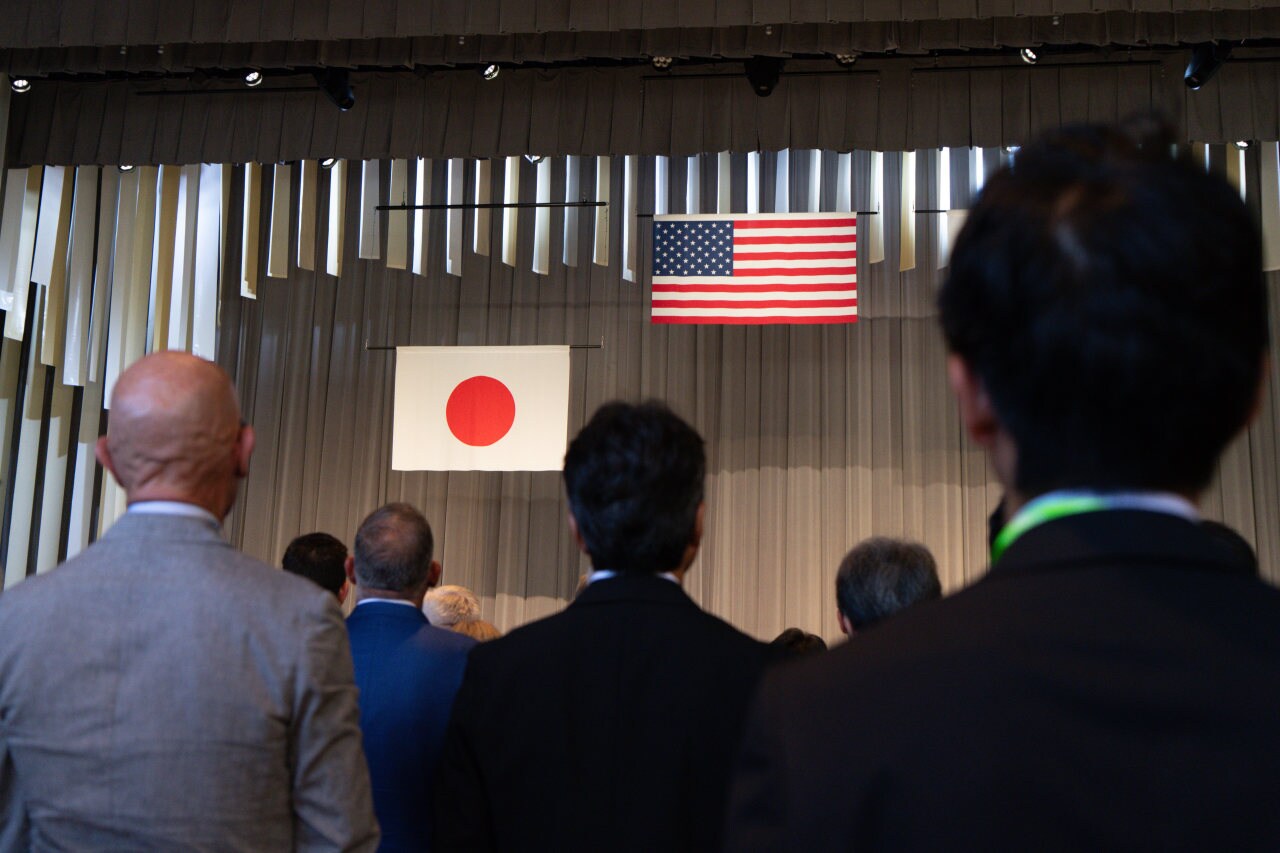
A ceremony Saturday at the World Expo in Osaka, Japan.
Fifteen percent “is a huge number for tariffs. If that is what we see for other countries, we’re in a new and costlier world,” said Gene M. Grossman, international economics professor at Princeton University.
The 15% on Japanese autos represents a reduction from the 25% tariff Trump put in place for most car and car parts coming into the U.S. American automakers hope that similar tariff reductions will follow for their vehicles and auto parts imported from Canada and Mexico, which currently face 25%, with exemptions depending on the origins of the components.
The U.S. automotive industry criticized the 15% tariffs as giving Japanese automakers an unfair advantage. “Any deal that charges a lower tariff for Japanese imports with virtually no U.S. content than the tariff imposed on North American-built vehicles with high U.S. content is a bad deal for U.S. industry and U.S. auto workers,” said Matt Blunt, head of the American Automotive Policy Council, on Wednesday. The body represents GM, Ford and Stellantis.
Thomas Simons, chief U.S. economist at Jefferies investment bank, said even 15% tariffs will likely result in more expensive cars for American consumers.
The fate of the automotive sector has been a sticking point in U.S.-EU trade discussions, with the bloc trying to secure relief from the U.S.’s current 25% tariffs on the sector.
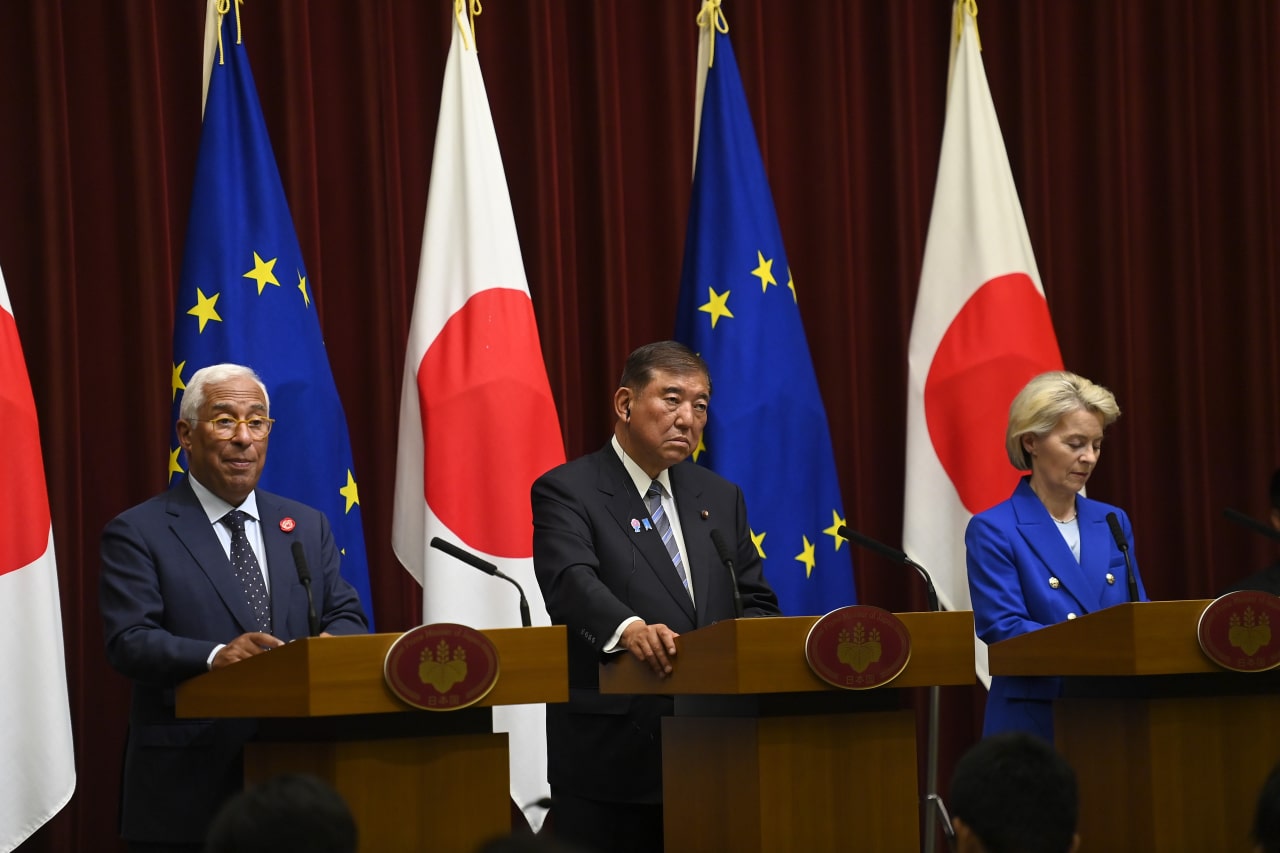
From left, European Council President António Costa, Japanese Prime Minister Shigeru Ishiba and European Commission President Ursula von der Leyen at a press conference in Tokyo on Wednesday.
European officials expect that a potential deal with the U.S. would apply a 15% baseline tariff as a flat rate for most EU exports to the U.S., said people familiar with their thinking. That amount wouldn’t be added on top of levies that existed before Trump started raising tariffs this year. That is different from the U.S.’s current 10% blanket tariff, which was layered on top of existing tariffs.
As a result, the 15% tariff rate currently being discussed wouldn’t be much higher, on average, than the actual level the EU currently faces, the people said. The 15% baseline tariff would apply to cars, though it is not expected to apply to steel and aluminum, which currently face 50% tariffs.
EU officials are discussing those terms as part of a potential deal with their U.S. counterparts, who appear to be on board with the 15% level, the people said. But they emphasized that a deal wasn’t certain and any agreement would need President Trump’s signoff.
The U.S. and EU have also discussed creating exemptions from the baseline tariff for certain sectors, including aircraft, the people said.
Trump appeared to suggest on Wednesday that he was open to a deal with the EU that could be similar to Japan’s. After touting the agreement with Japan, he said the U.S. plans to put a simple tariff on countries that will range from 15% to 50%.
“We’ve offered such a deal to the European Union,” Trump said, without referencing Japan directly. “We’re in serious negotiations, and if they agree to open up the union to American businesses, then we will let them pay a lower tariff.”
A White House spokesman said any discussion of possible deals should be considered speculation unless announced by Trump.
The EU had thought it was close to a deal with the U.S. several weeks ago that would have put baseline tariffs at 10%, with some sectors exempted. But that was thrown into question when Trump posted a letter threatening to impose 30% tariffs on the bloc beginning Aug. 1.
Since then, the EU has continued talks with the U.S.
Officials told the EU’s trade chief, Maros Sefcovic, last week that they expected Trump to demand a baseline tariff of 15% or more to get an agreement.
After the Japan deal was announced, it became easier for European officials to accept the idea that they might also have 15% baseline tariffs, people familiar with their thinking said. The Japan deal represented a signal that 15% is the level that could be established for most major U.S. trading partners.
The bloc is also continuing to prepare countermeasures against the U.S. in case a deal can’t be reached. Member states on Thursday are expected to approve a package of potential tariffs on U.S. goods worth more than $100 billion, in a sign that the bloc doesn’t view its hoped-for agreement with the U.S. as a done deal. Those tariffs wouldn’t take effect before Aug. 7.
The deal agreed upon by Japan and the U.S. also contains a novel financial commitment that the administration says will involve Japanese banks and financial institutions contributing $550 billion to a fund that the administration can then direct to infrastructure projects of its choice.
“The Japanese are going to give America the ability to choose the projects, decide the projects and execute the projects,” Commerce Secretary Howard Lutnick said Wednesday on Bloomberg TV. “The Japanese will finance the project and then we’ll give it to an operator who will run it and the profits will be split—90% to the taxpayers of the [U.S.] and 10% to the Japanese.”
It remains unclear how the investment fund would be structured. Japanese Prime Minister Shigeru Ishiba said that it would consist of loan investments and guarantees, but Lutnick said it would also involve equity. “The Japanese are the financier, the banker,” he said on Bloomberg.
Republican senators briefed on the deal praised the new investment fund as a way to deliver on critical national-security investments like semiconductors, minerals and energy production.
“It’s a structure that I haven’t seen before,” said Sen. Bill Hagerty, Trump’s first-term ambassador to Japan. “They’re going to put a massive financing package together. So it’s not foreign investment, it’s a financing package, and we will pick the best [projects], and we’ll let people compete for these projects.”
Democrats said they are skeptical of a pot of money that some labeled a “slush fund” that they fear will be spent on political priorities favored by Trump, and not only strategic projects.
Earlier Tuesday, the U.S. also reached a pact with the Philippines and gave details on its trade framework with Indonesia, building on an initial announcement last week.
Write to Chao Deng at chao.deng@wsj.com, Kim Mackrael at kim.mackrael@wsj.com and Gavin Bade at gavin.bade@wsj.com