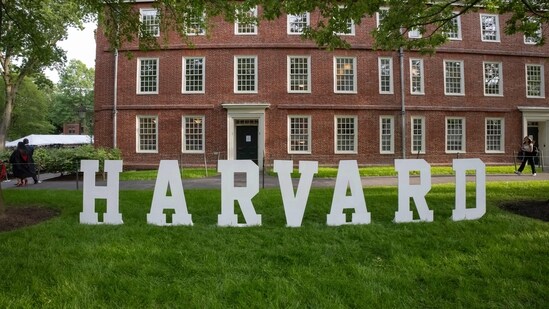
At Harvard you can study negotiation. This being Harvard, there is in fact an entire academic programme dedicated to the craft. The principles are simple. Understand your alternatives—what happens if you fight rather than compromise—and your long-term interests. This being Donald Trump’s America, Harvard itself is now the case study.
Harvard has been making changes on campus that may be labelled as concessions in any eventual settlement.
Mr Trump has turned full guns on that supposed hotbed of antisemitism and left-wing indoctrination. America’s oldest and richest university would be his most satisfying trophy and its capitulation would become a template for coerced reforms across higher education. The government has sought to review some of Harvard’s coursework as Mr Trump has pressured it to hire fewer “Leftist dopes” and discipline pro-Palestine protesters. When the university refused, his administration froze federal research grants worth $3bn and tried to bar it from enrolling foreign students.
Harvard has fought back and sued the government twice. Its many constituencies have loudly supported this resistance. Seven in ten faculty who took part in a poll by the Crimson, a student newspaper, said the university should not agree to a settlement. Yet it seems likely that Harvard will fold in the manner of Brown University and Columbia; reports suggest it will pay up to $500m.
Consider Harvard’s options. Litigation has succeeded initially: a judge paused the ban on foreign students. Harvard had a sympathetic hearing in its lawsuit to restore government funding. Yet the university knows that it cannot count on the Supreme Court, with its conservative majority. Meanwhile, the potential damage from Mr Trump’s campaign looks both acute and existential. Losing federal funds would transform Harvard from a world-class research university to a tuition-dependent one. They constitute 11% of the operating budget and represent almost all the discretionary money available for research. Making do without while maintaining current spending levels would see the university draw down its $53bn endowment by about 2% a year. That is possible for a while, though it would erode future income and much of the endowment is constrained by donor restrictions anyway.
Already Harvard has frozen some hiring and laid off research staff. More trouble awaits. The Internal Revenue Service is considering revoking Harvard’s tax-exempt status. Elise Stefanik, a Republican congresswoman, has suggested that the university committed securities fraud when it issued a bond in April and failed initially to tell investors about the government’s demands. She wants the Securities and Exchange Commission to investigate. The Department of Homeland Security has sought records about foreign students who participated in pro-Palestine protests.
Alumni, faculty and students report pride in Harvard’s president, Alan Garber, resisting Mr Trump’s extortion scheme. Yet more and more faculty are calling for a deal, especially in medicine and science since they have the most to lose. Steven Pinker, a psychology professor, has argued for a “face-saving exit”: Mr Trump may be “dictatorial” but “resistance should be strategic, not suicidal”.
A deal similar to Brown’s would not be so hard to swallow. To restore its federal funds, that university will pay $50m to workforce-development organisations. A likelier model is the one reached with Columbia, which coughed up $200m to the government. Most of its federal funding, worth $1.3bn, was reinstated and probes into alleged civil-rights violations were closed. Viewed from the outside, the price paid by Columbia looks arbitrary—there was no explanation for how it had been calculated.
Columbia also agreed to dismantle DEI initiatives and will hire faculty specialising in Israel and Judaism, among other concessions. An outside monitor will ensure compliance. Claire Shipman, the university’s acting president, said Columbia had not accepted diktats about what to teach or whom to hire and admit.
Maybe so, but the settlement was still a shakedown. Mr Trump skipped the legal process by which the government can cancel funds. By law the administration has to offer a hearing and submit a report to Congress at least 30 days before the cut-off takes effect. None of that happened. Of course coercive, bilateral deals are Mr Trump’s métier—he has achieved them with law firms and trading partners.
Harvard has been making changes on campus that may be labelled as concessions in any eventual settlement. Some do appear designed to assuage Mr Trump. Since January the university has adopted the government’s preferred definition of antisemitism; ended a partnership with Birzeit University in the West Bank; removed the leadership of the Centre for Middle Eastern Studies; and suspended the Palestine Solidarity Committee, an undergraduate group. DEI offices have been renamed and their websites scrubbed.
Harvard’s lack of ideological diversity will not be fixed by fiat. In 2023 a Crimson poll found that less than 3% of faculty identified as conservative. Now the university is reportedly considering establishing a centre for conservative thought akin to Stanford’s Hoover Institution. Across campus it is understood that too many students seem ill-equipped to deal with views that challenge their own, says Edward Hall, a philosophy professor.
Another insight you will glean in a Harvard negotiation class is to grasp your opponent’s interests. In Mr Trump’s practice, this means bagging a deal and bragging about it. He wrote a whole book on the topic. It could go on a syllabus.
Get the latest headlines from US news and global updates from Pakistan, Nepal, UK, Bangladesh, Russia and US Iran war Live, get all the latest headlines in one place on Hindustan Times.

 E-Paper