
 E-Paper



Indian-origin lawyer behind Supreme Court tariff setback for Trump. Who is Neal Katyal?
While Trump called the SC ruling ridiculous, Neal Katyal, who argued the case on behalf of small businesses, called it a “total victory" for the challengers.

 Prefer HTon Google


Neal Katyal, an Indian-origin American lawyer, has emerged as one of the key names linked to the US Supreme Court ruling that struck down President Donald Trump's far-reaching global tariffs on Friday.
While Trump said he was “absolutely ashamed” of some justices who ruled 6-3 against him, it wasn’t immediately clear how the decision restricting Trump’s power to unilaterally set and change tariffs might affect trade deals with other countries. Track latest news in Trump tariffs here
Friday's Supreme Court ruling was authored by Chief Justice John Roberts and joined by two fellow conservatives who Trump appointed during his first term in office - Neil Gorsuch and Amy Coney Barrett - as well as the three liberal justices, according to a Reuters report.
Who is Neal Katyal?
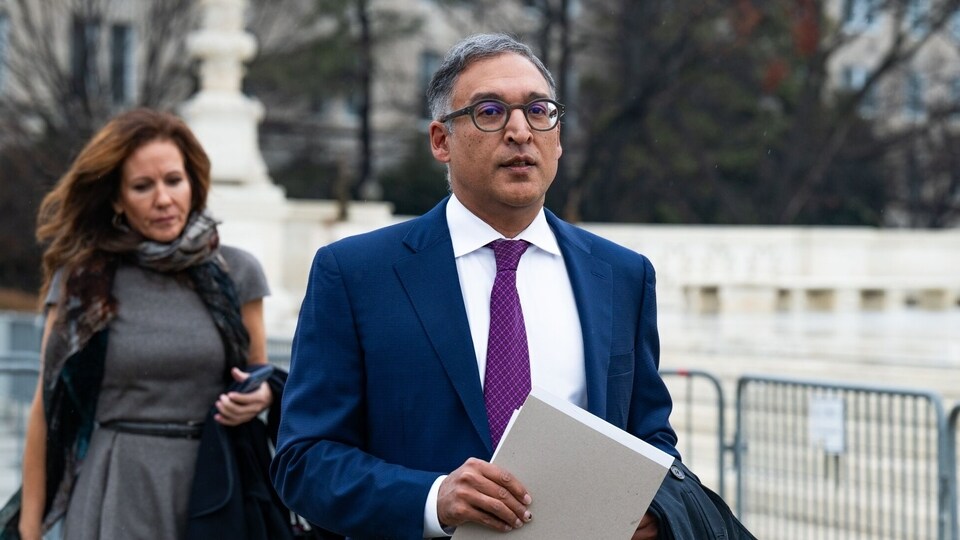
While questions about what Trump can do next remain unanswered, the ruling is a “complete and total victory" for the challengers, said Neal Katyal, who argued the case on behalf of a group of small businesses in the matter.
Katyal was reportedly born in Chicago to Indian immigrant parents, a doctor and an engineer.
Katyal had said in an interview with Original Jurisdiction that his parents came over from India the year before he was born.
Katyal previously served as National Security Adviser in the US Justice Department and was commissioned by President Clinton to write a report on the need for more legal pro bono work, according to the website of Georgetown University, at which he is the Paul Saunders Professor.
Reacting to the ruling, Katyal said through an X post on Friday that the US Supreme Court gave us everything we asked for in our legal case. “Everything.”
Katyal said today, the US Supreme Court stood up for the rule of law and Americans everywhere. “Its message was simple: Presidents are powerful, but our Constitution is more powerful still. In America, only Congress can impose taxes on the American people.”
“I’m grateful for the leadership of the Liberty Justice Center, and in particular for the brilliant advocacy by its chair, Sara Albrecht, who led the fight when others wouldn’t and was dauntless in its defense of our constitutional order. I'm also grateful to the five small business owners who stood up against these unjust, unconstitutional taxes. By taking a stand, they have delivered crucial relief to tens of thousands of businesses and millions of consumers across the country,” he said.
“Finally, I lack the words to properly thank my brilliant Milbank team, especially Colleen Roh Sinzdak and Sami Ilagan, who worked with me day and night for many months to craft the winning argument,” Katyal said.
“This case has always been about the presidency, not any one president. It has always been about separation of powers, and not the politics of the moment. I'm gratified to see our Supreme Court, which has been the bedrock of our government for 250 years, protect our most fundamental values,” he added.
Katyal is a Charles F Kettering Foundation senior fellow and previously served as acting solicitor general of the United States. Katyal has argued 50 cases before the Supreme Court of the United States, according to kettering.org, which added that by the age of 53, he had already argued more Supreme Court cases in US history than any other minority attorney.
Katyal has received many distinctions, including the highest civilian award given by the US Department of Justice, the Edmund J Randolph Award. He was also named The American Lawyer’s Grand Prize Winner of the Litigator of the Year award in 2017 and was named a Litigator of the Year again in 2023.
The SC Justices who ruled 6:3 on Trump tariffs
In the Supreme Court ruling on tariffs, the Justices in the majority (voted to strike down the tariffs), were: Chief Justice John Roberts - wrote the majority opinion stressing that tariff powers belong to Congress; Justice Neil Gorsuch - joined the majority; Justice Amy Coney Barrett - joined the majority; Justice Sonia Sotomayor - joined the majority; Justice Elena Kagan - joined the majority and; Justice Ketanji Brown Jackson - joined the majority, according to The Sunday Guardian.
Justices in dissent - who voted against striking down the tariffs - were: Justice Clarence Thomas; Justice Samuel Alito and; Justice Brett Kavanaugh.
The three dissenters argued Trump's use of the law should be upheld, but the majority held that the Constitution reserves tariff-setting powers to Congress unless clearly delegated.
Trump responded to the tariff ruling by saying he would sign an order imposing a 10 per cent global tariff. He pledged a raft of investigations that could allow him to impose more import taxes.
Sharing the announcement in a post on Truth Social, the US President said, "It is my Great Honor to have just signed, from the Oval Office, a Global 10% Tariff on all Countries, which will be effective almost immediately. Thank you for your attention to this matter! PRESIDENT DONALD J. TRUMP"
A White House official stated that this new tariff will remain in place until another authority is invoked, emphasising the expectation that trade partners abide by US trade deals.


