E-Paper



With Islamabad's new security policy, Pakistan-India trade on the cards
Pakistan’s new security policy is being described as the first-ever codified policy covering both internal security and foreign policy

 Prefer HTon Google


Pakistan’s new security policy, to be launched on January 14, includes the possibility of trade and business ties with India without the resolution of the Kashmir issue as part of a focus on economic diplomacy and peace in the neighbourhood.
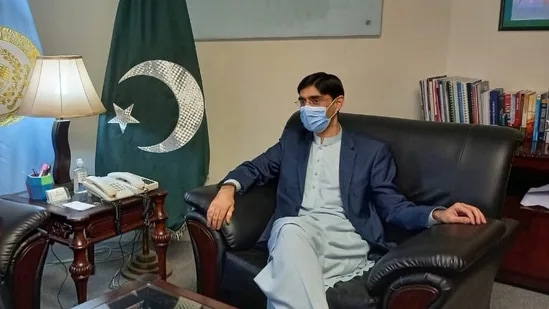
The public version of the security policy, which was approved by Pakistan’s cabinet on December 28, will outline the direction of the country’s foreign policy in the coming years. Ahead of its release, officials such as Pakistan’s National Security Adviser Moeed Yusuf have said that economic and human security is at the core of the new policy.
The original 100-page policy, which will be kept under wraps, “leaves the door open for trade and business ties with India without final settlement of the longstanding Kashmir dispute provided there is progress in the talks” between the two neighbours, The Express Tribune newspaper quoted an unnamed Pakistani official as saying.
“We are not seeking hostility with India for the next 100 years. The new policy seeks peace with immediate neighbours,” the official said at a background briefing for journalists in Islamabad on Tuesday.
The official said that if there is a dialogue and progress in these talks, “there would be a possibility of normalising trade and commercial ties with India as it had happened in the past”. Peace with Pakistan’s immediate neighbours and economic diplomacy will be the central theme of the foreign policy under the new national security policy, the official added.
India and Pakistan have not held any substantial and structured talks since the 2008 Mumbai attacks, carried out by the Pakistan-based Lashkar-e-Taiba (LeT), disrupted bilateral ties. Several attempts in the following years to revive talks ran aground after a series of terror attacks, mainly targeting Indian security forces, that was mostly blamed on the Jaish-e-Mohammed (JeM).
The terror attack at Pulwama in February 2019, which resulted in the death of 40 Indian troopers and was blamed on JeM, brought both countries to the brink of a conflict.
Though India granted Most Favoured Nation (MFN)-status to Pakistan in 1996, this was withdrawn in the aftermath of the suicide attack at Pulwama. An attempt by the previous Pakistan People’s Party (PPP) government to grant MFN status to India in 2012 had to be scrapped because of opposition from the country’s trade lobbies.
India-Pakistan relations took another hit in August 2019, when New Delhi scrapped the special status of Jammu and Kashmir. Pakistan retaliated by downgrading diplomatic ties and suspending bilateral trade.
After a series of back-channel contacts between security officials of the two countries, the Indian and Pakistani armies agreed in February 2021 to restore the 2003 ceasefire along the Line of Control (LoC). However, the ending of exchanges of fire on the LoC did not lead to further breakthroughs between the two sides.
With Pakistan’s new national security policy espousing a shift from a geostrategic approach to geo-economics, there is renewed optimism of a possible thaw with India, The Express Tribune reported.
“Economic security will be the central theme of the new national security policy,” the unnamed Pakistani official was quoted as saying by the Tribune. “But geo-economics does not necessarily mean we overlook our geo-strategic and geo-political interests,” the official said, adding the Kashmir issue has been identified as a “vital national policy” issue for Pakistan.
The official also said there were “no prospects” of rapprochement with India under the current government in New Delhi.
Pakistan’s new security policy is being described as the first-ever codified policy covering both internal security and foreign policy. Only part of the national security policy, which took seven years to prepare following initial efforts by then NSA Sartaj Aziz in 2014, will be made public. The classified portion of the policy lays out an implementation mechanism and the prime minister will review progress every month.
Significantly, Pakistan’s opposition parties were not taken on board regarding the new policy. A recent briefing by NSA Moeed Yusuf for Pakistan’s parliamentary committee on national security was boycotted by the opposition.