
 E-Paper



'Extraordinary riddle' of MH370 now enters third week
Three Australian planes took off at dawn on Saturday for a third day of scouring the desolate southern Indian Ocean for possible parts of missing Malaysia Airlines Flight 370, now lost for two full weeks. Flight MH370 hunt leads to debris off Australia coast | MH370 debris analysis slowed by enormous data


Three Australian planes took off at dawn on Saturday for a third day of scouring the desolate southern Indian Ocean for possible parts of missing Malaysia Airlines Flight 370, now lost for two full weeks.

Australia promised its best efforts to resolve "an extraordinary riddle," but two days of searching the seas about 2,500 kilometers (1,550 miles) southwest of Perth have not produced any evidence.
A satellite spotted two large objects in the area earlier this week, raising hopes of finding the Boeing 777 that disappeared March 8 with 239 people on board.
"It's about the most inaccessible spot that you could imagine on the face of the Earth, but if there is anything down there, we will find it," Prime Minister Tony Abbott said at a news conference in Papua New Guinea.
"We owe it to the families and the friends and the loved ones of the almost 240 people on Flight MH370 to do everything we can to try to resolve what is as yet an extraordinary riddle," he added.
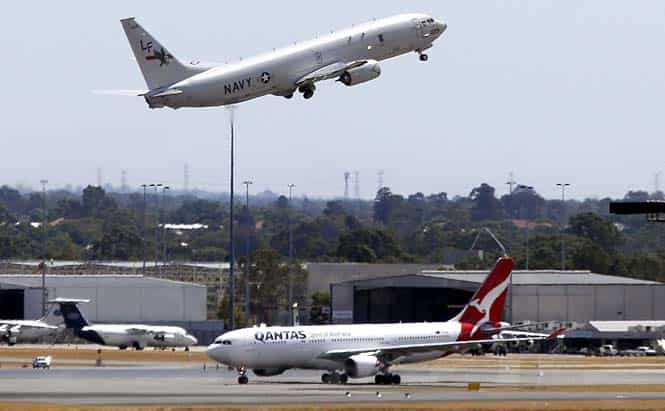
A total of six aircraft were to search the region Saturday: two ultra long-range commercial jets and four P3 Orions, the Australian Maritime Safety Authority said.
Because of the distance to the area, the Orions will have enough fuel to search for two hours, while the commercial jets can stay for five hours before heading back to the base.
Read: Flight MH370 hunt leads to debris off Australia coast
Read: India to deploy P-8I, C-130J planes to locate Malaysian airliner
Two merchant ships were in the area, and the HMAS Success, a navy supply ship, was due to arrive late Saturday afternoon. Weather in the search zone was expected to be relatively good, with some cloud cover.
Two Chinese aircraft are expected to arrive in Perth on Saturday to join the search, and two Japanese planes will arrive Sunday. A small flotilla of ships from China is still several days away. The plane passengers included 154 Chinese.
AMSA officials also were checking to see if there was any new satellite imagery that could provide more information. The satellite images were taken March 16, but the search in the area did not start until Thursday because it took time to analyze them.
In Kuala Lumpur, where the plane took off for Beijing, Malaysian Defense Minister Hishammuddin Hussein called the process "a long haul" as he thanked the more than two dozen countries involved in a search that stretches from Kazakhstan in Central Asia to the southern Indian Ocean.
Read:Satellites searching for missing plane have limits
China's request for entering Indian waters turned down
Hunt for flight MH370: Norwegian ship reaches spot to check debris
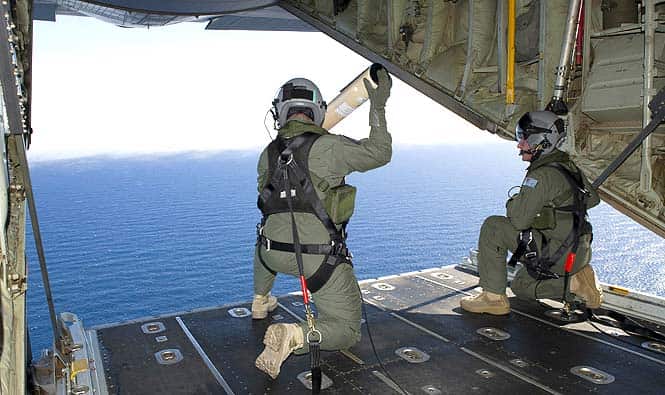
Searchers on Friday relied mostly on trained spotters aboard the planes rather than radar, which found nothing Thursday, Australian officials said. The search will focus more on visual sightings because civilian aircraft are being brought in. The military planes will continue to use both radar and spotters.
"Noting that we got no radar detections yesterday, we have replanned the search to be visual. So aircraft flying relatively low, very highly skilled and trained observers looking out of the aircraft windows and looking to see objects," said John Young, manager of the maritime safety authority's emergency response division.
Malaysia asked the U.S. for undersea surveillance equipment to help in the search, said Rear Adm. John Kirby, a Pentagon spokesman. Defense Secretary Chuck Hagel promised to assess the availability of the technology and its usefulness in the search, Kirby said.
The Pentagon says it has spent $2.5 million to operate ships and aircraft in the search and has budgeted another $1.5 million for the efforts.
Read:We've not hidden anything about MH 370, says Malaysian consul
There is a limited battery life for the beacons in the cockpit-voice and flight-data recorders - about 30 days, said Chuck Schofield, vice president of business development for Dukane Seacom Inc. He said it's "very likely" that his company made the beacons on the missing jet.
The devices work to a depth of 20,000 feet (6,096 meters), with a signal range of about 2 nautical miles (2.3 miles; 3.7 kilometers), depending on variables like sea conditions. The signals are located using a device operated on the surface of the water or towed to a depth.
Experts say it is impossible to tell if the grainy satellite images of the two objects - one 24 meters (almost 80 feet) long and the other measuring 5 meters (15 feet) - were debris from the plane. But officials have called this the best lead so far in the search that began March 8 after the plane vanished over the Gulf of Thailand on an overnight flight to Beijing.
For relatives of those aboard the plane, hope was slipping away, said Nan Jinyan, sister-in-law of passenger Yan Ling.
"I'm psychologically prepared for the worst and I know the chances of them coming back alive are extremely small," said Nan, one of dozens of relatives gathered at a Beijing hotel awaiting any word about their loved ones.
The Norwegian cargo vessel Hoegh St. Petersburg is also in the area helping with the search. Haakon Svane, a spokesman for the Norwegian Shipowners' Association, said the ship had searched a strip of ocean stretching about 100 nautical miles (115 miles; 185 kilometers).
Aircraft pieces have sometimes been found floating for days after a sea crash. Peter Marosszeky, an aviation expert at the University of New South Wales, said the wing could remain buoyant for weeks if fuel tanks inside it were empty and had not filled with water.
Other experts said that if the aircraft breaks into pieces, normally only items such as seats and luggage would remain floating.
"We seldom see big metal (pieces) floating. You need a lot of (buoyant) material underneath the metal to keep it up," said Lau Kin-tak, an expert in aircraft maintenance and accidents at Hong Kong Polytechnic University.
Malaysian authorities have not ruled out any possible explanation for what happened to the jet but have said the evidence so far suggests it was deliberately turned back across Malaysia to the Strait of Malacca, with its communications systems disabled. They are unsure what happened next.
Police are considering the possibilities of hijacking, sabotage, terrorism or issues related to the mental health of the pilots or anyone else on board.


