
 E-Paper



Goodbye oil! This US navy plane flies on sea water
The predicted cost of jet fuel using these technologies is in the range of $3-$6 per gallon, and with sufficient funding and partnerships, this approach could be commercially viable within the next seven to ten years.


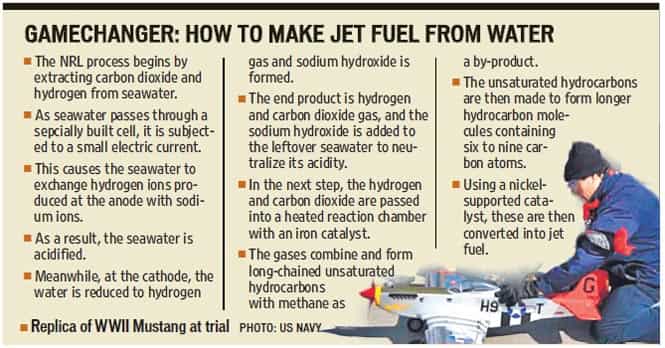
US navy scientists have successfully flown a radio-controlled airplane that runs purely on fuel derived from sea water. Scientists obtained the fuel using the US Naval Research Laboratory (NRL)’s gas-to-liquid technology, which involved removing carbon dioxide from water at 92% efficiency while simultaneously producing hydrogen.

The CO2 and hydrogen gases were then converted into a liquid hydrocarbon fuel, using a metal catalyst in a separate reactor system, ‘Gizmag’ reported.
That fuel was used to power an RC model P-51 Mustang’s unmodified two-stroke engine in a proof-of-concept test performed September last year at Blossom Point, Maryland.
The event marked the first time that the fuel had been used in a conventional combustion engine, the report said.
"This is the first time technology of this nature has been demonstrated with the potential for transition, from the laboratory, to full-scale commercial implementation," said Dr Heather Willauer, NRL research chemist.
Researchers are now working on upscaling the system to a commercial scale.
Apart from its use in fuel production, the CO2 could also have applications in the fields of horticulture or aquaculture, NRL said.
The ultimate goal is to eventually get away from the dependence on oil altogether, which would also mean the navy is no longer hostage to potential shortages of oil or fluctuations in its cost.
The predicted cost of jet fuel using these technologies is in the range of $3-$6 per gallon, and with sufficient funding and partnerships, this approach could be commercially viable within the next seven to ten years.
Pursuing remote land-based options would be the first step towards a future sea-based solution, the Navy says.


