E-Paper



Nepal celebrates ‘coming out of grief’ festival after deadly quake
Four months after a devastating quake claimed nearly 9,000 lives in Nepal, residents of Kathmandu Valley celebrated a ‘coming out of grief’ festival in memory of those dead.


Four months after a devastating quake claimed nearly 9,000 lives in Nepal, residents of Kathmandu Valley celebrated a ‘coming out of grief’ festival on Sunday in memory of those dead.

Gai Jatra or the cow festival, celebrated mainly in Kathmandu and neighbouring towns of Lalitpur, Bhaktapur and Kirtipur, is the first major festival since the April disaster.
Families who lost relatives in the past 12 months joined the ‘jatra’ or procession with a cow. Those who don’t have cows substituted with a young boy dressed as one or with traditional costumes.
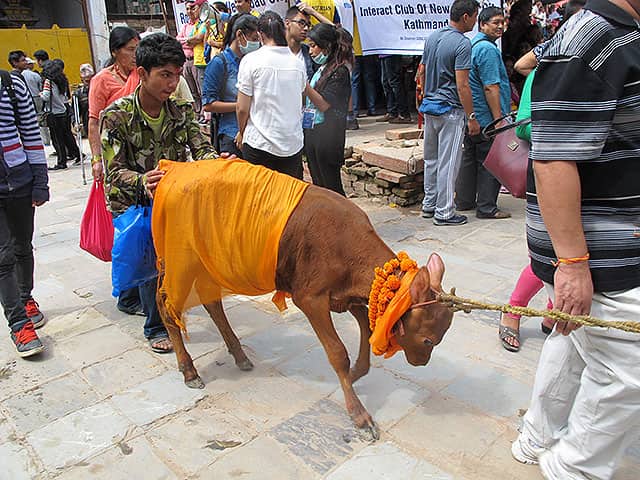
A boy pushes a cow while taking part in Gai Jatra festival in Kathmandu on Sunday. (Utpal Parashar/HT Photo)
Like in India, cow is considered as a sacred animal for Nepal’s Hindus and it is believed one has to hold a cow’s tail to cross the mythical Baitarani River after death to reach heaven.
“The festival symbolizes a ‘coming out of grief’ which gives the strength to deal with death in the family and move on.” said Sarad Pradhan, media consultant with Nepal Tourism Board.
Kathmandu’s Basantapur Darbar Square wore a festive look on Sunday with hundreds of residents including those who lost family members gathered to mark the occasion.
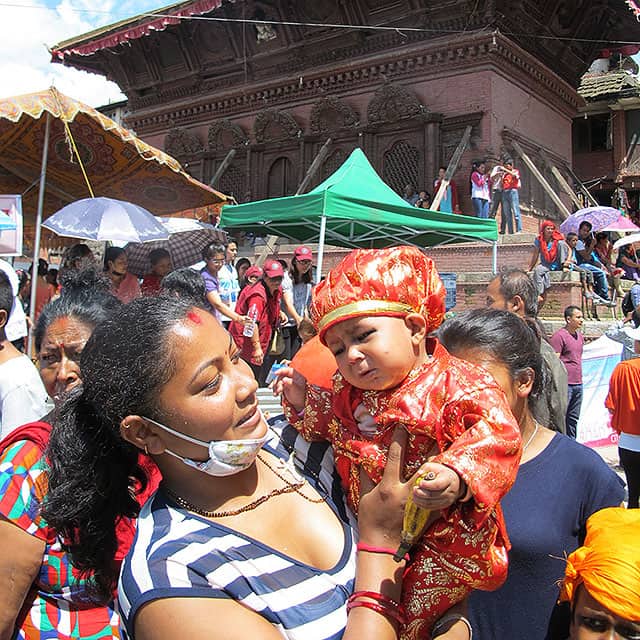
A woman carries her baby dressed in traditional costume during the Gai Jatra festival at Basantapur Darbar Square. (Utpal Parashar/HT Photo)
Residents distributed traditional sweets, money, biscuits and soft drinks to young boys in costumes as the procession winded its way through the world heritage site which suffered major damages in the quake.
"It is a sad feeling to be taking part in the festival, but I hope it will grant peace to the souls of my daughters and give us strength to cope," said Binod Shahi, a participant in the procession.
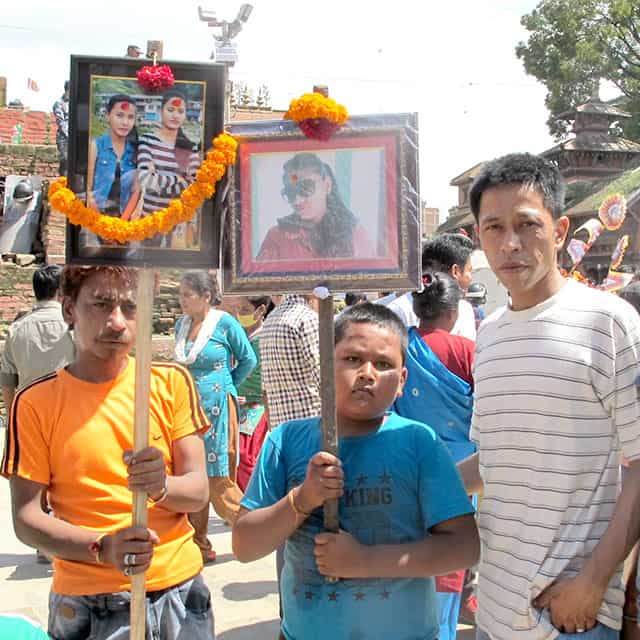
Binod Shahi (right), who lost his three daughters in the earthquake takes part in the festival carrying photos of the deceased girls. (Utpal Parashar/HT Photo)
A resident of Dhalkhu in Kathmandu, Shahi lost three daughters Babysha (16), Nisha (15) and Pinky (22) in the quake. They are among the 1233 quake-related deaths recorded in Kathmandu.
It is said King Pratap Malla started the festival in 17th century to make his queen to come out of her grief after losing her infant son.
It was also a platform for participants dressed in costumes to mock the royalty and use comedy to highlight social issues. The procession is said to have made the queen smile and it continued.
“In the days of strict enforcement of a zero tolerance for challenging royalty, this was indeed revolutionary,” said noted social entrepreneur Anil Chitrakar.
These days people mock politicians and government officials during the seven day festival. Since 2010, Nepal’s LGBT community has also been celebrating Pride Parade on the same day.