
 E-Paper



New solar system with 5 Earth-sized planets found
New solar system with 5 Earth-sized planets found


In a major discovery, scientists led by University of Birmingham asteroseismologists have discovered a solar system with five Earth sized planets dating back to the dawn of the galaxy.
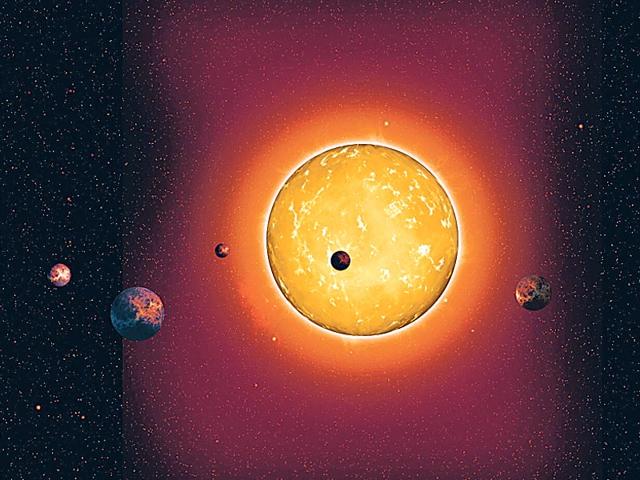
The scientists announced in The Astrophysical Journal on Tuesday that due to the NASA Kepler mission, the observation of a Sun-like star (Kepler-444), hosting five planets with sizes between Mercury and Venus, was possible.
Kepler-444 was formed 11.2 billion years ago, when the universe was less than 20% its current age. This is the oldest known system of terrestrial-sized planets in our Galaxy - 2 and a half time older than the Earth, a university release said.
The team carried out the research using asteroseismology — listening to the natural resonances of the host star caused by sound trapped within it.
These oscillations lead to miniscule changes or pulses in its brightness which allow the researchers to measure its diameter, mass and age.
The release added that the planets were then detected from the dimming that occurs when they passed across the stellar disc.
This fractional fading in the intensity of the light received from the star enables scientists to accurately measure the size of the planets relative to the size of the star.
Tiago Campante from the University of Birmingham’s School of Physics and Astronomy, who led the research, said, “There are far-reaching implications of this discovery. We now know that Earth-sized planets have formed throughout most of the universe’s 13.8 billion-year history which could provide scope for the existence of ancient life in the galaxy.” He added, “By the time the Earth formed, the planets in this system were already older than our planet is today. This discovery may now help to pinpoint the beginning of what we might call the era of planet formation.”
Bill Chaplin, also from the School of Physics and Astronomy, who has been leading the team studying solar-type stars, said: “The first discoveries of exoplanets around other Sun-like stars in our galaxy have fuelled efforts to find other worlds like Earth and other terrestrial planets outside our solar system.”
He added the path towards a more complete understanding of early planet formation was now unfolding.


