
 E-Paper





Follow the latest breaking news, major developments and agenda-setting stories from India and around the world with the newsdesk at Hindustan Times. Operating round the clock, the desk brings together experienced editors, reporters and correspondents to deliver fast, accurate and contextual reporting across subjects that influence public policy, governance, business, society and international affairs. The HT News Desk covers politics, elections, government policies, the economy, business and markets, science and technology, the environment, law and order, infrastructure, education, climate issues and geopolitics, while closely tracking developments across states, institutions and global capitals. The team also leads coverage of major breaking news events, policy announcements, court proceedings, natural disasters, public emergencies and significant international developments. Reports published by the newsdesk are based on information gathered from reporters on the ground, official statements, government agencies, court records, regulatory filings, recognised institutions and other authoritative sources. Stories undergo editorial scrutiny and verification processes to ensure accuracy, fairness and relevance, and are updated as events evolve and additional information becomes available. Whether covering a key political decision in New Delhi, an economic policy shift affecting millions, a landmark court ruling or a major global event, the HT News Desk aims to provide readers with reliable, fact-based journalism that delivers not only the latest developments but also the context and analysis needed to understand their wider implications.
 Trending News
Nepal names 3-year-old as new ‘living goddess’ of Kathmandu
Once a girl is anointed a living goddess, she is allowed to leave her new home only 13 times a year on special feast days.


A three-year-old girl has been named the new “Kumari” of Nepal’s capital Kathmandu after her predecessor retired when she reached puberty, continuing an ancient tradition that sees young girls worshipped as “living goddesses”.
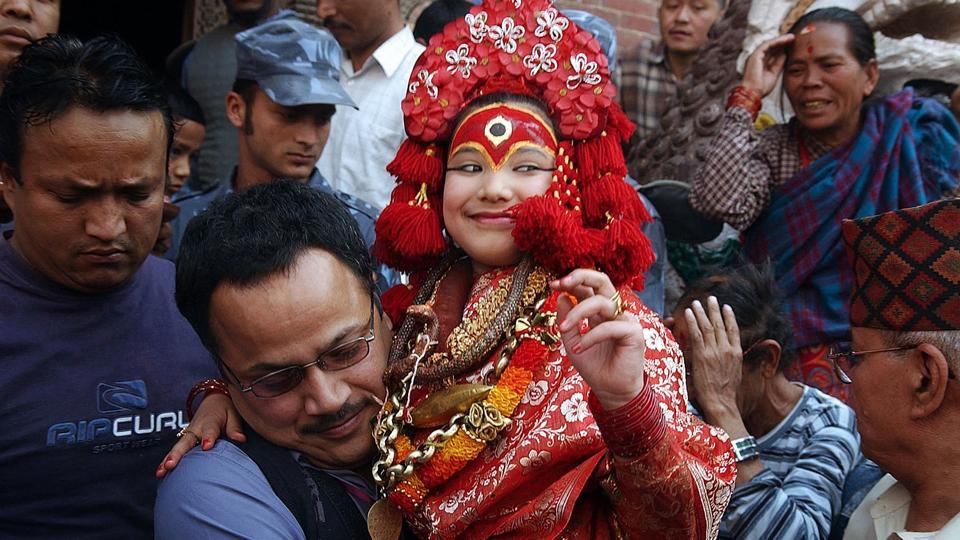
Trishna Shakya will be anointed as the new Kumari in a ceremony on Thursday, when she will be taken from her family home to live in a palace in Kathmandu’s ancient Durbar Square where she will be cared for by specially appointed caretakers.
She was selected from among four candidates, Uddhav Man Karmacharya, a Hindu priest who attends to the Kumari, told AFP on Tuesday.
“She will take her place on the Kumari’s throne after we perform prayers and tantric rituals,” Karmacharya said.
Once she is anointed a living goddess, Shakya – who, like her predecessors, belongs to the Newar community indigenous to the Kathmandu valley – will only be allowed to leave her new home 13 times a year on special feast days.
She will be paraded through Kathmandu in ceremonial dress and elaborate makeup to be worshipped.
When outside, the Kumari – who is considered an embodiment of the Hindu goddess Taleju – is carried because her feet are not allowed to touch the ground.
Selection criteria for aspiring Kumaris is strict and includes a number of specific physical attributes such as an unblemished body, a chest like a lion and thighs like a deer.
Even if a girl fulfils all the physical requirements, she must then prove her bravery by not crying at the sight of a sacrificed buffalo.
The Newar tradition blends elements of Hinduism and Buddhism, with the most important Kumaris representing each of the three former royal kingdoms of the Kathmandu Valley: Kathmandu, Patan and Bhaktapur.
The practice was historically closely linked to the royal family, but has continued despite the end of Nepal’s Hindu monarchy in 2008.
The tradition has drawn criticism from child rights activists who say the Kumaris are denied a childhood and their isolation from society hinders their education and development.
In 2008, Nepal’s Supreme Court ruled the living goddesses should be educated and they are now taught inside the palace where they live and are allowed to sit their exams there.
Many former Kumaris have spoken about the struggles they face reintegrating into society after they are dethroned.
The outgoing Kumari, Matine Shakya, was anointed in 2008 at the age of three.
But the number of girls being put forward by their families to be selected as a Kumari has dwindled in recent years.


