
 E-Paper



Delhi-Dhaka ties move beyond symbolism, seek to power growth and connectivity
PM Narendra Modi made it clear early in his first term that Bangladesh, like Bhutan, Nepal and Myanmar, occupies a special place in Indian diplomacy and should be helped for mutual growth and security.

 Prefer HTon Google


Prime Minister Narendra Modi laid the foundation for his neighbourhood visit well before he took oath on May 26, 2014 when he asked Ajit Doval, the then director of Delhi-based think tank Vivekananda International Foundation, to request leaders of Saarc countries to attend the swearing-in ceremony at the Rashtrapati Bhavan forecourt.
Prime Minister Sheikh Hasina couldn’t make it. She had a scheduled visit to Japan at that time and conveyed through her interlocutors that Bangladesh Parliament Speaker Shirin Sharmin Chaudhury would represent Dhaka at the event.
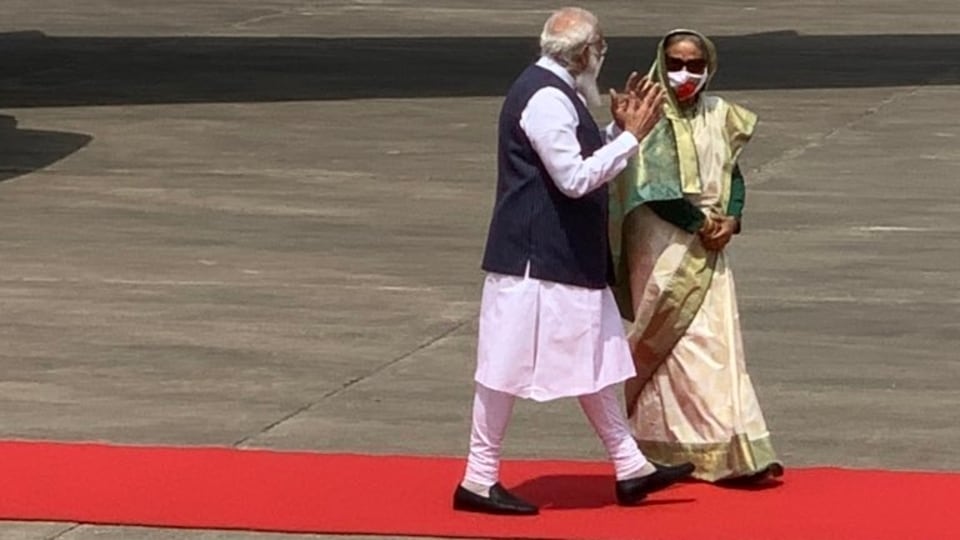
As PM Modi landed in Dhaka on Friday to begin a two-day visit to remember ‘Bangabandhu’ Sheikh Mujibur Rahman, the father of the nation of Bangladesh, and celebrate the golden jubilee of the 1971 liberation war, India’s ties with Bangladesh has gone way beyond symbolism. It is part of an integrated vision of PM Modi for the development of eastern India, particularly the North-East with the help and support of Bangladesh.
What started with a historical 2015 Land Boundary Agreement (LBA) to settle legacy issues with Bangladesh has developed into a close partnership with India making it a priority to supply Covid-19 vaccine to Dhaka under the “Vaccine Maitri” initiative. PM Modi has made it clear to all that Bangladesh, like Bhutan, Nepal and Myanmar, occupy a special place in Indian diplomacy and all help should be extended to them for mutual growth and security. Since 2014, the bilateral relationship with Dhaka has achieved the following milestones:
1. Land Boundary Agreement
2. Restoration of pre-1965 rail links with India. Five out of six have been completed.
3. Reviving the protocol on inland water and trade transit.
4. Agreement on the use of Chittagong and Mongla ports for trade and transit.
5. Building of the Maitree Bridge on the Feni river.
6. Agreement to export power including building a transmission line from Berhampur in India to Bheramara in Bangladesh
7. Supply of diesel to Bangladesh from Numaligarh refinery.
While Bangladesh is the key to connectivity to north-eastern India, it also fits into the calculus of trans- Asian highways that will link India to Vietnam by road and could become an economic engine for growth in Myanmar, Thailand, Cambodia, Laos and Vietnam.
The development and growth of India’s eastern flank will not only contribute to its GDP with tourism holding a vast potential in North-East but also politically stabilise the region with the Bharatiya Janata Party is a major political force on the eastern front.
The development of ties with immediate neighbours is also a priority with PM Modi, now that legacy issues like Article 370 and 35 A have been resolved and Kashmir is no longer the permanent stick for adversaries to beat India. When PM Modi becomes the first foreign leader to visit the Bangabandhu mausoleum at Tungipara tomorrow, he will be taking the next steps to cement ties with Dhaka under Sheikh Hasina’s leadership.


