E-Paper



A graphic artist’s vision of Mumbai in 2098 is dark and dystopian

 Prefer HTon Google


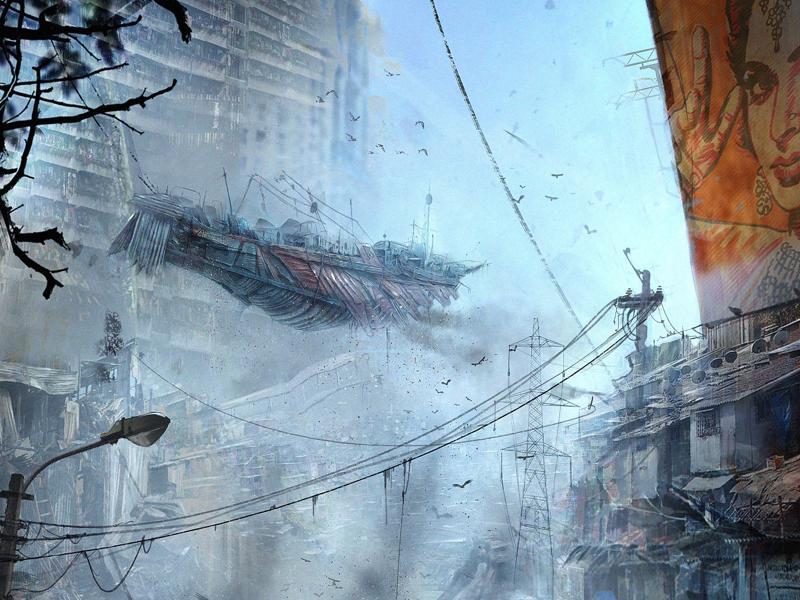
Spacecrafts hovering over a city full of debris and devastation. Kushal Tikle’s vision of Mumbai in 2098 is dark, dystopian, and ideal for a graphic novel
The year is 2098 and all that is left of Mumbai is crumbling buildings and abandoned residential complexes. High-tech, yet worn out spacecrafts hover in the skies, and broken cars are scattered across streets. And amidst all this devastation, a group of five orphans struggle to survive, driven by a common aim — to avenge their city.
Such is the premise of the dark, post-apocalyptic Mumbai conceptualised by graphic artist Kushal Tikle (30). The Singapore-based artist has created a series of nine elaborate sketches, called Mumbai 2098, that depicts the city of his imagination, in a world robbed of resources by multinational corporations. “The story has a dystopian theme. I chose to base it in Mumbai because of the city’s intensity and the cultural elements it has to offer. There was a lot I could play with while designing,” says Tikle.
For Tikle, the project happened as an extension of his conceptual art studies at the Feng Zhu School of Design in Singapore. “While researching for an assignment, I came across a graphic series called Maggot, by a California-based studio — Thought Gun Shells. It revolved around a post-apocalyptic theme where corporations had run the global governments to the ground. I approached them to take the project forward and they agreed,” says Tikle, who has been working on the series since 2013. “We were given seven weeks to complete the assignment. I had initially aimed to do four paintings. But during the process, it evolved piece by piece to what it is today,” he says.
Warrior spirit
Despite the various design elements, Tikle’s focus was on telling the story of the unnamed orphans. “The story developing in my mind was about the orphans’ struggle against the evil corporations ruling the zone. That’s the other reason why I chose to base the series in Mumbai, because of its grittiness,” says Tikle.
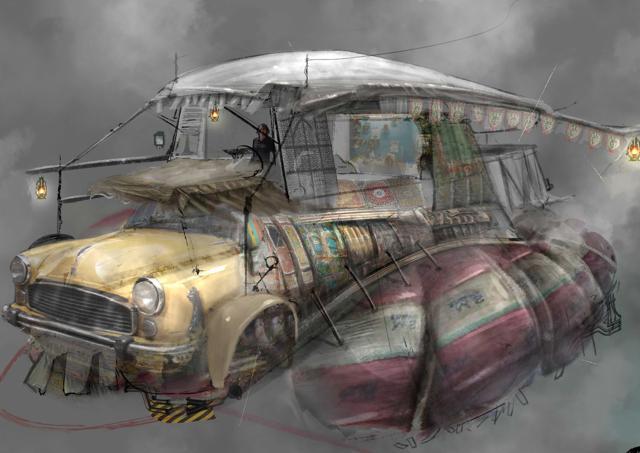
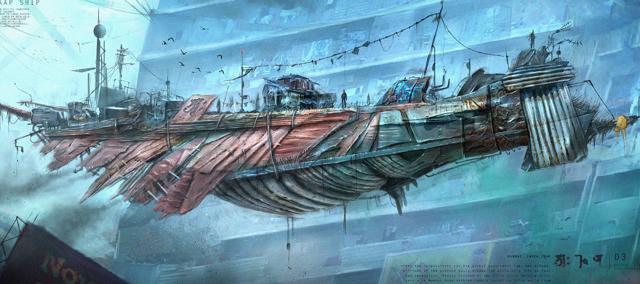
Additionally, one of the most interesting elements of Tikle’s work is the air cruisers made using material scavenged from the wreckage. “The orphan protagonists are technologically sound to construct their own ship using scrap materials. That’s how I got the idea of integrating various elements of not just vehicles but even chariots, hoardings, turbans and network towers,” he says.
The cruisers even come with unique names. “The Pagdi Ship has a turban at the back of it, the Jaadi is a modified Ambassador car and the Dhakkan Cruiser is part-chariot,” he explains. Tikle has even added informative captions at the bottom of each sketch. And though the figures and functions of the cruisers are all hypothetical, Tikle hopes that they will help viewers visualise the city as he sees it: “Art enables an individual to travel to a place they have never been to and experience it. I hope viewers will get a better sense of the project and see how a ship could play a role in the story by reading the text.”
Despite the general sense of dread that pervades the series, it does retain some original elements of the Mumbai of the past: one can spot Bollywood posters sticking out from the corners of streets, and even an abandoned local train.
For Tikle, the project has always been more than just homework, though he has lately been struggling to complete the story due to professional commitments. The story, however, constantly plays on his mind and he plans to revisit it sometime this year. “I will elaborate on the story to make an illustrated graphic novel. I even plan to direct a movie based on Mumbai 2098,” he says.
Visit kushaltikle.com to view the entire Mumbai 2098 series.