
 E-Paper



States may need loan to waive farm loans
The newly elected Congress-led governments in Madhya Pradesh, Rajasthan and Chhattisgarh have little financial legroom left to hand out sweeping farm-loan waivers, the plank on which the party won these states handily, a review of their finances shows.


The newly elected Congress-led governments in Madhya Pradesh, Rajasthan and Chhattisgarh have little financial legroom left to hand out sweeping farm-loan waivers, the plank on which the party won these states handily, a review of their finances shows.
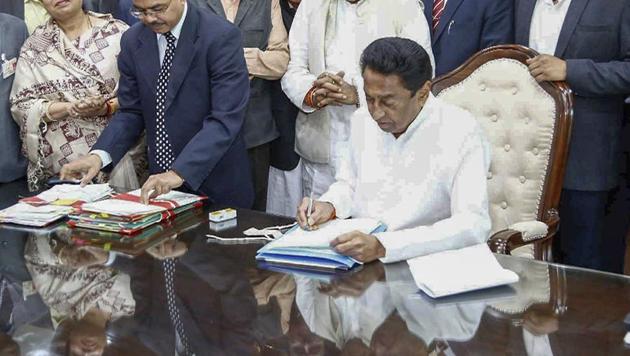
While farmers have been hit badly by falling prices of produce, loan write-offs will surely bloat deteriorating state budget balances. Economists have called for more growth-propelling investments in farming rather than doles, whose benefits they claim are short-lived.
The prospects of off-balanced budgets or fiscal deficits , which arise when governments spend more than they earn, weigh heavily this year on both the Centre and states.
A budget surplus, a rarity, means revenues are higher than expenditure, while a deficit refers to expenditures being greater than revenues, which is almost always the case.
For full coverage on assembly elections, click here
The Centre itself is under pressure to meet a deficit target of 3.3%. The combined fiscal deficit of states is poised to exceed limits for the third year in a row in 2018-19, an RBI report shows.
Madhya Pradesh and Chhattisgarh on Monday signed off on an order to waive off farm loans of up to ₹2 lakh but there’s no clarity yet on how it will be funded. It’s almost certain that these three states will have to resort to more borrowing.
This is alarming because loan waivers have already worsened their finances. “Debt waivers (earlier) announced by five states together are likely to widen the combined fiscal deficit of states by ₹1,077 billion ( ₹1,07,700 crore) or 0.65% of GDP,” says Devendra Kumar Pant, chief economist, India Ratings & Research.
A good source for an overview of states’ fiscal health is the Reserve Bank’s “State Finance, A Study of Budgets 2017-18 and 2018-19”, which shows why the room for farm doles is limited.
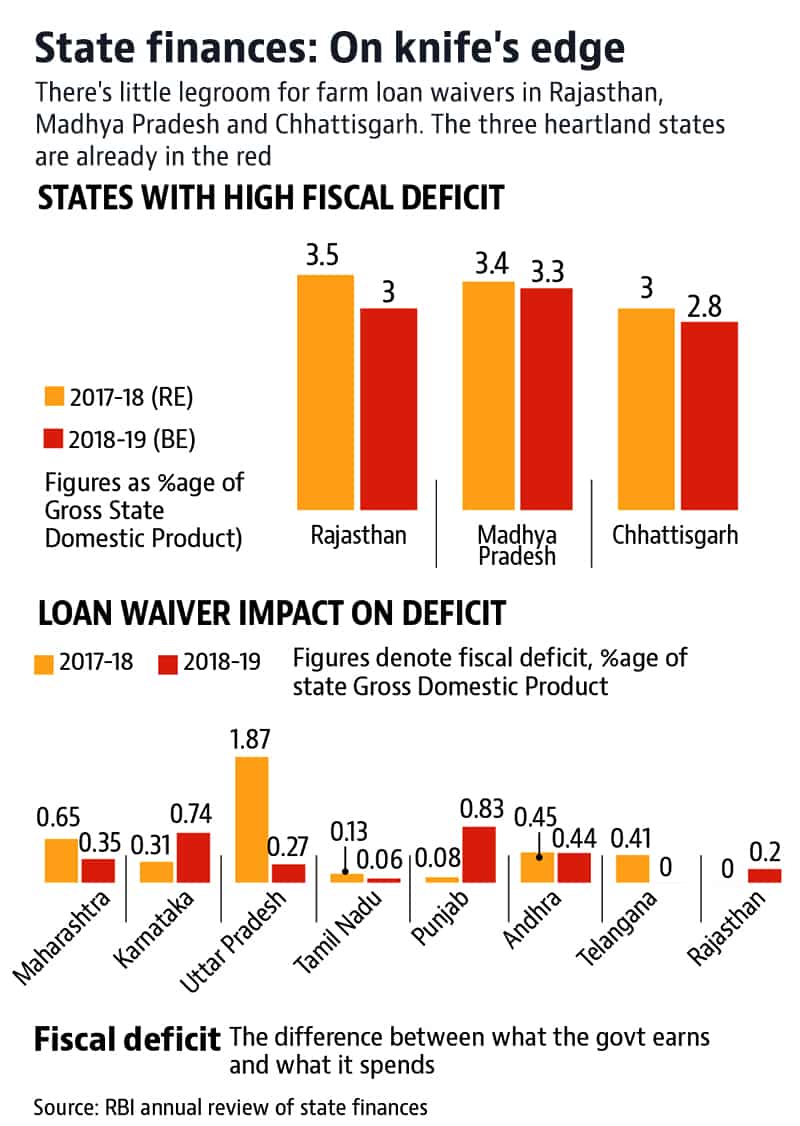
Rajasthan, Madhya Pradesh and Chhattisgarh have either breached their deficit targets or are just a touch away from overshooting the 3% norm. (see graphic)
Economist Ashok Gulati, a professor with the think-tank ICRIER, says loan waivers will limit the ability of states to undertake investment in agriculture necessary for long-term growth.
Higher borrowing by states has deeper implications since states raise loans by issuing bonds. Largescale bond issuance to fund loan waivers can worsen the country’s overall fiscal math.
For instance, it could result in the Centre paying more yields (or returns) on its own bonds, known as “spreads” in financial jargon. A sovereign bond is a debt instrument in which an investor loans money to the government.
All this could eventually complicate “debt sustainability” and make investors demand “more premium on central government securities”, according to an analysis led by Priyanka Kishore, lead Asia economist at Oxford Economics.
States ought to adhere to a deficit target of 3% of their GSDPs. Their revised fiscal deficit stands to be “3.1 per cent, essentially due to shortfalls in own tax revenues and higher revenue expenditure on account of pay revisions and farm loan waivers”, RBI says. There’s another challenge: under constitutional provisions, states can’t borrow without the approval of the central government.
Borrowing costs of states have been steadily rising, the RBI report shows. Waivers by Andhra Pradesh and Telangana in 2014 were 4.6% of their combined state GSDP (Gross State Domestic Product).
Tamil Nadu’s waiver of 2016 came in at 0.5% to its GSDP, while the 2017 waiver of Maharashtra, Uttar Pradesh and Punjab were at 1.3%, 2.7% and 2.1% of their respective GSDPs. Karnataka’s waiver announced recently is an estimated 2.4% of its GSDP.


