E-Paper



One week on, cause of fish mortality in Bhopal lake unclear
One week after thousands of dead fish washed ashore in the Bhopal’s Lower Lake, authorities are still unsure about the exact cause.

 Prefer HTon Google


One week after thousands of dead fish washed ashore in the Bhopal’s Lower Lake, authorities are still unsure about the exact cause.
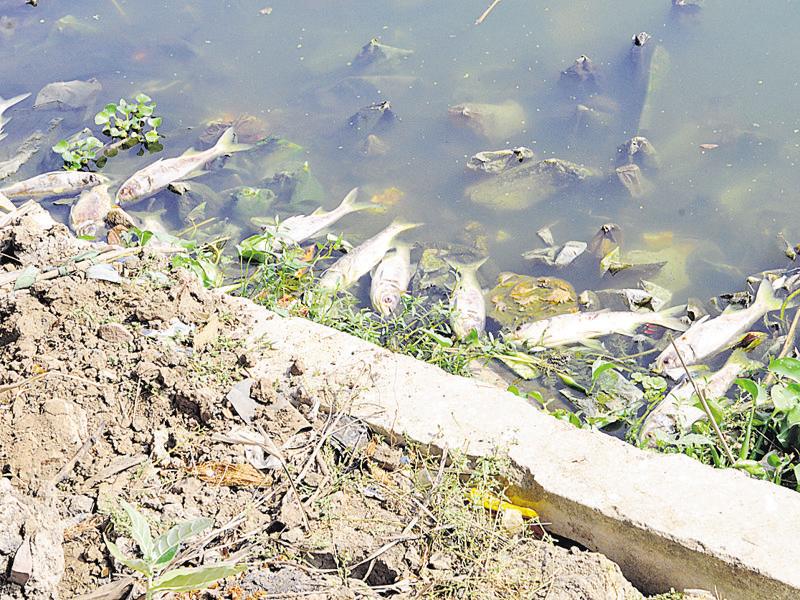
Thousands of dead fish were spotted in the Lower Lake, one of two lakes in Bhoj wetland that is designated wetland of international importance under the international Ramsar Convention, on October 30.
However, officials in the state fisheries department claim to have no information of the incident. According to the officials, issues related to the twin lakes — Upper Lake and Lower Lake — were primarily dealt by the Bhopal Municipal Corporation (BMC), which hadn’t inform the department about the large-scale fish mortality in the Lower Lake.
“We were not even informed by the BMC about the large number fish dying in lake waters,” chief research officer in the state fisheries department SB Singh said. “Prima facie, the fish died because of the cumulative effect of three factors — the lake is receiving sewerage water from the surrounding habitations; recently hundreds of idols of Lord Ganesha and Goddess Durga made of plaster of Paris and painted with synthetic colours were immersed in the Lower Lake.”
“(Also,) there were cloudy days in Bhopal, which reduces dissolved oxygen in the water. All these factors possibly suffocated the fish in the already polluted waters,” adding that a thorough analysis of the water and dead fish was required to ascertain the exact cause of fish mortality, he added.
Deputy director-fisheries Shashi Goliat said experts from the National Green Tribunal and the state fisheries department and pollution control board would inspect the Lower, Upper and Shahpura lakes on Saturday.
Meanwhile, MP state pollution control board (MPSPCB) regional officer PS Bundela said after hearing about the incident from media reports, they collected water samples from the lake to check its toxicity or the pollutants present. “The samples have been sent to our Indore lab and results are awaited,” he said.
MPSPCB’s counsel at the NGT Parul Bhadoriya said that in the case of Shahpura Lake, the tribunal on Friday had asked the MPSPCB to investigate why the fish were dying in the lake and submit a report.