
 E-Paper



Petlawad explosion: Life goes on, but not as usual
The people of Petlawad in MP haven’t forgotten the godown blast, which had left 84 dead and over 100 injured, even one month after it rocked the nation.

 Prefer HTon Google


Time is a great healer, they say. But, the people of Petlawad in MP haven’t forgotten the godown blast, which had left 84 dead and over 100 injured, even one month after it rocked the nation.
The police investigations have yet to answer many questions related to the incident and those who lost their near and dear ones still can’t get over the pain, shock and haplessness that the blast pushed them into.
Life is not as usual in Petlawad as yet.
On Sunday, at the NH-18 highway, right in front of the bloody site, a person was seen standing and crying out loud for 30 minutes, his eyes fixed on the debris lying within the fence erected by the district administration.
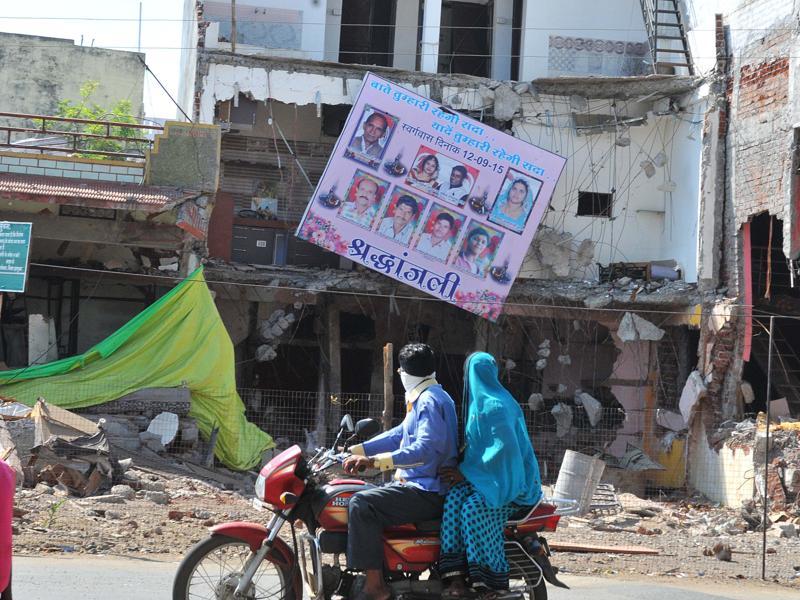
A banner, Shrradhanjalii, has been placed on the fence by the victims’ family. Rajkumar Tank had lost his son Prince in the September 12 blast which took place around 8 in the morning.
Prince had gone there to attend his coaching classes. “This is the first time since the incident took place that I have come to this place. I had no courage earlier but today I decided to visit the spot where my son died,” said Tank.
The residents, who had lost their families in the incident, held a grand havan near the spot for the peace of the departed souls.
The spot has been named ‘Shraddhanjali Chowk’ by the residents who visit there once a day and pay tributes to the victims whose photographs could be seen placed there.
But, people are yet to get over the grief. Local shopkeeper Raju Rathore said, “I close my shop at around 1 pm and return with my kids. And then again open it for two hours in the evening. My wife and kids are coping up with the shock and fear after the blast.”
A local scribe, Mukesh Sisodia, who was first one to film the incident, said he couldn’t sleep after the incident when he saw heaps of bodies in a pool of flesh and blood. The condition is the same with many others who often share their grief with him.
“If Rajendra Kaswa, the owner of the godown who came to the spot had warned the people, no one would have died. He knew that a big blast would follow hence he left the spot leaving the people to die. He is a mass killer,” said Shanu Rathore, a resident of Petlawad.
“We cannot forget that day. That was black day for us,” said Dilip Parihar, another resident.
-kW0H-U20214218012MgB-250x250%40HT-Web.jpg)


