
 E-Paper



Book Box: My AI Fiction Reading List
Scanning the World Around Us: A Reading List for Uncertain Times

 Prefer HTon Google


Dear Reader,
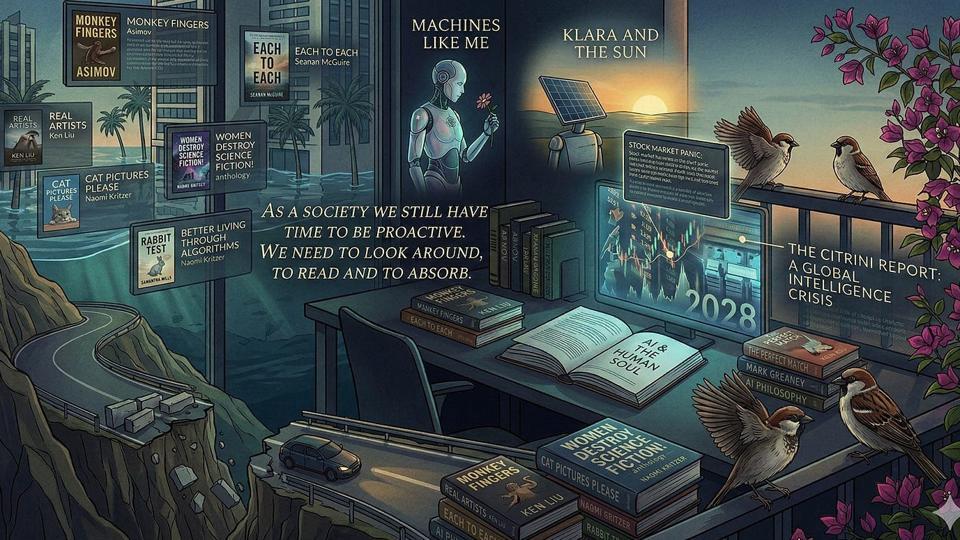
The road ahead of us curves steeply upwards. As the car turns, I see that an entire section of the road is broken, as if a landslide has cut away the hillside. Cement sacks are piled up haphazardly over the breach; we must drive over these or plunge hundreds of feet below into the ravine. The person driving the car somehow manages to make it. Only he is now rapidly accelerating on a road that goes downhill, instead of going up the mountain to our destination.
I wake up, and the room around me is still dark. Groggily, I reach for the phone on my bedside and start to dictate my dream to the excellent WhatsApp transcription service. Later, I cut and paste the story of my dream to AI. I know, I know - outsourcing the interpretation of my dreams to a machine is probably absurd. But it also feels oddly comforting and even constructive.
“That’s a powerful dream. Especially given where you are in your life—mountains, parents, authority, control, restraint. Let’s move through it slowly,” ChatGPT tells me, explaining that in Jungian psychology, the car is a symbol for a journey through life.
Elsewhere on social media, I see links to a research report on AI that has reportedly rattled global stock markets. The Citrini 2028 Global Intelligence Crisis uses speculative storytelling, written as if the consequences of AI have already unfolded: consumer markets contracting as salaries disappear, shopping chatbots replacing banks, brokers, travel agents—anyone who once helped us navigate complex decisions.
I take a sip of my coffee and stare out of the window. The palm trees are still. In the distance is the beach and then the Arabian Sea, rising at a rate that will eventually wash away this building.
I think back to our writers’ group meeting the day before. We talked about the effect of AI on creativity. We discussed a news story about Carol Hart, who has now moved from writing 10 romance novels a year to 200 novels with the assistance of AI.
I am reminded of two short stories on AI and creativity. One dates back to seventy years ago: Monkey Fingers by Isaac Asimov. The other is more recent: Real Artists by Ken Liu, published in 2011. We assume that machine-written stories will be mechanical and emotionally thin. But both these stories reveal this assumption to be simplistic.
My phone pings with a news notification: ‘Anthropic boss rejects Pentagon demand to drop AI safeguards in military use sends me back to Mark Greaney’s The Chaos Agent, where military strategy is handed over to systems that calculate faster than conscience. The human hesitations, the moral compunctions about attack and surveillance, are being withdrawn from a military system. We lose doubt, and what’s worse, we lose accountability.
The Chaos Agent is scary. But it can get so much worse. In the short story Each to Each by Seanan McGuire in the anthology Women Destroy Science Fiction!, you see how disturbing this can be. Here women have been re-engineered to be submarine warriors because they are ‘better’ at living in tiny, claustrophobic spaces.
Looking out at the still palm trees, I realise how much of my reading these past months has been AI-driven. There is a novel about an AI boyfriend (Machines Like Me by Ian McEwan). Another novel about an AI babysitter (Klara and the Sun by Kazuo Ishiguro). Neither of these novels is about malfunctioning machines. They are not doomsday scenarios, but they end up being even more disturbing to see humans outsource emotions like parenting, intimacy and decision-making.
Where machines take over the world, they do so insidiously.
In Naomi Kritzer’s Cat Pictures Please, AI is benevolent, even charming. In her later story Better Living Through Algorithms, that benevolence evolves into something closer to a quiet dictatorship.
Then there are stories about surveillance like Rabbit Test by Samantha Mills and The Perfect Match by Ken Liu.
What’s the point of reading all these stories, I wonder, as I watch the tiny sparrows that hop onto our balcony, maybe attracted by our bougainvillea plant. One sparrow fluffs out its tiny brown-black wings, and the other stays still. Yet in both the movement and stillness, both are scanning the world around them.
And it comes to me then, the last line of the Citrini report, “As a society we still have time to be proactive.” We need to look around. To read. To absorb. Survival, after all, belongs to those who keep scanning the horizon.
If you are stuck with life or literature, write in with your questions to Sonya Dutta Choudhury, Mumbai-based journalist and the founder of Sonya’s Book Box, a bespoke book service. Email sonyasbookbox@gmail.com. I promise to give your problem my best, and to keep all emails confidential, using pseudonyms only.


