
 E-Paper



Review: Breaking Through; A Memoir by Isher Judge Ahluwalia
Isher Judge Ahluwalia’s journey from being a pickle maker’s great granddaughter to an astute policy maker is unprecedented


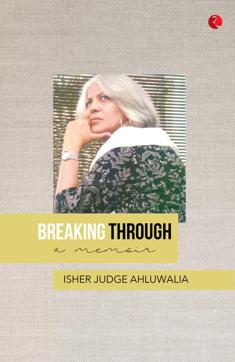
In December 2019, Isher Judge Ahluwalia, a leading Indian policy economist of her generation, was diagnosed with a brain tumour. She had been ignoring the symptoms for a while, choosing instead to focus on the edits of her husband Montek Singh Ahluwalia’s book Backstage: The Story Behind India’s High Growth.
The doctors ruled out surgery and started her on radiation therapy which weakened her to an extent that at the book launch in February she was on a wheelchair.
It struck her that she may never see many friends who had come for the book launch and decided to utilise the time she had left to write her memoir: “In life, one never knows what comes next. It is always a surprise. The hard part for me today is knowing that I won’t be there to see it.”
The Covid-19 pandemic made this feeling worse. “…and I knew that the rest of my life could well be spent under lockdown. My age, and the brain tumour, meant I was highly vulnerable.”
Ahluwalia, 74, wrote this memoir in a few months and in unusual circumstances. While she was still writing she lost the ability to read and write and had to rely on help from family, especially her husband – “certainly the highest qualified Research Assistant that I could hope for…” she writes.
She died on 26 September.
From a humble background, Isher Judge Ahluwalia was the first woman in her family to pursue higher education. The ninth child in ‘a full cricket team of 11!’ she grew up in Indore and Kolkata before moving to Delhi to enrol for a master’s degree at the Delhi School of Economics (DSE). She attended a vernacular medium school in Indore and, even later in life, saw herself as a “Hindi-medium person”. That her knowledge of English was poor struck her when her family moved to Kolkata.
An exceptionally bright student she was ranked within the top 10 in the West Bengal Higher Secondary Board examination. She went on to study at the prestigious Presidency College with her father reluctantly giving in when she won a scholarship of Rs 35 a month!
“My scholarship not only allowed me to pay my tuition fees without burdening my parents, it also meant I could afford the tram fare to college from home. I have always believed that scholarships for deserving students, especially those in need, is the best investment a society can make,” she writes.
Of the 24 students in her class, only four were girls. What readers may find rib-tickling is ‘…if a boy was the first to reach the classroom, the girls would wait outside until the professor arrived. If a girl reached first, it would be the boys waiting outside.’
She did well at Presidency College and moved to Delhi for her post graduation. The Rs 120 monthly scholarship helped her live in Delhi. At DSE she was taught by Amartya Sen who was then in his early 30s. She recalls him as an outstanding lecturer who was good looking and popular with students. Thereon it was smooth sailing for Ahluwalia and she got into Massachusetts Institute of Technology (MIT) on a full scholarship. Later, she landed a job at the International Monetary Fund (IMF) after she realised she was not cut out for teaching but enjoyed policy-oriented research, especially on developing economies.
Brimming with anecdotes from the 1970s when she struggled to make a mark in a very male-dominated world, she details how the ‘boys’ clubs’ ignored ‘female sensitivities’. The Delhi that she returned to in 1979 with her husband Montek was not an easy place to live in and she juggled being a hands-on mother with research on industrial stagnation in India, and attempts to avoid becoming ‘Mrs Finance Secretary’.
In 1984, she was offered the post of “economic advisor” in the Ministry of Industry. Although not keen on a government post, when she did go to the ministry the offer was changed to “deputy economic advisor” citing her young age. “…I felt they were engaging in gender discrimination because Montek had been offered the position of an economic advisor five years earlier when he was only 36. I was 39 and my qualifications were no less — in fact, they were greater as I had a PhD from MIT whereas Montek was not a PhD.”
As the 1970s drew to a close, India was performing poorly but the policymakers seemed to be in denial. The leading advocates of the market-oriented approach, some of whom were Ahluwalia’s teachers and mentors, had moved out of the country. Ahluwalia fought against Indian economic orthodoxy highlighting the excessive controls which were dwarfing growth. Her book on industrial growth in India submitted to the Oxford University Press (OUP) for publication, was initially rejected. “Left-leaning reviewers were unhappy at my call for a rethink of our policies of control over industry,” she writes.
Economic liberalisation was finally ushered in under the leadership of PV Narasimha Rao whose advisor was Dr Manmohan Singh. The Ahluwalias were close friends of Dr Singh and it is on his insistence that Montek had returned to India. Although Ahluwalia looked up to Dr Singh almost all her life, she is critical of the slowdown of the economy during UPAII, and wonders what held Dr Singh back. “On many occasions, I wondered why the PM didn’t just resign. His continuance in office in an under-performing government was only eroding his own legacy.”
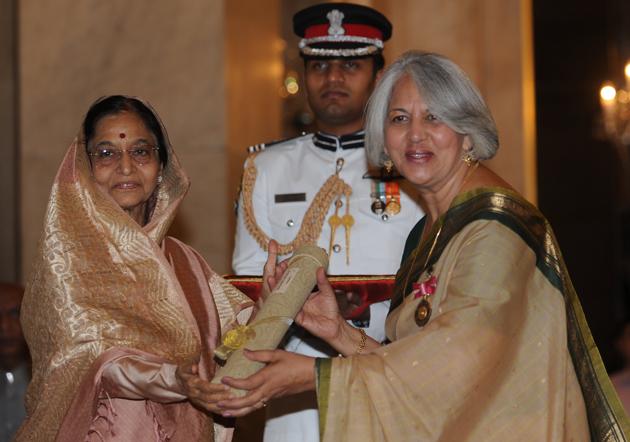
In her glorious career spanning five decades, Ahluwalia headed the Indian Council for Research on International Economic Relations (ICRIER) for over a decade. She is credited with transforming ICRIER from a slightly sleepy entity into one of India’s top economic think tanks. More recently, she focussed on the challenges of urbanisation in India.
Ahluwalia’s family was originally from Lahore and her great grandfather was a well-known pickle maker who sold meetha gobhi shalgam ka achaar at that city’s famed Anarkali Bazaar. She recalls, in jest, her first meeting with the late journalist-author Khushwant Singh who was only interested in her being “the great granddaughter of a well-known pickle maker in pre-Partition Punjab!” and not the young policy economist who was fighting against Indian economic orthodoxy.
Isher Judge Ahluwalia’s journey from being a pickle maker’s great granddaughter to an astute policy maker is unprecedented. Only a strong-willed woman like Ahluwalia could have utilised the last few months of her life to look back on what it took to break through in a man’s world. With her gone, we can only appreciate her sense of urgency, and the importance of that life lesson.
Lamat R Hasan is an independent journalist. She lives in New Delhi.


