
 E-Paper



Ria Chopra: “While the Internet makes us open, it also makes us overexposed”
The author of Never Logged Out on writing about the Indian Gen Z Internet experience, identity formation, and online authenticity

 Prefer HTon Google


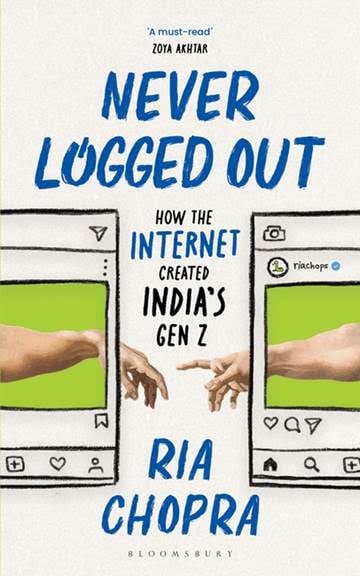
Never Logged Out feels like the result of years of thinking and writing about the Internet. When did you realise these ideas needed the permanence of a book?

The Internet is important to me by virtue of me having been on it for a big part of my life, and having had many formative experiences on it. It was a feeling which was shared by everyone of our generation — I’ve been here for a long time, and now I can see it changing. Additionally, much of my work in recent years has been about the Internet culture, specifically of India. I definitely intended to write a book some years down the line; it just happened a lot sooner than expected.
You’ve written about Internet culture in shorter forms before — from thoughtful essays to viral reels — what changed when you started thinking in the slower, more deliberate form of a book?
The feeling of not being constrained by word counts or time limits was very freeing. When you write/create for social media, you have to have a hook, cut down any fluff and condense everything. But I am someone who goes on tangents, exploring concepts that arise, then later coming back to the core of the conversation. For example, the What’s In My Bag chapter of the book starts off with a 2500 word history of tote, simply because it was interesting to me. That ability to go on digressions, experiment with form, being able to go on detours, was very fun — mostly because I knew that there was a certain commitment I had from the readers, so I wasn’t trying to hit retention metrics.
How do you think the Indian Internet experience differs from the Western narratives about Gen Z and digital life?
We’re at a stage where we can say that Internet experience is globalized for the most part. But there’s still so many ways in which India’s experience differs from the First World Internet experience. India got access — or liberal and easy access — to the Internet very late. So, we can’t relate and draw the same parallels to the Internet culture arguments that are made in the west. The societal structure of India also affects the Internet experience — from caste discussions, the way men talk about women online, to the percentage of women online, to how politicians use the Internet in India.
The Indian Internet is multilingual, chaotic, and constantly code-switching. How important was it for you to reflect that hybridity in the book?
The book is still an English-language book, so you will not see a lot of Hindi sprinkled in. I have included a lot of Internetisms. Readers catch those references which add an additional layer of #iykyk. I’ve also tried to include very “hyper-India” examples when talking about certain points — say sharing live locations with friends and family while you’re out and about.
Was there a specific technological or cultural shift that you see as a turning point for Gen Z in India?
The 2016 watershed moment [Jio] in the Indian Internet simply because of the sheer amount of people who were able to get online all at once. Not only did exposure levels change, but the crowd also started changing the culture in their own way. The content culture diversified to a great extent — because people from tier 2 or a tier 3 city made something that was nothing like what was being made in tier 1 cities — which is what the Internet used to be before.
Another event, across the world, which was the turning point was the advent of the smartphone with a camera, specifically the front camera. In early days, Instagram used to be coffee or sunset photos — basically looking outward at the world. Once the front camera came, suddenly it’s all selfies and self-created content — it led to a more personal Internet.
For many people, the Internet is where identity is formed. How do you think that changes how Gen Z understands the self?
That’s an hour-long conversation in itself. When we (Gen Z) entered the Internet, there was also an older generation who entered with us. But for them, the Internet was a space for identity expression because they had built their selfhood offline and were using Orkut, Facebook, etc. just to express themselves. For us who were malleable, the identity formation happened online. There’s no way to divorce that identity from the medium it was created on.
The critique about Gen Z today is “they’re very self-centered” “they can’t handle difficult things/mental stress”. But when someone grows up spending time in a space where you are the centre of attention — it is not hard to fall into the trap of “the world revolves around me” — because in an algorithmic way, it does. Every social platform quite literally feeds content that is specifically tailored and personalized for you.
A recurring tension in the book is between visibility and vulnerability. Do you think our generation is more open — or simply more exposed?
I didn’t even start the book thinking this is something I would explore, especially since it’s something I struggle with a lot due to being a “public figure”. Though I enjoy it for the most part, sometimes the scrutiny and overanalysing of everything I say and do gets to me. While the Internet makes us open, it also makes us overexposed. As a creator, it turns into obsessive curation and self-censoring to minimize any misunderstandings. As a consumer, it results in overstimulation. It makes me think of that meme “we should all know less of each other.”
We’re often told to be “authentic” online. Do you think authenticity is even possible on platforms built around performance and metrics?
On one hand, 100% authenticity is impossible online by virtue of it being your choice to post things on the Internet, which basically ends up in filtering and curation — even if you’re not a creator. On the other hand, I have to say that genuine corners still do exist on the Internet, where people try to create meaningful dialogue that is not guided by the motivation to hit reach and retention metric.
READ MORE: Review: Never Logged Out by Ria Chopra
How has the Internet changed the way Gen Z understands closeness, romance, and emotional labour?
Nowadays, there is a huge focus on the visibility of things. We’re fed so much content about how love is supposed to “look” like that the focus has shifted from the feeling of love to the surface level looks of a relationship. Visible gestures of love have always been important, and especially in India where weddings are mainly to show off to friends and family; the focus on it nowadays is a bit too much.
This shallowness also leaches into closeness and emotional labour. Dating apps are the most harmful manifestation of it. They make it very easy to string someone along and once you’re done, all you have to do is hit “block” and delete chats. I think people trying to be open and vulnerable with each other deserve more than that. Love, the emotion at the core of it all, is still the same, but the way we process it has changed drastically.
Gen Z often feels nostalgic for moments that weren’t that long ago. What do you think that nostalgia is really responding to?
Nostalgia is always not for a time or a thing, but for who you were back then. So, most of our nostalgia is for a time when we felt safe and free, and the world and the Internet seemed to be a better place.
Secondly, trend cycles are shorter now. So naturally, the nostalgia cycles are also shorter. We have gone from being nostalgic about the 80s, Y2K, to now about the golden age of Instagram. What’s funny is that it was just about 13 years ago.
Largely, the nostalgia speaks to the tiredness and contention we feel with how deeply intertwined our lives have become with technology. A lot of us can’t work, make money, and live without at least three devices supporting us. So maybe we’re yearning for the time where we used to be capable of maintaining connection and life without having to depend on technology.
What was the hardest part of writing this book?
I had to grapple with my perspective and stances on topics first. I had to analyze things from a logical and impersonal perspective and that resulted in confronting myself about the way I did things. In the AskFM chapter, for instance, I had to confront my own past self and confess to myself, and the world, that yes, I did send anonymous hate to the people I didn’t like.
In terms of logistical aspects, writing about memes and videos without being able to hyperlink or embed them was difficult. I had to describe the videos in text form, go back and find original posters for recycled tweets for proper citation, and things like that. The Internet is fragmented and multimedia. So, condensing it and making it cohesive in text was difficult.
Rutvik Bhandari is an independent writer. He lives in Pune. You can find him talking about books on Instagram and YouTube (@themindlessmess).


