
 E-Paper



Seán Hewitt: “Love is a great spur to fiction”
The award-winning poet on the texture of memory, William Blake, and his debut novel, Open, Heaven, that’s both queer centric and pastoral

 Prefer HTon Google


Earlier, you’ve noted that you “kind of ran out of life” having already leveraged your experiences in poetry and memoir.
I think, perhaps, more than having “run out of life”, I felt at that time that I had run out of events, which necessitated the invention of events that lends itself to fiction. Inevitably, and positively, I think all literature carries the marks of its maker, whether that’s in some power of observation or a particular viewpoint, even if the maker has to invent characters or plot lines in order to be themselves differently, or more fully. We have singular experiences, though not as many as we might think, since all experiences share common threads across people, but what is really singular about us is the way we think, and the best writing carries the mark of that mind, or tries to.
You invoke William Blake in the epigraph. What does his work mean to you?
I think Blake’s work is so powerful, not only for its bizarreness (and no one could argue that he was not a bizarre writer and painter), but for its radical counter culturalism. So much of his writing, and I’m thinking particularly about The Marriage of Heaven and Hell, offers shocking and transgressive ideas about love, sex, desire, and joy. I remember reading him when I was younger and being shocked but also liberated by his ideas, especially his proverbs, like “Sooner murder an infant in its cradle than nurse unacted desires.” Or in love with the simplicity and infallibility of others, like “Dip him in the river who loves water.” But, most of all, I think he gave me license for the joy of making things, and the joy and necessity of expression. I have a t-shirt with his painting of Newton on, and above my desk, the line “Exuberance is Beauty.”
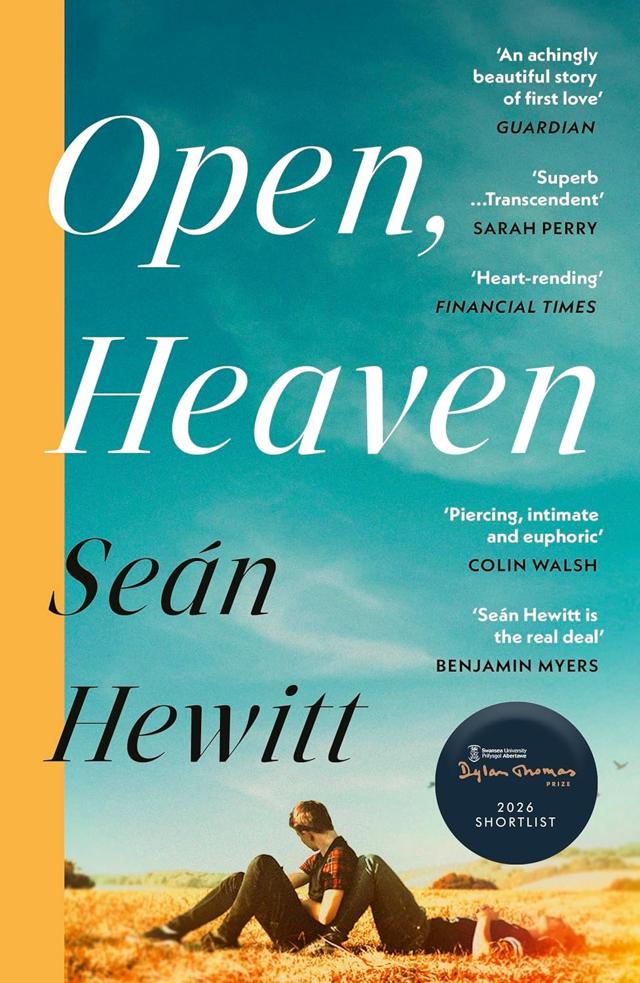
In the Prologue to Open, Heaven, you write about the “imagined reversal”, the ‘return’ towards one’s past as both an exercise in fictionalising the real and realising the fictional, making what had transpired somewhat bearable. Doesn’t time and the distance it provides have a role to play in this novel?
I was interested in giving this texture of uncertainty to Open, Heaven. As much as it is about the thing that is returned to, it is also about the act of returning, the failure to return (or the inability to return), and also the ways in which the narrator elides certain things, so that the reader is set the task of figuring out what is real and what is not.
I liked having two timelines for the novel, 2002-2003, and 2022, though we only visit 2022 twice, briefly. Mainly, this was because it set up a sort of echo over time, and gaps that could only be filled with suggestion and recurrence. We all have our own fictions — I would go as far as to say the majority of our life is a sort of fiction — and love, which is the real core of Open, Heaven, is a great spur to fiction. When we fall in love, we tell ourselves stories about the person we fall in love with, and we hope that the story we’ve told ourselves comes true. But in Open, Heaven the truth sometimes remains unclear, and is lost in the gaps between memories, or between characters.
The protagonist James Legh’s post-facto rationalisation of his own complicated relationship, and his meanness and vulnerability in the face of events, seems to present ‘coming out’ as a process that’s uniquely difficult for each individual.
I’m glad you think that James can be mean — it was really important for me to have a fallible protagonist, and one whose decisions, though we understand them, aren’t always the best. I didn’t want James’s coming out to be the pinnacle of Open, Heaven. Instead, I wanted it to happen before the book started, and to think about what happens afterwards.
Coming out involves a very fraught moment of self-expression, and is the tip of a very deep iceberg. Often, it might take years, even decades, before a person is able to utter the simple words that ‘out’ them. And then what? What happens? The rest of life, the reckoning, the blossoming. There can be isolation, friction, rejection, joy, all sorts of possibilities, and the reason coming out is so difficult is that we don’t know which possibility will come true. For James, who is robbed of the moment of self-expression (he is outed by a girl in school), he feels like he has lost his secret. And so, as a form of defence, he becomes more secretive and detached, guarding his ego against any further intrusions, and insisting (in that very teenage way) that he cannot be understood.
Please share your views on developing Eddie and Luke. Was Eddie there when you were conceptualising the novel? And what about Luke, whose reticence is a result of his familial past.
The more I think about it, the more I think the novel might be about Eddie, rather than Luke, necessarily. It is a novel about different forms of love, and the ways these put tension onto a person. James is torn between his responsibility towards his younger brother, Eddie, and his desire for romance, sex, adventure. And, without spoiling the book, the decisions he makes are of huge importance to his life and the lives of those around him. Eddie began as a small character, but as I wrote and revised the novel, he kept cropping up, becoming more necessary, and more pivotal, each time. I think he may be my favourite character.
Luke is in many ways unknowable to James, and for that reason had to be somewhat unknowable to the reader too. It is vital that we cannot tell what Luke thinks, though I hope the reader sees and knows more than James does. I think that may make parts of the story somewhat excruciating — there were times I myself wanted to jump inside the novel and shake James — but both James and Luke suffer from an inability to fully express themselves, not only to each other but to their families. Luke, for James, represents everything he doesn’t have; and, because James falls in love with him, he represents the dream of a different life.
Open, Heaven turns the need to centralise ‘happenings’ in fiction on its head. It invites readers to imagine things for themselves. Tell us about developing a story about unrequited love.
You’re right. The reader is trapped in James’s head for the whole book, meaning that we see what he sees, and witness the way these things provoke him into imagination. The book is about what love does to James’s mind, the way he reads and misreads the world, the uncertainties he has, and it was important to me to replicate that for the reader, to leave them guessing beyond the end of the novel, because James is not a perfect narrator, and there are things he isn’t telling us, or cannot bear to admit. The novel might be less about unrequited love than it is about our ability to know, or really see, the people around us. Both James and Luke see love, and each other, differently, and so I wanted to redeem this apparently failed thing — unrequited love — and ask what moments of joy, or grace, or salvation, can be found within it.
You’ve spoken about your desire to have a queer-centric pastoral novel. How has being a poet helped you realise this?
I noticed that so many queer novels take the city as their home. The city is the place, they seem to say, where queer life happens, where we meet each other, where we come together. And of course, historically, that’s often true. But I wanted to explore rural queer life, and what it means to live in a place where we don’t see people like us, where there aren’t queer bars or clubs to go to, where we’re left to imagine a life from our own resources.
Open, Heaven would have been a very different book if James had been able to meet another queer person, or go to a queer community group. Instead, he’s isolated, and has to imagine his way through all the challenges of growing up. When I wrote the book, I knew from the very beginning that I wanted it to be structured around four seasons — beginning in autumn and moving through to summer — not only because I had the sense that the novel moved towards brightness and warmth and heat, but also because I wanted the reader to be able to feel the natural world, to smell it, to be immersed in it. One thing poetry does very well is atmosphere and close observation. When I wrote the first draft of Open, Heaven, I wrote it over the course of a year, and wrote the autumn section during the autumn, the winter section during the winter, and so on, so that I could get the minute, real, vivid detail of the changes in weather and the natural world onto the page.
Saurabh Sharma (they) is a nonbinary, queer writer, essayist, and culture critic. On X: @writerly_life; Instagram: @writerlylife.


