E-Paper



Govt plans new policy to boost household savings
The government is mulling a comprehensive plan to encourage financial savings and boost money parked in a slew of products including bank fixed deposits, insurance premium, mutual funds and post-office savings.


The government is mulling a comprehensive plan to encourage financial savings and boost money parked in a slew of products including bank fixed deposits, insurance premium, mutual funds and post-office savings.

While the government is set to relaunch the Kisan Vikas Patra in the next few weeks, it would also come up with two more such instruments, one aimed at the girl child and the other at the country’s youth.
“We would be coming out with a comprehensive policy on boosting savings in which all the channels like banks, post offices and even insurance firms would be used to boost savings in a co-ordinated way…we have been holding talks on the same,” a senior finance ministry official, who did not wish to be identified, told HT.
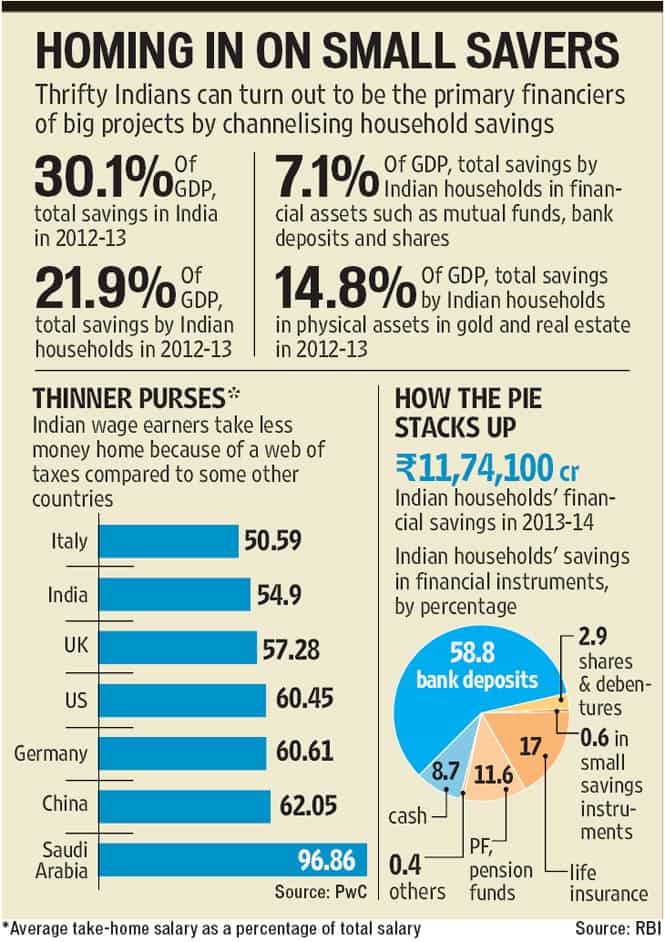
Total household savings in India at the end of 2012-13 — the latest for which data is available — stood at Rs 24.72 lakh crore.
Two-thirds of these savings (66% or about Rs 16.01 lakh crore), however, were in physical assets such as gold and real estate, with the remaining ( 34% or about Rs 8.06 lakh crore) in financial savings such as bank deposits, mutual funds and company shares and debentures.
India’s savings rate, which had peaked at 38.1% of GDP in 2008, fell to 30.1% of GDP in 2012-13.
Frugal households could well turn out to be the primary financiers of mammoth infrastructure projects. India’s savings rate could reach 40% of GDP in the next few years and can potentially be sustained at high levels for well over a decade, primarily due to its armies of young people entering the workforce.
“It should be the endeavour of all the agencies engaged in mobilisation of savings to ensure that the savings movement is taken to the farthest corners of our country,” finance minister Arun Jaitley said at a recent function.
For Indians, gold, for long has been a tested hedge against inflation and has been a traditional favourite for parking surplus income as it has long been considered a safe haven asset.
In August, the government launched an ambitious scheme — the Pradhan Mantri’s Jan Dhan Yojana — to provide bank accounts to 75 million people by January.
According to the World Bank’s Global Financial Inclusion (Global Findex), only 26% of women in India admit to having a bank account. More than four out of ten adults in India still do not have a bank account.
In the last budget, the finance minister had raised tax exemption limits on a range of instruments popularly known as the ‘Section 80 scheme’ from Rs 1 lakh to Rs 1.5 lakh per annum.