
 E-Paper



Nirmala Sitharaman's prediction for India's economy as IMF cuts global growth
Nirmala Sitharaman said growth will be among the top priorities of the Narendra Modi government and attention will be paid to sustaining the momentum that the Indian economy has got coming out of the Covid-19 pandemic.

 Prefer HTon Google


Union finance minister Nirmala Sitharaman, who is in the US to attend the annual meetings of the International Monetary Fund (IMF) and the World Bank, on Tuesday forecasted India's growth rate to be around 7 per cent this financial year.
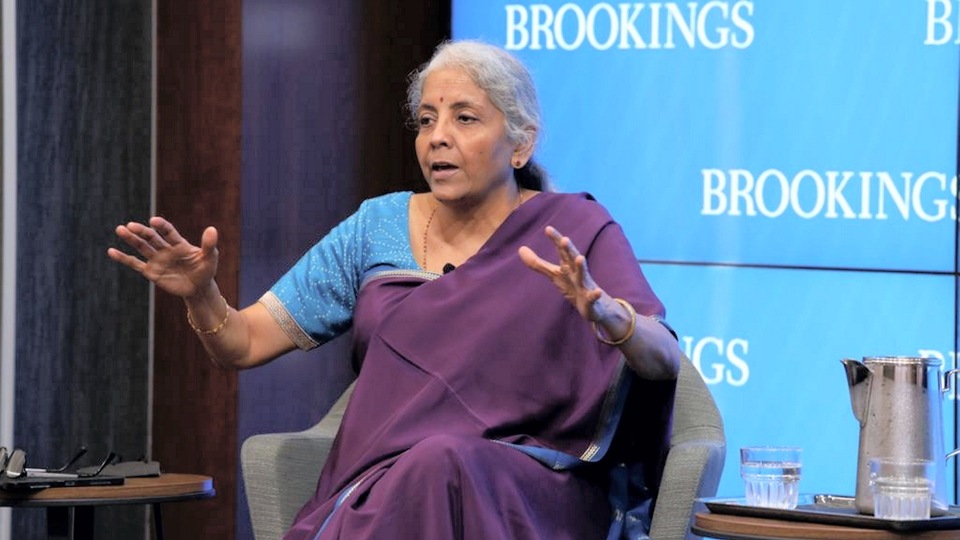
Sitharaman said growth will be among the top priorities of the Narendra Modi government and attention will be paid to sustaining the momentum that the Indian economy has got coming out of the Covid-19 pandemic.
Her statement comes even as the IMF, in its latest projection, predicted India's GDP growth to be 6.8 per cent - down from a January projection of 8.2 per cent and in July estimate of 7.4 per cent. However, despite the slowdown, India would remain the fastest-growing major economy.
The IMF said on Tuesday global growth is expected to slow further next year, downgrading its forecasts as countries grapple with the fallout from Russia's invasion of Ukraine, spiraling cost-of-living and economic downturns.
The world economy has been dealt multiple blows, with the war in Ukraine driving up food and energy prices following the coronavirus outbreak, while soaring costs and rising interest rates threaten to reverberate around the globe.
"I am aware that growth forecasts around the world are being revised lower. We expect India's growth rate to be around 7 per cent this financial year. More importantly, I am confident of India's relative and absolute growth performance in the rest of the decade,” she said addressing a gathering in Washington.
Sitharaman, however, observed that the Indian economy is not exempt from the impact of the world economy. “No economy is,” she said.
“After the unprecedented shock of the pandemic, came the conflict in Europe with its implications for energy, fertiliser and food prices. Now, synchronised global monetary policy is tightening in its wake. So, naturally, growth projections have been revised lower for many countries, including India. This triple shock has made growth and inflation a double-edged sword,” Sitharaman said.
After the Russia-Ukraine conflict started in February 2022, there was a sharp increase in food and energy prices. India had to ensure that the rising cost of living did not lead to lower consumption through erosion of purchasing power.
“We addressed these multiple and complex challenges through a variety of interventions. One, India ramped up its vaccine production and vaccination. India has administered over 2 billion doses of vaccine produced domestically. Two, India's digital infrastructure ensured the delivery of targeted relief Third, in 2022, after the conflict erupted in Europe, we ensured adequate availability of food and fuel domestically, lowered import duties on edible oil and cut excise duties on petrol and diesel. The central bank has acted swiftly to ensure that inflation did not get out of hand and that currency depreciation was neither rapid nor significant enough to lead to a loss of confidence,” the minister said.
'India in talks with different countries to make Rupay acceptable'
Sitharaman said India is discussing with different countries to make Rupay acceptable in their nations.
“Not just that, the UPI (Unified Payments Interface), the BHIM app, and NCPI (the National Payments Corporation of India) are all now being worked in such a way that their systems in their respective country, however, robust or otherwise can talk to our system and the inter-operability itself will give strength for Indians expertise in those countries,” she said.
(With inputs from PTI and ANI)


