
 E-Paper



AI should assist human intelligence, not replace human judgement: Yogi
At TechSangam 2026, chief minister Yogi Adityanath says 35,000 industrial units established in Uttar Pradesh since 2017, targets 5 GW data centre capacity by 2030

 Prefer HTon Google


Chief minister Yogi Adityanath on Saturday linked Uttar Pradesh’s forensic capabilities and technology-driven policing to his government’s law-and-order record, asserting that criminals would be traced even if they hid behind artificial intelligence (AI) and deepfakes. He also cited industrial expansion and infrastructure development since 2017 to position the state as an emerging technology and investment hub.
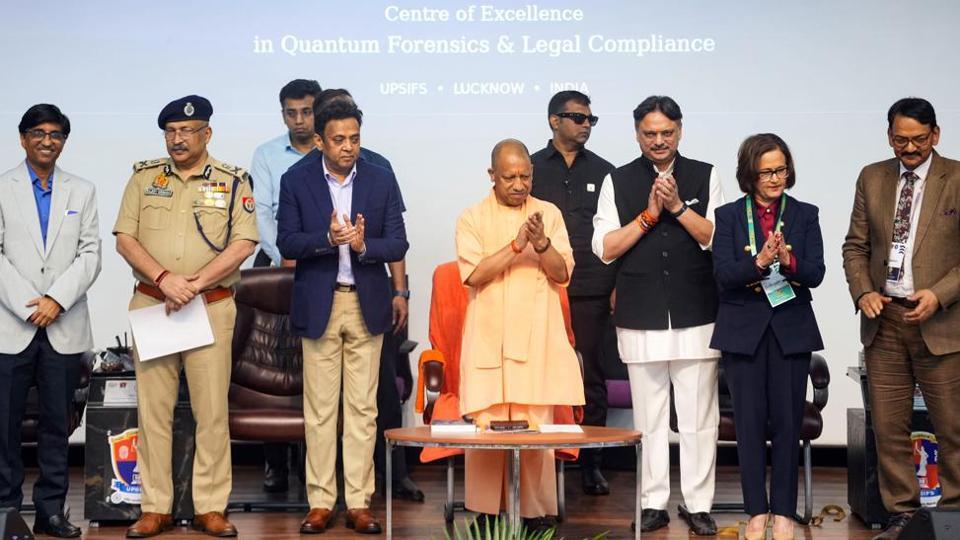
Addressing the three-day international conference TechSangam 2026 at the Uttar Pradesh State Institute of Forensic Science (UPSIFS) in Lucknow, Yogi said AI should assist human intelligence, not replace human judgement.
“AI should be a helper, not the decision-maker,” he said, warning that excessive dependence on technology could create serious challenges.
The chief minister also inaugurated the LEXQ Centre of Excellence to promote research at the intersection of quantum technology, law and forensic science. He also launched a consent management portal, laid the foundation stone for the ‘Abhedya’ project and released “AI in Construction”.
He said the government aims to develop five gigawatts of data centre capacity by 2030 through five major clusters, while investments in semiconductors, AI and cybersecurity are expected to strengthen the technology ecosystem. He also referred to the proposed semiconductor fabrication facility in Noida.The chief minister said around 14,000 industries had been established in Uttar Pradesh between 1947 and 2017, compared with 35,000 since 2017, attributing the growth to improved law and order and a more favourable investment climate.The state had received investment proposals worth ₹50 lakh crore and had a land bank of approximately 75,000 acres, he claimed. Citing HCL’s Lucknow centre, Yogi said its workforce had grown from around 100 employees in 2017 to 12,600. Women were also working night shifts, which he cited as evidence of improved security and greater workforce participation.
Invoking the television crime series CID, he said techniques once seen on screen, such as identifying criminals through fingerprints or strands of hair, were increasingly possible through forensic science. Citing a case in which a mafia figure, who committed his first crime in 1980 was convicted in 2022, he stressed the importance of preserving scientific evidence to strengthen prosecutions and prevent delays in justice delivery.Forensic laboratories were being developed across all 18 police ranges, with 12 completed and six nearing completion. More than 150 forensic vans had also been deployed to collect evidence at crime scenes, he said, adding that the new criminal laws placed particular emphasis on forensic evidence in offences punishable with imprisonment of more than seven years.
Adityanath said UPSIFS stood on nearly 100 acres of land in Lucknow that had earlier been occupied by a prominent land mafia figure. Following an inquiry and the registration of FIRs in 2017, the accused surrendered and vacated the land, he said.He also highlighted infrastructure development in Ayodhya, including its international airport and plans to develop the city as a solar hub. Uttar Pradesh accounted for around 60% of the country’s expressway network and had five international and 17 domestic airports, he said.UPSIFS founding director GK Goswami said Union home minister Amit Shah laid the institute’s foundation stone on August 1, 2021. The institute has trained more than 5,000 officials from the police, defence forces and administration and has laboratories for DNA, cyber and digital forensics.
Director general of police Rajeev Krishna highlighted the importance of specialised training in cyberbullying, digital evidence and crime-scene management. University of Indianapolis president Prof Tanuja Singh praised Uttar Pradesh’s work in AI and cybersecurity, saying its students could help shape India’s future.The conference also saw memoranda of understanding signed with national and international institutions, including the University of Indianapolis, Jiwaji University, the SANS Institute, the Uttar Pradesh Skill Development Mission, the National Institute of Electronics and Information Technology, the Directorate of Forensic Science Services, Digital India Corporation, Software Technology Parks of India and the Centre for Development of Advanced Computing.
NITI Aayog member Prof Abhay Karandikar, Defence Cyber Agency director general Rear Admiral Sanjay Sachdeva, additional chief secretary (home) Sanjay Prasad and Sarojini Nagar MLA Dr Rajeshwar Singh were also among those present.


