
 E-Paper



Nifty 50, Sensex today: What to expect from the Indian stock market on Thursday?
The US tariff announcement came after the markets closed and could result in investors taking fresh bearish positions.

 Prefer HTon Google


Mumbai: Indian equities could extend their decline on Thursday after US President Donald Trump on Wednesday slapped a 25% tariff on imports from India, along with an unspecified penalty.
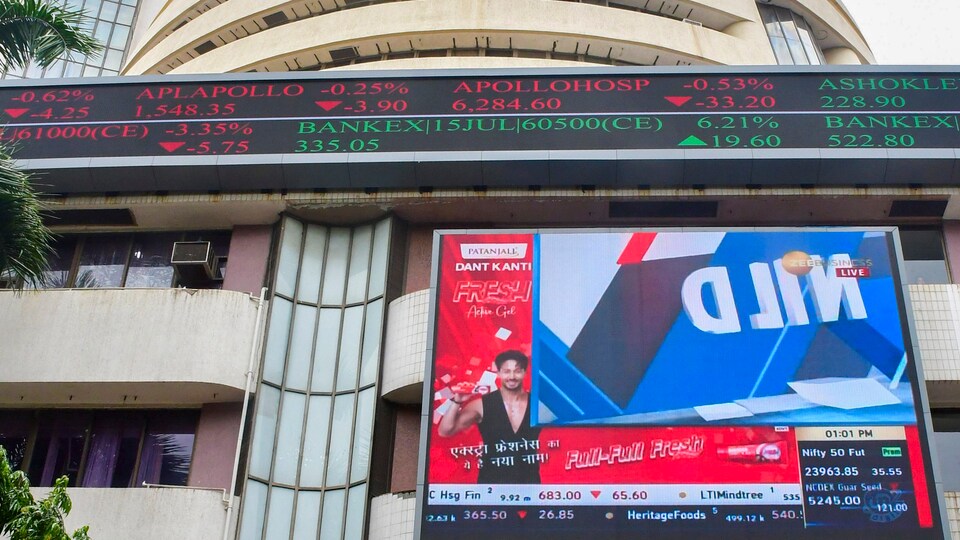
Stocks of textiles, pharmaceuticals, and automotive component companies—key Indian exporters—are likely to be hurt the most, said experts. However, they also expect the fall to be short-lived on hopes of a trade deal eventually being struck. India and the US are negotiating a bilateral trade agreement and the next set of talks are scheduled in August.
The benchmark Nifty, which fell 3.1% over the past four weeks to 24,837 last Friday, recovered marginally to 24,855.05 on Wednesday. The tariff announcement came after the markets closed and could result in investors taking fresh bearish positions. The market was expecting a 20% tariff.
Also Read: 'PM Modi a friend of mine, but…': What Donald Trump said on 25% US tariff bomb
However, an additional 5 percentage point tariff rate along with an unquantified penalty “could result in a knee-jerk reaction”, said Swarup Mohanty, chief executive officer (CEO) of Mirae Asset Investment Managers, which manages ₹2 trillion. “But things will begin to stabilise sooner than later as a large part of the uncertainty is out of the way. It’s a negotiating tactic and we could reach a deal soon.”
Options traders had baked in a 1% move from 24,900 in the Nifty, with a range of 24,780-25,020, at Wednesday’s closing. That range may now break on the downside after the announcement.
In the past four weeks, the markets were already under pressure as a weakening rupee and higher stock valuations than other emerging markets prompted foreign portfolio investors (FPIs) to pull out over ₹32,000 crore from Indian equities in July — a sharp reversal from their buying trend last month. The rupee declined 2.2% over the past month—from 85.49 on 27 June to 87.42 against the US dollar on Wednesday—to its lowest level in five months.
The fiscal first-quarter earnings of Indian companies have also been weak. Consolidated profits of 704 companies fell 6.2% over a year earlier. The Nifty trades at a price-to-earnings multiple of 22.8 times on a trailing basis, compared to 14.21 for the Kospi index. The Korean market is the best performer in Asia, and it closed at a four-year high on Wednesday. At Wednesday’s closing, the Nifty 50 is almost 6% off its record high of 26,277.35 on 27 September 2024.
Still, money managers such as Ashish Gupta, who oversees assets of ₹3.37 trillion as chief investment officer at Axis Mutual Fund, believe that there could be at best a short-term knee-jerk reaction.
“DIIs (domestic institutional investors) will continue to buy at lower levels, which will cushion any fall,” he said.
To be sure, while FPIs have sold cash shares worth ₹1.32 trillion in the year to date, domestic institutional investors have purchased shares worth ₹4.12 trillion over the same period.
One area of concern for FPIs is the weaker local unit, which dents their dollar returns. With the tariff tensions persisting, the rupee could weaken a tad more before the Reserve Bank of India intervenes to keep it within a range of 86-87 in the month ahead, according to Madan Sabnavis, chief economist at Bank of Baroda. “The stock market reaction to the tariff imposition won’t be longer than a few days,” added Sabnavis.
Some economists expect the higher-than-expected tariff to hit India’s GDP growth.
“When the US had initially imposed tariffs, we had lowered our forecast of India’s GDP expansion to 6.2% for FY2026, presuming a tepid rise in exports and a delay in private capex,” said Aditi Nayar, chief economist at ICRA Ltd.
“The tariff (and penalty) now proposed by the US is higher than what we had anticipated, and is therefore likely to pose a headwind to India’s GDP growth. The extent of the downside will depend on the size of the penalties imposed,” she said.


