
 E-Paper



Covid-19 leaves central Delhi on edge
The central revenue district, which includes trade hubs such as Karol Bagh and Sadar Bazar, the Walled City, Civil Lines, and rural areas such as Burari, has seven containment zones.


New Delhi Drones flying over the mesh of labyrinthine streets and alleys of Old Delhi is becoming a common sight now. These remote-controlled devices are coming in handy for the police and administration officials to enforce the lockdown and keep people indoors as the old quarters has been hit by the coronavirus disease (Covid 19).
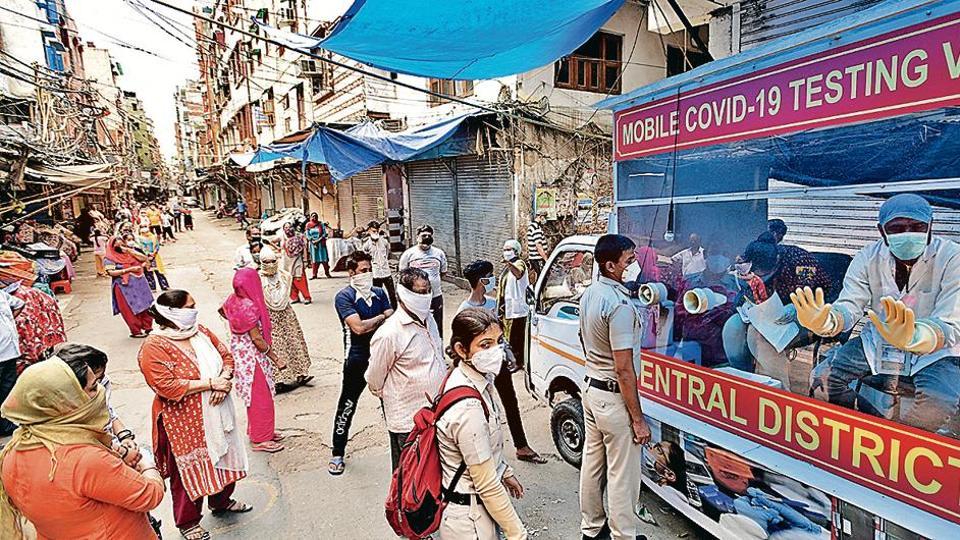
The central revenue district, which includes trade hubs such as Karol Bagh and Sadar Bazar, the Walled City, Civil Lines, and rural areas such as Burari, has seven containment zones.
Of the seven, five are located in Old Delhi —Sadar Bazar, Chandni Mahal, Nabi Karim, Nawab Ganj and Bara Hindu Rao, spread over less than two square km. The other two containment zones are in Sant Nagar Burari and Oberoi Apartment in Civil Lines.
Till Monday, 201 confirmed Covid-19 cases, including 25 deaths, had been reported in Central Delhi district. In addition to this, 108 people with links to Tablighi Jamaat tested positive in the district. A majority of them were found living in 13 different religious locations in Chandni Mahal and nearby areas.
“There were 235 people found living in different mosques in Old Delhi areas of which 108 tested positive. The 108 cases are counted separately, as these people didn’t live here,” said a senior district official.
At all these places, the movement of outsiders has been restricted through only a few entry/exit points that are protected round-the-clock by police officers. Most entries/gates have been blocked with tin sheets, handcarts, police barricades and logs.
Surveillance a challenge
A senior district administration official said the Chandni Mahal and Sadar Bazar areas are turning out to be a real challenge . “When Sadar Bazar was declared a containment zone (on April 8), we had seven cases. But today, there are 48 cases, including eight deaths,” said Nidhi Srivastava, district magistrate, Central Delhi.
Surveillance in these areas is a tough task, as the lanes are narrow and people are often found on the rooftops.“It is important that people stay indoors. We are using drones for surveillance in the area and to ensure that people don’t step out, not even on the rooftops. It is a big deterrent,” said Srivastava.
Eight police personnel posted at Chandni Mahal police station and one ASHA (Accredited Social Health Activist) worker are among those who were found Sars-cov-2 positive in the area, posing a challenge for these frontline workers to keep themselves safe while containing the spread of the virus.
Cases and containment
At Chandni Mahal, police have blocked 46 of the 48 entry points to the area with barricades and tin sheets. The local police station has also been sealed after two constables tested positive. After that six more personnel have tested positive. Near Chandni Mahal, another locality, Nabi Karim, has also been declared a containment area. Both are densely-populated places. In Nabi Karim, only two of the total 30 entry points are open. CCTV cameras have been installed at the entry and exit points to keep an eye on the movement of the people.
Deputy commissioner of police Sanjay Bhatia said, “We have barricaded the area in such a way that people can use only two lanes to enter or exit. At those points, our officers deployed in PPE suits are allowing only essential service providers and those working under essential services to enter or exit. While enforcing the lockdown, we are also ensuring that people do not face problems.”
A district official added that a majority of the new cases being reported from the five containment zones in the central district are isolated ones. While contact tracing is going on, the biggest challenge before the district administration right now is to keep people indoors.
People try to step out of their homes on the pretext of withdrawing money from the ATMs or to buy ration, Srivastava said. “To stop this, we have deployed ATM vans in the containment zones and provided civil defence volunteers in each zone to provide ration at people’s doorsteps or till the main entrance of the lane,” said Srivastava.
“When we realised that the cases in Chandni Mahal were above the threshold level, the whole area was declared as a containment area. The police station was sealed. Half the police personnel from the station have gone into self-quarantine. The other half have shifted to Jama Masjid police station and are working another a new station in charge because the Chandni Mahal station in charge is also in quarantine. Yes, there are challenges. But we have a plan B and are up for the challenge,” said Bhatia.
Bhatia said that samples of 76 police personnel, including the station house officer (SHO), of the Chandni Mahal police station were sent for Covid-19 testing after two constables of the police station were tested positive for the virus. “Of the 76, five have been found infected with the disease. The test results of SHO and 70 other police personnel of the police station are negative. In total, eight personnel have been found infected with the virus,” said Bhatia.
At Chandni Mahal and Nabi Karim, police are using five drones to keep an eye on the movement and ensure social distancing.
“The challenge was to keep an eye on the residents inside the congested lanes. We have limited staff but we are using drones to keep an eye on the people, make announcements by harnessing speakers to them, and disperse people by sounding police siren,” Bhatia said.
The district administration has stepped up door-to-door screening within the containment zones to identify people with flu-like symptoms. According to a senior district official, close to 250 samples have been collected from the area till last week.
“We have deployed a mobile testing van in the containment zone. On the first day, we collected 31 samples. One of the reasons why we are getting more cases is that we are testing more. We have also stepped up a door-to-door survey in these areas,” said Srivastava.
What residents say
In areas such as Chandni Mahal, Sadar Bazar, Nabi Karim there are a lot of migrants and people belonging to the lower-income group.
Rakesh Yadav, a resident of Sadar Bazar, told HT on the phone that the district administration had allowed a few grocery shops to open for a fixed duration in the morning and evening. “There is no problem as such in Sadar Bazar area, as we have adequate supplies. But in the neighbouring areas where there is a big migrant population, there are some issues related to the food supply. Earlier, we were supplying ration or distributing cooked food to them. But now we can’t,” said Yadav.
Kamaal, a resident of Nabi Karim, said, “Supply of food items is the main problem. Being a containment zone, people are not allowed to step outside. There are a lot of poor people who are now dependent on the government’s food shelters for daily meals. The houses are small and families are big so social distancing and remaining indoors throughout the day is difficult,” said Kamaal.
The district administration said that they had deployed civil defence volunteers who are helping people by providing essentials which have to be procured from outside. “We try to provide all possible essential items within the zone,” said a senior official.
The North Delhi Municipal Corporation has been spraying disinfectants in the areas. “We have deployed 12 trucks to spray water on big roads. There are six other trucks used for power spraying in narrow lanes and 20 people who are spraying disinfectants door-to-door using handheld machines. We have deployed 10 teams to create awareness about the disease and to advise people to stay indoors,” said Jai Prakash, standing committee chairman, North corporation.

Stay updated with all top Cities including, Bengaluru, Delhi, Mumbai and more across India. Stay informed on the latest happenings in World News along with Delhi Election 2025 and Delhi Election Result 2025 Live, New Delhi Election Result Live, Kalkaji Election Result Live at Hindustan Times.


