
 E-Paper



Delhi’s air quality dips further, touches ‘severe’ zone
Central Pollution Control Board (CPCB) data shows that Delhi’s overall Air Quality Index (AQI) on Tuesday was 418 as of 4pm, down sharply from 332 (very poor) on Monday.

 Prefer HTon Google


Delhi’s air quality took a turn for the worse on Tuesday, dropping into the ‘severe’ category, with the Met department predicting that pollution levels will stay high in the coming days due to slow winds and low morning temperatures.
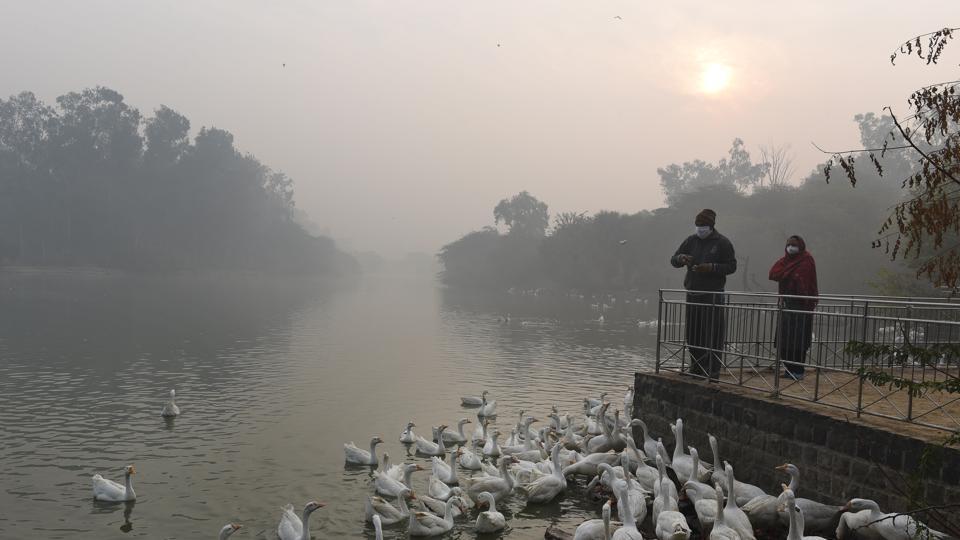
Central Pollution Control Board (CPCB) data shows that Delhi’s overall Air Quality Index (AQI) on Tuesday was 418 as of 4pm, down sharply from 332 (very poor) on Monday.
Before this, Delhi’s air had touched the severe zone on December 5, when the overall AQI was 404.
Pollution levels showed a steady Tuesday morning onwards, when the average hourly AQI deteriorated from 352 at 7am to 377 at noon, before it crossed the 400 mark later in the day.
At 7pm, the average AQI touched 426, with many monitoring stations clocking pollution levels above 450.
VK Soni, head of IMD’s environment monitoring and research division, said winds had calmed down completely for a few hours on Tuesday morning. Apart from this, he said, the air got worse due to a weather phenomenon called ‘inversion’, because of which pollution-carrying air dropped closer to the surface.
“Around noon, we observed that because of inversion, the pollution that was floating higher up in the air suddenly dropped and settled closer to the ground. This was the primary reason behind this severe drop in the air quality,” Soni said.
IMD scientists also attributed the spike in pollution levels to low wind speeds and the increase in moisture levels in the air, after a western disturbance passed by on Sunday.
Kuldeep Srivastava, head of IMD’s regional weather forecasting centre, said the average wind speed on Tuesday was 6kmph — not strong enough to disperse pollutants.
“The wind speeds have been low and there is an increase in moisture in the air, which is also holding the pollution particles down closer to the ground,” Srivastava said.
He also warned that the forecast does not show any significant improvement in the wind speed till December 26, which means that pollution levels are also expected to be on a rise. The temperature is also forecast to fall and reach around 4 degree Celsius in the next two days, IMD said.
On Tuesday, the minimum temperature at the Safdarjung observatory, considered the official recording for the city, was 5.3 degree Celsius, three below normal. The maximum temperature was 23.9°C.
Meanwhile, the Commission for Air Quality Management (CAQM) on Tuesday observed that the industrial sector is one of the major contributors to air pollution in Delhi and the National Capital Region, as it directed all industries in the Capital to switch over to Piped Natural Gas (PNG).
The commission reviewed the progress of switching over of industries operating in Delhi to PNG during a meeting attended by representatives of the state government, Gail, and Indraprastha Gas Limited (IGL).
The commission, headed by former Delhi chief secretary MM Kutty, directed IGL to ensure PNG supply to all identified industries in Delhi by January 31, 2021.


