
 E-Paper



Bus services take back seat in Karnataka as focus on airports, metro rises
According to “Sustainable Public Transport for Karnataka” report prepared by MR Sreenivasa Murthy, retired IAS officer, to the state government last week, the combined losses of all major transport corporations is ₹4,600 crore.


The focus on building airports, increasing dependence on private vehicles and poor connectivity (in some cases) is leading to the declining in use of public buses, even in cities like Bengaluru, where this mode of transport accounts for nearly 50% of all commuters.
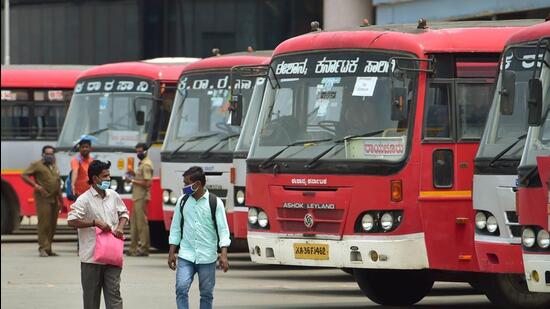
According to “Sustainable Public Transport for Karnataka” report prepared by MR Sreenivasa Murthy, retired IAS officer, to the state government last week, the combined losses of all major transport corporations is ₹4,600 crore.
A large reason for this is the stagnation of fleet strength which has remained around 24,000 for several years while private vehicles purchases have, on average, gone up by 10-14% per year, flooding inadequately designed streets and choking vehicular movement in cities like Bengaluru, which was adjudged to have the worst traffic globally in 2018.
“There is a political unwillingness to invest in buses. All governments, irrespective of party, take the bus and its commuters for granted. They invest thousands of crores in Metro and its infrastructure which looks shiny but not on the bus infrastructure which actually carries more passengers,” Vinay Srinivasa, an advocate and a member of Bengaluru Bus Prayanikara Vedike (Bengaluru Bus Commuters Forum), told HT.
There are just 6,769 buses in Bengaluru for a population that exceeds 13 million currently. But the growth of private vehicles has witnessed an exponential increase in recent years.
According to government data, the number of vehicles in Bengaluru has increased from 50.33 lakh in 2011-12 to 1.04 crore till March 2022. Of the total vehicles registered in the city, more than 69.31 lakh are two-wheelers and 21.97 lakh are cars.
According to the city traffic police department, of the total vehicle density, two-wheelers account for 70% of all vehicles, 15% are cars, 4% are auto rickshaws and the remaining are buses, vans and tempos.
The higher number of time spent on roads results in loss of productivity hours.
“These high levels of congestion have huge cost in the form of reduced productivity, fuel waste, and accidents. As an example, recent estimates from the Bengaluru Development Authority, released as part of Master Plan 2031, suggests that 1.18 crore citizens’ waste 60 crore person-hours annually and almost 2.8 lakh litres of fuel are wasted per hour in the Bengaluru city because of congestion,” according to a 2018 report by NITI Aayog titled “Transforming India’s Mobility”.
Further, the report added that the combined cost of losses for Delhi, Mumbai, Kolkata and Benglauru is over $22 billion annually.
Delays in construction of the metro add about 5% annually to total costs.
In the 14 years since Metro first began construction, it has managed to operationalise just over 50 km. The Metro’s highest daily ridership is just over 5 lakhs (on June 6).
The Regional Transport Corporations (RTC) that operate inter-district and other longer routes outside of Bengaluru, have not fared very well either, data from the report shows.
The outstanding liabilities of RTCs stands at ₹4,426 crore as on March this year.
“Regional Transport Corporations carry 27% of all work-related trips. 20 lakh students (16% of all students) depend on bus passes (45% pass users are girl students),” according to the expert committee report.
There are 2,600 villages in Karnataka without access to RTC bus services, the report added.
“The report is currently placed before the government and will come in the state cabinet for discussion,” said V Anbukumar, the managing director of the Karnataka State Transport Corporation (KSRTC).
He said any measures to be taken will be done after it comes up before the government.
The expert committee has recommended going in for “driver only” buses, moving towards electric vehicle options, reducing the cost of ticket distribution among other measures to bring down costs.
“The report makes it crystal clear that unlike other states, Karnataka Government is not investing in RTCs. As many of us have been demanding for years, this is bad policy and hurting public interest. This needs urgent fixing and state government must at the very least double the subsidies so there is no pressure of loss on the RTCs and they can focus on quality of service,” Srinivas Alavilli from Janaagraha told HT.
He added that the report has not also looked into positive environmental impact of buses. “Not just in Bengaluru but in all major cities. The report confines itself to bus corporations but in the case of Bengaluru a multi modal integrated transport system is needed and a central planning authority, the BMLTA is long pending,” he added.
Stay updated Bengaluru Weather Live and with all the Breaking News and Latest News from Bengaluru. Click here for comprehensive coverage of top cities including Delhi, Mumbai, Hyderabad, and more across India . Stay informed on the latest happenings in World News.


