
 E-Paper



Lockdown, rain revive groundwater level
Copious rainfall in Bengaluru last year coupled with the lockdown-induced decline in demand by commercial establishments helped reverse a downward trend of dipping water levels.


Covid-19 brought with it endless suffering to people world over but for Bengaluru, it also brought in some relief in the form of increased groundwater levels, according to government data.
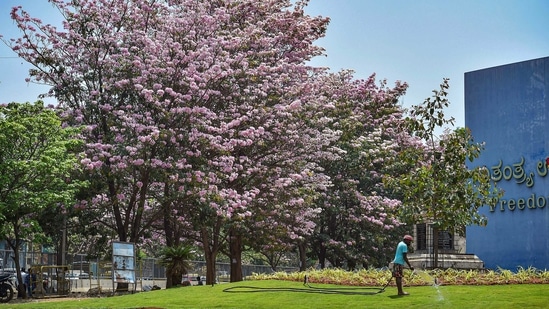
Copious rainfall in Bengaluru last year coupled with the lockdown-induced decline in demand by commercial establishments helped reverse a downward trend of dipping water levels.
The four talukas of Bengaluru—North, South, East and Anekal—have seen a marginal average rise in static water levels ranging from 0.30 metre to as high as 8.75 metres between 2016 and 2020, government data shows.
“Good rains last year have helped reverse the trend of declining water levels. But there is over exploitation in all four talukas of Bengaluru,” said a Karnataka government official aware of the developments.
Bengaluru received 1,082 mm of rainfall in 2020, 28% more than its normal, according to the Karnataka State Natural Disaster Monitoring Centre.
But the rise in water levels cannot be mistaken for a reversal of the downward trend in the long term as excessive commercial activities, high-rise residential buildings and lack of reusing water have weighed in on India’s IT capital, experts and officials said.
The crisis in Bengaluru comes on account of over exploitation of groundwater and the lack of resources to reuse water or feed it back into the earth to help recharge water levels below the surface, experts and scientists said.
The United Nations World Water Development Report 2021, themed “Valuing Water” and released on Monday, stated that there will be a global water deficit of 40% by 2030.
“Humans certainly use water as if it was limitless: an estimated 80% of all industrial and municipal wastewater, for example, is released into the environment without prior treatment,” the UN report stated.
The report added that over 2 billion people worldwide already live-in areas subject to water stress and around 45% of the global population (3.5 billion) lack access to safely managed sanitation facilities.
Several urban centres in India face a similar crisis, but few witness problems that Bengaluru endures on account of its water shortages. The city, despite all the money it spends on lake rejuvenation and other exercises, remains firmly in the grip of water tankers that deliver the precious resource as a business model to apartments and other households in Bengaluru.
“The water mafia has sucked water dry and there is no groundwater because there is no recharge. People are paying a heavy price and the water scarcity in the region is really worrying,” said T.V Ramachandra from Centre for Ecological Sciences at the Indian Institute of Science.
He added that over concretisation has led to the crisis, which the decision makers are yet to acknowledge.
Having lost the river Vrishabhavathi to over exploitation and several lakes to encroachments, sewage inlets and bad maintenance, Bengaluru is heavily dependent on the inflow of Cauvery water from about a 100 km away to quench its thirst, experts said.
Being Karnataka’s biggest revenue generator, successive governments have followed a predictable path of diverting Cauvery water into the city even if it deprives surrounding districts of their requirements.
With no river water in close proximity, people in hundreds of villages in erstwhile Bengaluru built lakes and tanks as a resource for irrigation and drinking. Out of the remaining 210 lakes, around 19 are encroached and most others are in a pitiable state that neither quench the city’s thirst nor improve the groundwater table due to over three to four decades of accumulated silt, experts said.
Bengaluru also receives copious rainfall but barely a fraction of it is harvested, leaving most of this water to flood streets and then flow into drains and eventually find its way into lakes, experts said.
Several other parts of Karnataka face a similar problem with water, according to the groundwater directorate in Bengaluru.
“There are about 14 districts, 41 talukas and 1,199 villages in Karnataka that are over exploited,” M Raveendrappa, the project director of the groundwater directorate, said. The directorate on Monday launched a campaign in 1,199 water-stressed villages of the state as part of a nation-wide campaign.
Even where groundwater level is available, almost at nearly 2,000 ft, it is of poor quality like in Peenya industrial area, a locality where several micro and small industries operate.
Priyanka Jamwal of Ashoka Trust for Research in Ecology and the Environment (ATREE) said that in Peenya, the borewell water has heavy metals, trace metals and other toxic contaminants largely since most of the used water is let out without being treated.
“If you go to parts of the city where there is Cauvery water supply, groundwater is not that contaminated because there is proper recharge happening,” she said. But in the outskirts of the city, which largely depend on borewells, there are high levels of nitrate and fecal coliforms because of the soak-away pits present there with no lining and contaminating the groundwater, Jamwal added.
“Where there is no sewerage system or pipe water supply, there is groundwater contamination,” Jamwal said.
Stay updated Bengaluru Weather Live and with all the Breaking News and Latest News from Bengaluru. Click here for comprehensive coverage of top cities including Delhi, Mumbai, Hyderabad, and more across India . Stay informed on the latest happenings in World News.


