E-Paper



Parents accuse Bhopal hospital of ‘hiding truth’
On Wednesday, the hospital administration said that a total of eight newborns, who were “saved” in the fire in the SNCU on Monday night, died due to other medical complications.

 Prefer HTon Google


Ankush Yadav’s twin daughters were born on October 8, within seven months of his wife Ranjana‘s pregnancy. The couple knew they would face hardships and the children battled to tide over health problems that are often associated with premature births.
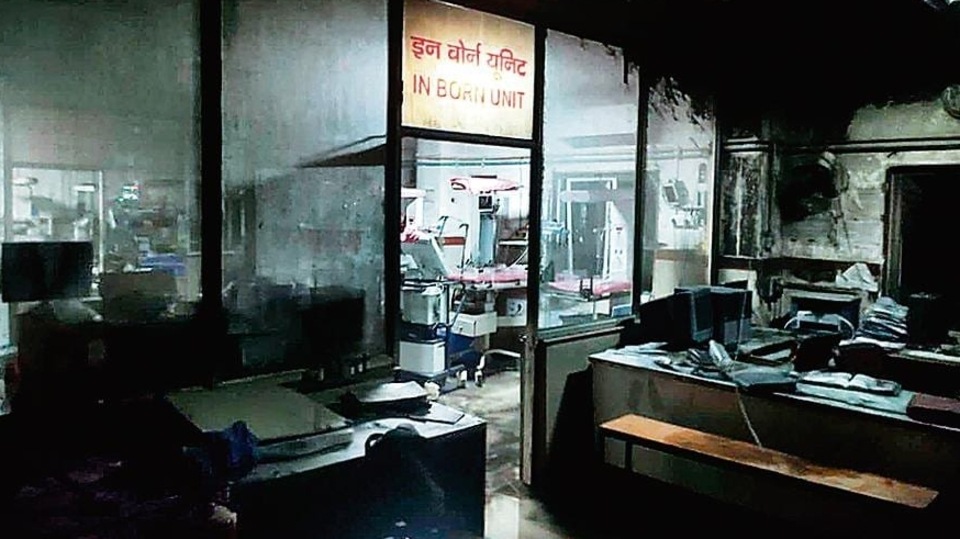
On Monday, the girls died within 16 hours of being admitted to the childcare ward at Kamla Nehru Hospital -- where a fire on Monday claimed the lives of at least four newborns. One of Yadav’s daughters is among those in the fire deaths count -- the other, hospital authorities say, died due to “medical conditions” (like seven other children in the ward since the fire broke out at 8.30 pm on Monday).
Yadav, however, alleged that both the girls were killed in the blaze. “If what the hospital people are saying is true, I should have been allowed to see my other child. I was given the bodies of my twins in boxes,” said the vegetable seller in Bhopal.
Ankush said that he was at the nearby pharmacy, purchasing an injection, when the fire broke out. He was allowed to enter the hospital at around 2 am, and later informed that her one child died because of fire, and the condition of the other was serious. On Tuesday morning, one of the bodies was handed to him in a box; and that night, the other’s.
“I have not shared the news with my wife as she would not be able to bear the pain of the loss,” he said.
On Wednesday, the hospital administration said that a total of eight newborns, who were “saved” in the fire in the SNCU on Monday night, died due to other medical complications.
These eight deaths are more than twice the average deaths reported at SNCU ward over a 36-hour period -- about two a day due to various complications, according to hospital records.
Arvind Mishra, an activist working on health issues in Bhopal, said the neonatal deaths in MP is highest in India quoting a report of Sample Registration Survey (2018), which said the rate is neonatal deaths per lakh in Madhya Pradesh was 35.
According to a national health mission, out of total admission, 11.5% newborns die at SNCU.
“It is hard to understand that out of 40, eight i.e., 20%, newborns died due to medical complications in Kamla Nehru Hospital after the fire. The hospital should clear the actual cause of deaths,” he said.
The fire at the broke out at the child intensive care unit reportedly due to a short-circuit in a ventilator machine. At the time of fire, there were 40 children in the ward that can house 60 newborns.
The eight floor building of Kamla Nehru Hospital is a part of Hamidia Hospital, the biggest government hospital in Bhopal, and didn’t had a fire clearance for the past 15 years. Officials admitted that no fire safety audit of the building was done in the last five years.
After the incident the Bhopal Municipal Corporation (BMC), under which the fire department comes, sought fire safety report from the hospital authorities. “We are going to review fire safety in all government hospitals,” said state health minister Vishwas Sarang.
Even after the tragedy, the tussle between parents and the hospital continues.
Seeta Vishwakarma, a resident of Bagsewaniya , in Bhopal, said the doctors told her that her two-day-old baby was absolutely fine after the fire. “But on Tuesday afternoon, they handed over her body to us.”
Rahul Prajapati, a resident of Bhopal’s New Jail Road, said he was finding it hard to trust the hospital’s version. “The doctor said on Tuesday that the condition of the baby is serious, and they asked me to arrange blood. But later, a nurse informed that I lost my baby. I don’t know whether the death of my child is natural or not, but I lost trust in the government hospital.”
Two parents refused to take the bodies, and demanded DNA tests to ascertain if the children were really theirs.
The hospital insists these deaths were not related to the fire.
“On Monday between 8pm to 12 midnight, we lost four babies [due to the fire]. But from Tuesday till 12 noon Wednesday, we lost eight more children due to other medical complications, and their death has nothing to do with fire,”said Dr Jyotsana Shrivasatava, head of the hospital’s paediatrics department.
Chief minister Shivraj Singh Chouhan on Wednesday held a meeting with health department officials, and dean of Gandhi Medical College, Dr Jitendra Shukla, hospital superintendent, Dr Lokendra Dave, and hospital director, Dr KK Dubey, were removed; and a deputy engineer of Capital Project Administration (CPA), Awadesh Bhadoria, was suspended. CPA runs the hospital.