
 E-Paper



At 351, Ludhiana records worse air quality this season
After remaining in ‘poor’ category for the past four days, Ludhiana’s air quality plunges to ‘very poor’ for 2nd time this year


After remaining in the “poor” category for the past four days, Ludhiana recorded its worst air quality of the season on Tuesday with an AQI of 351. It is for the second time this year that the city’s air quality has plunged into the “very poor” category (between 300-400) after November 3, when the AQI was recorded at 319.
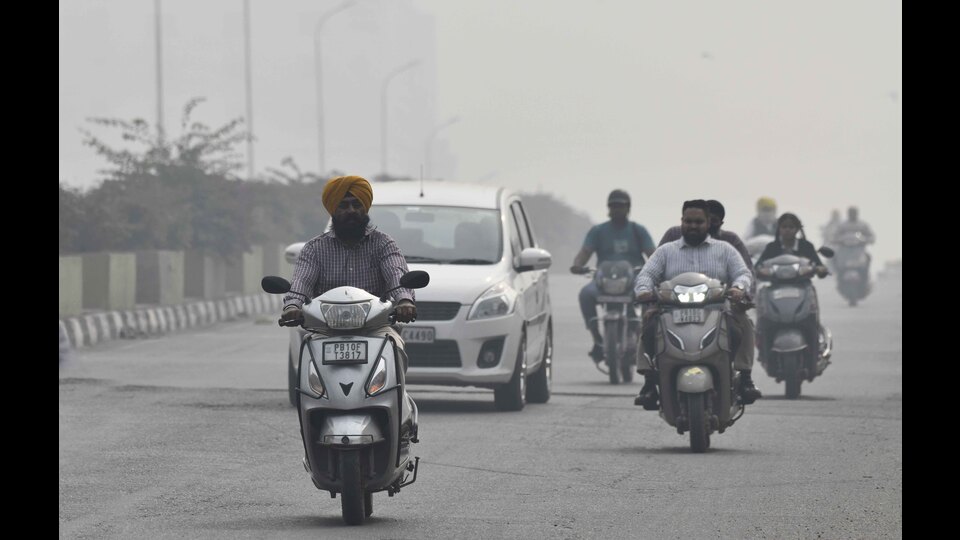
Experts said that the air quality in Ludhiana was almost as bad as Delhi on Monday. The AQI recorded at ITO in Delhi was 356, 391 at Ashok Vihar and 349 at Indira Gandhi International Airport.
According to the Central Pollution Control Board’s National Air Quality Index monitoring website, farm fires have directly impacted the air quality of the industrial town.
As many as 1,506 incidents of stubble burning have been reported from the district this season.
Pavneet Kaur Kingra, head of Punjab Agricultural University’s meteorology department,said, “Low wind velocity (less than 5 km/hour) and declining temperature is causing suspended particles to keep hanging in the air. Farm fires and overcast conditions have compounded the problem and led to the rise in pollution level.”
As per the weather forecast, light to moderate showers are expected soon, which will bring respite from rising pollution levels.
With deteriorating air quality leading to an increase in number of patients suffering from allergic conjunctivitis, doctors have advised residents toavoid venturing out of their homes. “Symptoms of allergic conjunctivitis include burning sensation and difficulty in opening the eyes, accompanied by sore throat and cough. it is more common in patients from rural areas and can be avoided by washing eyes frequently, drinking plenty of liquids and not going out in the peak smog hours,” said Dr Priyanka Arora, ophthalmologist at Dayanand Medical College and Hospital (DMCH).
Senior DMCH pulmonologist Dr Akashdeep Singh, said, “Such weather conditions are detrimental to health of people with respiratory disease and cause allergies among all age groups.” He advised people to avoid venturing out and if required, wear a mask.
Experts said the pollution levels would have been even higher if there wasn’t a public holiday on account of Guru Nanak Jayanti and commercial establishments and vehicles were running at full capacity.
Gurmeet Sondhi, a banker, who lives in Punjab Mata Nagar, said, “The city was engulfed in smog since morning. The situation improved in the afternoon, but it was back to square one in the evening. I could feel a burning sensation in my eyes and the city felt like a large gas chamber.”
While only five farm fires were reported from the district on Tuesday, experts at the remote sensing department said that a fall in the number of cases on could be due to the overcast condition.
“Because of the cloudy conditions, thermo-sensors could only detect large fires, while satellite images could not catch small fire events,” said a remote sensing department official.
Environmentalist Gagnish Khurana said the current air quality results may not be accurate, as the city’s observatory is installed deep inside the Punjab Agricultural University (PAU). To get a clear projection, it should be put up at a prime location, he said.
“The agri varsity is considered to the cleanest area in the city. The pollution level inLudhiana is at par with Delhi. If the observatory was installed in Bharat Nagar Chowk, Chaura Bazar or Industrial Area, the projection would have been much higher,” Khurana said.


