
 E-Paper



At 70K hectares, area under cotton shrinks amid repeated crop failure, crop diversification takes a hit
Punjab struggles to meet cotton cultivation targets, with only 70,000 hectares sown out of a planned 2 lakh. Farmers discouraged due to past crop failures.


Bathinda: Though the state government had set a target of 2 lakh hectares under cotton cultivation in eight districts of south Punjab till May 15, it has struggled to reach even the 1-lakh mark. The provisional data prepared by the state authorities indicates cotton has been sown on about 70,000 hectares till May 23. Officials are skeptical to see much improvement as May 15 was the last recommended day of sowing.
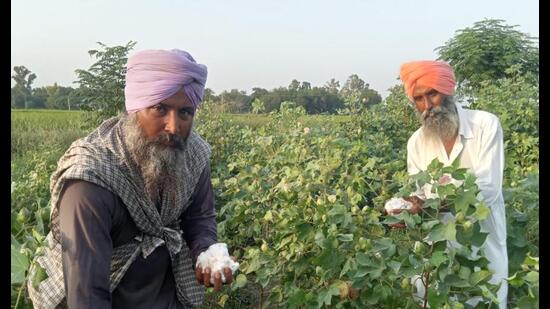
In 2016, the area under cotton was recorded 2.95 lakh hectares and it jumped to 3.35 lakh hectares in 2019. Officials said that in the last two decades, the cotton area in Punjab remained more than 2.50 lakh hectares but it decreased to 1.73 lakh hectares in 2023.
Experts say that due to subsequent crop failures amid pest attacks and inclement weather conditions in the last three years, farmers faced an economic setback. In the absence of an organised policy to boost the crop that was once considered an economic lifeline of the belt, farmers are discouraged, they say.
Officials admit that a drastic decline in cotton area would hit the crop-diversification programmes as this time a sizeable area of the semi-arid region will switch to the water-guzzling paddy cultivation.
In 2023, the state government had started a 33% subsidy on the Bt cotton seed to ensure that only approved varieties are used. According to information, the state authorities haven’t initiated the process to grant subsidy to incentivise farmers who suffered heavy losses. Officials attribute it to the imposition of model code of conduct for the parliamentary elections.
Punjab agriculture director Jaswant Singh remained unavailable for comments on Thursday. Deputy director (cotton) Dharampal Singh said that despite best efforts by the fields teams, the state achieved only 40% of the target this year. “Farmers have been reluctant to sow cotton due to three consecutive failed kharif seasons since 2021. The state is providing all support but farmers are keen to move towards paddy in the traditional cotton belt. This time, subsidy for cotton has not been announced officially and any decision in this regard is the domain of the state authorities,” he said.
Bathinda’s chief agriculture officer Karanjit Singh said the cotton area in the district in 2022 was 70,000 hectares that lowered to 23,000 hectares in 2023.
“This season, only 10,500 hectares have been covered and farmers are keen to sow rice varieties. Three seasons of pest attacks and low rates due to poor quality dashed the farmers’ hopes,” he added.
A progressive farmer from Bathinda’s Bajak village, Baldev Singh, whose family has been cultivating cotton for the last over 70 years, said that in the absence of ample support, the cotton growers are economically distressed.
Punjab Agricultural University’s (PAU) principal agricultural economist GS Romana said the government should rope in experts to chalk out a programme to ensure farmers do not move away from cotton. “A policy is needed so that farmers get assured rates and improved Bt varieties which are resistant to pest attacks. It is a traditional crop of the state and we have a strong canal network. An organised push will discourage farmers to move to grow paddy where the groundwater has gone down drastically,” he added.


