
 E-Paper



Chandigarh breathes easy post Diwali as AQI turns ‘normal’ from ‘very poor’ within hours
Experts say allowing green crackers seems to have worked, besides favourable weather conditions came as a boon; as per the data compiled by the Chandigarh Pollution Control Committee (CPCC), the average AQI on Diwali day this time was higher than the last two years, but it was better than the pre-Covid years


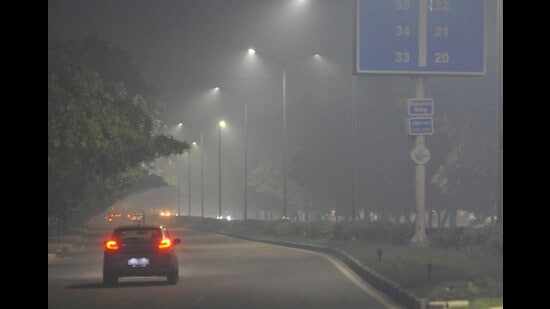
The UT administration’s move of allowing only green crackers and the favourable weather conditions on Diwali night ensured that city did not turn into a gas chamber after the festivities. The air quality index (AQI) skipped to “very poor” post the fireworks on Monday but bounced back to normal within a span of few hours, as per UT administration officials.
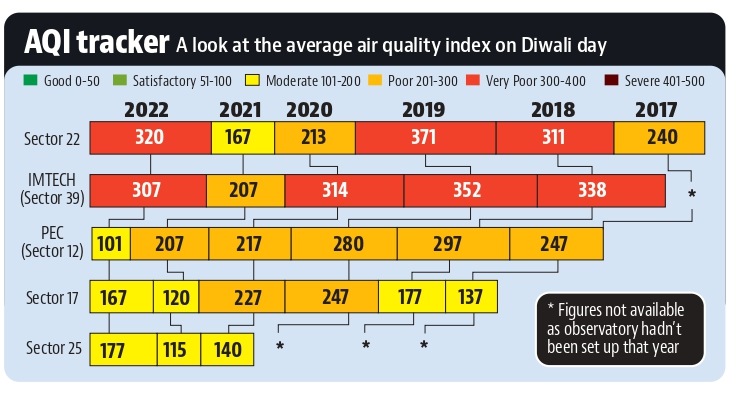
As per the data compiled by the Chandigarh Pollution Control Committee (CPCC), the average AQI on Diwali day this time was higher than the last two years, but it was better than the pre-Covid years (see box).
As per CPCC officials, the AQI levels in 2021 and 2020 were lower owing to the Covid restrictions in place and blanket ban on bursting of crackers imposed by the UT administration.
Sector-22 observatory recorded highest AQI, PEC lowest
With the concentrations of PM10 and PM2.5, both released by crackers, reaching 500 micro grams per metre cube of air the worst average AQI was recorded at the Sector 22 monitoring station. Here the AQI stayed at 320 (very poor) owing to its proximity to the densely populated residential area. For perspective, the AQI in Sector 22 stood at 113 on October 18 – a week before Diwali.
Of all the monitoring stations, the one at PEC had the lowest average AQI at 101. This was followed by Sector 17 with an AQI of 167 and Sector 25 with AQI 177. All these stations are surrounded by thinly populated areas.
At the observatory at IMTECH, Sector 39, the average AQI was 307 (very poor).
Impact of weather on AQI
UT director environment Debendra Dalai explained that this year’s Diwali pollution figures are comparable with 2019 as in the intervening years, there was a ban on bursting of crackers.
“In 2019, bursting of crackers was allowed. Also, Diwali was around the same time of the year, i,e on October 27. We see a downward trend in the average AQI now, as a result of use of green crackers and the efforts to check sale of illegal firecrackers. It was also fortunate that within a few hours, the AQI came down which is why the average AQI values are low at many of the stations.”
He added that AQI is also dependent on weather conditions.
India Meteorological Department (IMD)’s Chandigarh director Manmohan Singh said after monsoon withdrawal, an anti-cyclonic movement envelopes the city, creating an airlock, thus making it difficult to get rid of pollutants but this was not the case this year.
He said, “This time, we have North Westerly winds which were blowing in the city on Diwali. These winds are cold and dry in nature and don’t bring any rain, however, the moving air helps scatter the pollutants and clean the air faster.”
Temperature inversion is also a big factor when it comes to air quality and AQI tends to increase on its own when the temperature decreases. This Diwali was relatively early, thus it is relatively warmer, so the effects of temperature inversion haven’t been felt yet in the city.
Noise pollution also down
Green crackers are also touted for producing less noise which was seen this year with a slight drop in noise pollution levels. In 2022, the highest noise level was at the Sector 22 observatory which went up to 76.9dB. In comparison, in 2021, the highest noise level was in Sector 39 at 78.2 dB. In 2022 the highest value was 66.6 dB at the Sector 22 monitoring station and in 2019 it had gone up to 79.8 dB here.
At Panchkula, AQI levels remained moderate
In Panchkula, the average AQI stood at the Sector 6 observatory, set up of CPCB, recorded an average AQI of 104 (moderate). Around midnight, the air quality worsened as the PM2.5 particles went upto 467 micrograms per metre cube of air but it significantly improved within a couple of hours.


