E-Paper



Diwali ‘burst’ ignites air quality crisis in Chandigarh
Though the city’s AQI did not plunge into the severe category (401-500) as seen on Diwali last year, the levels remained dangerously high, with AQI reaching a staggering 395 at the Continuous Ambient Air Quality Monitoring Station in Sector 22.

 Prefer HTon Google


The unchecked bursting of crackers on Diwali night sent the city’s Air Quality Index (AQI) soaring into the “very poor” category, with no improvement even 24 hours later on Friday.
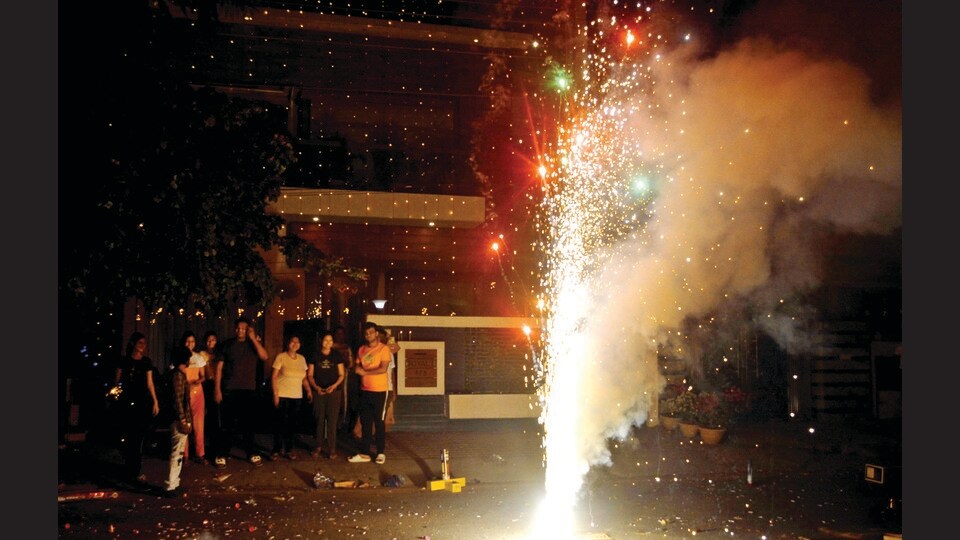
The administration’s efforts to maintain air quality — allowing only green crackers, imposing an 8 pm to 10 pm deadline on bursting and conducting awareness drives in schools — went up in smoke as the AQI reached a staggering 395 at the Continuous Ambient Air Quality Monitoring Station (CAAQMS) in Sector 22.
Until Diwali, the city’s AQI had not entered the very poor category (between 301-400) this season, despite stubble burning in neighbouring Punjab and Haryana, as well as increased vehicular movement and ensuing pollution amid the festive season.
Though the city’s AQI did not plunge into the severe category (401-500) as seen on Diwali last year, the levels remained dangerously high, with AQI at the Sector 53 CAAQMS closely following at 350. Both CAAQMS are run by the Central Pollution Control Board (CPCB).
Even at the manual observatories managed by the Chandigarh Pollution Control Committee (CPCC), alarming readings were reported: 306 at IMTECH in Sector 39, 287 in Sector 17, and 240 at Punjab Engineering College in Sector 12.
Even on Friday, AQI remained poor throughout the day and increased in the evening as temperature fell and crackers continued to be burst. At 6 pm, the AQI was 311 at the Sector 53 CAAQMS and 302 at the Sector 25 CAAQMS, still in the very poor category.
The prominent pollutant was PM2.5. As per CPCB research, short-term exposure to PM2.5 can damage lung function and exacerbate asthma and heart diseases, while long-term exposure is associated with an increased rate of chronic bronchitis, reduced lung function, and increased mortality from lung cancer and heart disease.
An AQI of 301-400 poses serious health risks, causing respiratory illnesses with prolonged exposure. Even lower levels, between 201-300, can lead to breathing discomfort for many. During Diwali last year, which fell on November 12, the city had recorded its worst air quality in five years, with the AQI hitting severe levels (453) at Sector 53, a first since 2019 (see box).
TC Nautiyal, member secretary of the CPCC, expressed concerns despite the lower AQI readings this year. “Lower temperatures can lead to higher AQI due to temperature inversion, which traps pollutants and prevents their dispersion. This year, Diwali occurred earlier in the year, resulting in relatively higher temperatures that kept the air quality from reaching severe levels, even though the use of crackers did not decline.”
Noisiest Diwali in five years
The noise levels recorded this Diwali were highest since 2020, as per records readily available with CPCC. Sector 22, which had the highest air pollution, also recorded the loudest noise levels, with explosions up to 79.4 decibels (dB) being recorded here between 9 pm and 10 pm, close to the sound of a busy road with heavy traffic.
Even last year, this area had logged the loudest explosions at 79.2 dB. On an average day, readings of 57.4 dB are recorded at the same station in the same time period. Standard value for night time is 45 dB.
PEC followed closely with a maximum reading of 74.2 dB, while at IMTECH Sector 39, a maximum reading of 66.1 dB was recorded. Sector 17 saw a maximum reading of 67.2 dB, followed by 65.6 dB in Sector 25.
At Sector 53, the maximum reading was 62.7 dB, significantly lower than 69.9 dB last year.