
 E-Paper



HC orders fact-finding survey on ‘apartmentalisation’ in Chandigarh’s northern sectors
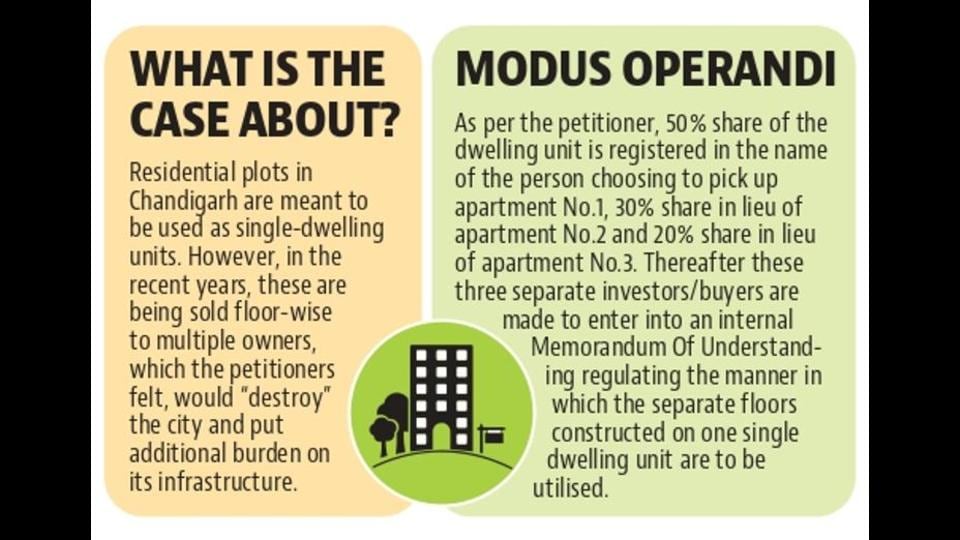
Only those residential properties, which were sold or transferred to a person outside the original owner’s family since December 2019, on sharehold basis of 50 %, 30 % or 20 % are to be checked

 Prefer HTon Google


The Punjab and Haryana high court (HC) on Tuesday directed the Chandigarh administration to carry out a survey, within two weeks, to identify residential properties which have been sold to a person outside the family of the original owner since December 2019, in a particular manner indicating that the purpose of the sale was construction of apartments.
The court also asked for a physical inspection of such buildings to find out whether the sale has actually led to the buyers occupying independent floors in an otherwise composite dwelling unit. The entire exercise is to be carried out under the supervision of the UT chief architect, and with assistance from police and other enforcement agencies.
“We are constrained to observe that the UT administration has chosen to skirt a vital issue that has been raised in the instant petition,” the HC bench of justice Tejinder Singh Dhindsa and justice Vivek Puri observed while seeking a report by August 11.
Only those residential properties are to be checked which were transferred or sold to a person outside the family of the original owner, after December 31, 2019, and where the pattern of share(s) is 50 %, 30 % or 20 %.
“We would also like to observe that it is only a fact-finding exercise, which we feel would be imperative for us to take a final view in the matter. The present order in no way expresses our opinion on merits,” the bench further observed.
The court was hearing a batch of petitions pending since 2016 seeking prohibitory orders on conversion of residential plots into apartments. Residential plots in Chandigarh are meant to be used as single-dwelling units. However, in the recent years, these are being sold floor-wise to multiple owners.
There is a huge divide among residents on the issue. A section says by allowing apartments, those who wish to get property in northern sectors would get a chance to own them. On the other hand, many owners in northern sectors have been opposing the move insisting that it could change the city’s character.
In the year 2001, Chandigarh administration notified Chandigarh Apartment Rules, 2001, whereby even single residential units, wherever they existed, could be subdivided into apartments but were repealed in October 2007. Chandigarh administration has maintained that no permission is being granted to convert residential houses into apartments.
The bench itself scanned newspapers to ascertain veracity of the claims and found that on a single day in an English daily, 24 advertisements scouting for purchasers/investors for separate floors/independent floors, were found.
“ ..(It) lend (s) credence to the assertion raised on behalf of the petitioners that under the garb of sale of certain percentage share of a residential unit, independent floors are being sold,” the court observed adding that UT had been silent on such aspect.
“In our view, the Chandigarh administration ought to have been alive to such situation and particularly when there were specific averments made in the present petition which was filed way back in the year 2016. Being in a state of denial on paper would not suffice. In the fitness of things, the administration should have carried out some kind of physical verification to ascertain as to whether such modus operandi had been resorted to after repeal of the Apartment Rules, 2001,” the bench said.


