
 E-Paper



Himachal: Rain deepens water crisis, turbidity leaves Shimla high and dry
Authorities resort to water rationing in Shimla, which amounts to 70L/head, while tankers struggle to meet demand; due to high turbidity in the Giri river, it has become difficult to lift water for consumption


gaurav.bisht@hindudstantimes.com
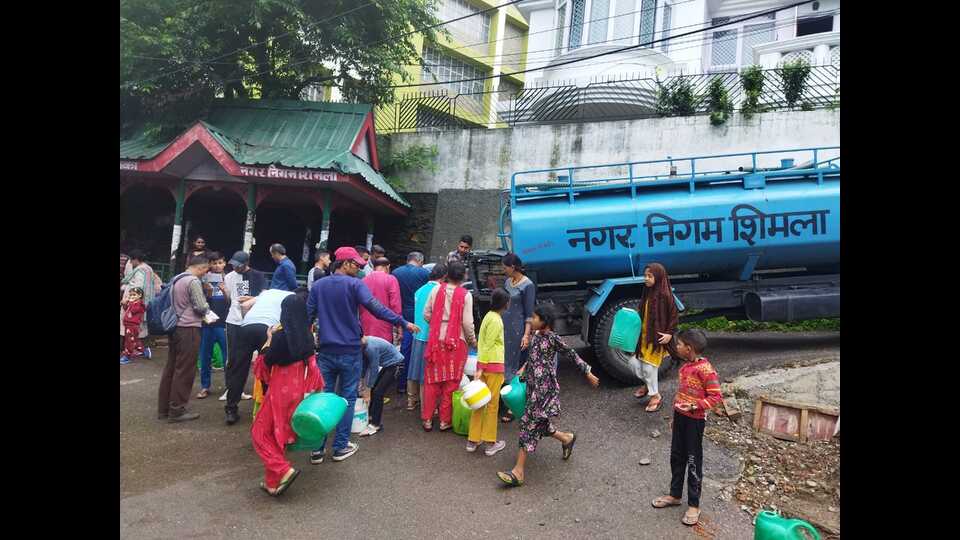
Water, water everywhere and not a drop to drink. This irony rings true for Shimla, the capital of rain-battered Himachal Pradesh, that has been without water supply for five days due to turbidity at the perennial source.
Shimla Jal Prabandhan Nigam managing director Pankaj Lalit said on Tuesday, “Due to high turbidity in the perennial source, it has become difficult to lift water for supply.”
Shimla’s daily water supply, which is between 36 and 42 MLD, dipped to 6.5 MLD on Tuesday. After the recent rains, the water turbidity (presence of suspended particles) at the Giri river was 7,720 NTU (Nephelometric Turbidity Unit) when the acceptable range is from 0.5-1.0 NTU.
Shimla town received only 2.23MLD of water from another perennial source, Gumma, while there was no supply from the Giri river. Churat Nullah could draw only 2.3 MLD of water and Seog 1.45 MLD. The Nigam could not draw any water from Charh that supplies only 0.77 MLD.
As a result, the Nigam has deployed tankers to meet the water supply. “So far, one dozen tankers have been engaged for the town, but we will be hiring more private ones,” said Lalit.
“We are inspecting water sources and will be tapping rainwater nullahs till the turbidity in the river doesn’t settle,” says chief parliamentary secretary, urban development, Ashish Butail.
Collecting rainwater to buying bottles
The local administration started water rationing as an immediate step. The Nigam resorts to rationing, which amounts to 70 litres per head in a day, when the supply drops below 30MLD. Water is routinely supplied on alternate days in Shimla.
The town faced its last such crisis in June 2018 when it went without water for 10 days.
Meanwhile, residents are left to their own devices to meet their water requirement. People are braving long queues at limited distribution points or resorting to desperate measures, such as collecting rainwater and buying bottled water to meet their basic needs.
“We have not got water in Sanjauli for the past four days and are depending on tankers. It will take a few days to resume normal supply given the scale of damage the rain has caused,” said local resident Sandhya Chauhan.
Hotels struggle to meet demand
Tourism has taken a hit too as hotels and restaurants in town are struggling to get water tankers to cater to the needs of their guests. “We are expecting the tourist footfall to go up again around the weekend by when normal supply should resume. At present, we are relying on tankers,” says Mohinder Seth, the president of Himachal Pradesh Tourism Stakeholders Association.


