
 E-Paper





Mir Ehsan has reported from Kashmir for the past more than 20 years. He is an assistant editor and bureau chief of HT in Kashmir since 2018. Before that he was associated with Indian Express. He has extensively covered Kashmir politics, militancy and developmental issues. He is also a recipient of Ramnath Goenka Excellence in Journalism Award in 2005.
Kashmir’s golden crop: As saffron harvest ends, J&K government seeks expert input for revival policy
J&K’s agriculture minister, Javeed Ahmad Dar, who recently visited saffron fields in Pulwama and interacted with the growers, said that the government is in the process of formulating a comprehensive policy for saffron
Published on: Nov 22, 2026, 07:46:00 IST


Share via
Copy link
These days, early in the morning across the meadows of Pampore in Pulwama, groups of men, women, and children collect the last batch of delicate saffron flowers as the season’s harvest comes to an end.
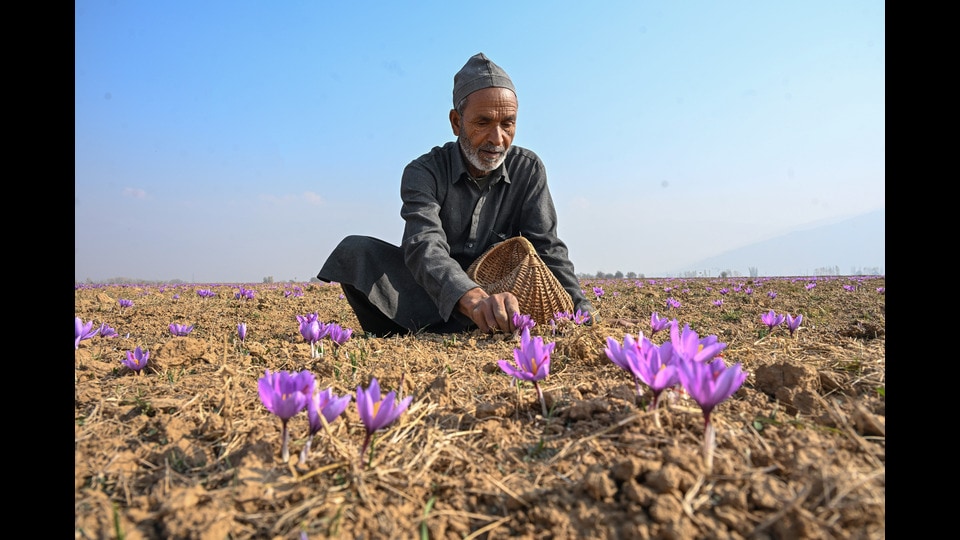
The harvesting of saffron, Kashmir’s golden crop, began on a positive note this year. After last year’s decline, growers expected a better yield due to timely rainfall. Villagers are now busy drying the saffron, hoping they will receive a good price for their produce.
After the failure of the much-talked-about Saffron Mission, the Jammu and Kashmir government is now formulating a plan to revive it by seeking advice from experts, scientists, and locals who are traditional growers.
J&K’s agriculture minister, Javeed Ahmad Dar, who recently visited saffron fields in Pulwama and interacted with the growers, said that the government is in the process of formulating a comprehensive policy for saffron.
“Mission Saffron had some issues. Now we are trying to find out how we can make it better. Suggestions are being sought from experts and growers to make it more progressive. We are in the process of formulating a comprehensive programme, which will be made public very soon,” he said. After taking feedback from the growers, he said the main issue is irrigation. “We are trying to provide them with a mechanism through which they will be able to irrigate their saffron fields on time, whenever required.”
Around 4,000 hectares under saffron cultivation in Pulwama
Around 4,000 hectares are under saffron cultivation in Pulwama, and for thousands of growers, this short season of barely 15 to 28 days decides the economy of the whole year. Saffron from Pampore, famous across the world for its colour, aroma and quality, sells for lakhs per kg, and yet, the production has been falling year after year.
“Our Saffron is known across world. Unfortunately, we will lose if government doesn’t take concrete steps. There are many reasons why the Saffron is under threat and government should do something before it is lost forever,” said Abdul Majeed, a grower from Pampore.
Director agriculture Kashmir, Sartaj Ahmad Shah, said saffron is part of our culture and has been here for generations. “It’s our craze. We are hopeful that this season, due to timely rainfall, we have a good saffron yield.”
The Centre had launched the National Saffron Mission over a decade ago with crores of rupees, but growers say many of its promises remained on paper. Borewells dried up, sprinklers stopped working, and production never reached the target. “This scheme was a flop and didn’t help growers at all. I don’t think saffron growers got any benefit from this much-hyped scheme,” former MP and Pampore legislator Husnain Masoodi said, adding that saffron has lost its sheen. “Last year, just 5 to 10% of saffron was produced in Kashmir. This needs to be investigated — why has our production declined?”
However, officials in the J&K government are now saying that the new policy will correct those shortcomings, bring more land under saffron, and help farmers get a better price, so that the golden crop can once again become the pride of Kashmir.
Centre’s National Saffron Mission has been a game changer: Report
The latest Economic Survey report, tabled in the J&K assembly, however, presented an encouraging picture of Kashmir’s red spice. The survey report acknowledged that the National Saffron Mission, through which around ₹267 crore has been spent, has been a game changer, as 2,598.7 hectares have been rejuvenated across the districts of Pulwama, Budgam, Srinagar and Kishtwar.
The National Saffron Mission — a centrally-funded ₹410-crore project — was launched in 2010 to rejuvenate saffron cultivation in Kashmir. The Economic Survey report said that by rejuvenating 2,548.75 hectares of saffron land and halting the decline in area under this crop, which remains at 3,715 hectares (3,665 ha in Kashmir division and 50 ha in Kishtwar) since 2010-11, more areas have been identified for expansion.
“The productivity has increased from 2.50 kg/ha in 2009-10 to a maximum recorded productivity of 4.42 kg/ha in rejuvenated areas during 2023,” the report said.
The report said that on the marketing front, efforts are underway to eliminate intermediaries from the saffron value chain to ensure better price realisation for farmers in domestic and international markets.
“The establishment of the India International Kashmir Saffron Trading Centre (IIKSTC) at Dussu, Pampore, with an estimated project cost of ₹38.11 crore, and the grant of Geographical Indication (GI) certification to Kashmiri saffron, has significantly strengthened its global market presence, increased demand, and enhanced income prospects for saffron growers.”
The establishment of the Saffron Park/IIKSTC has helped farmers realise enhanced prices, increasing from ₹80,000 per kg to ₹2,20,000 per kg during 2021-22.
“Implementation of various scientific post-harvest processing methods increased saffron stigma recovery from 22g/kg to 28g/kg (an increase of 6g/kg) during 2021-22,” Dar informed the House, and said that through the mission, new technologies were implemented via the IIKSTC, leading to an increase in saffron colour quality from 8% (traditional drying) to 16% (scientific drying).
Officials say that GI tagging of Kashmiri saffron and online marketing facilities at the spice park have made it easy for buyers and sellers to trade. The ₹40-crore park has been set up as part of the National Saffron Mission. The Spice Park can store two metric tonnes of flowers for 48 hours. After the flower’s stigma, which forms the saffron, is separated, the farmers’ produce is coded, dried scientifically and tested in the laboratory on eight quality parameters.
The figures presented in the House said production of saffron is increasing and revenue collection is also on the rise. The report said that 17.33 metric tonnes were produced in 2020-21, 14.87 MT in 2021-22, 14.94 MT in 2022-23, 23.53 metric tonnes in 2023-24, and around 19.58 metric tonnes last year.


