
 E-Paper



SC stays execution of Chandigarh admn’s 2008 employees housing scheme
Acting on the appeal of the Chandigarh administration, the apex court bench of justice Sudhanshu Dhulia and justice K Vinod Chandran, while staying high court’s order, has sought response from employees and other stakeholders by March 4


Eight months after the Punjab and Haryana high court directed the Chandigarh administration to provide eligible employees flats under the 2008 Self-Financing Housing Scheme within a year, the Supreme Court has slammed brakes on the scheme’s implementation.
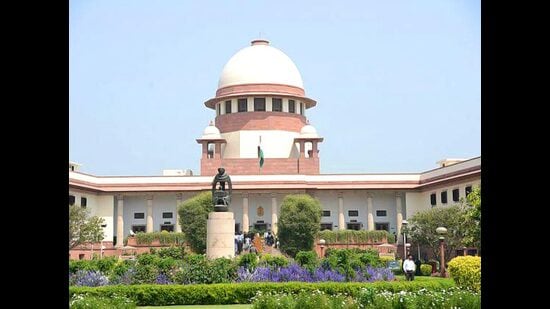
Acting on the appeal of the UT administration, the apex court bench of justice Sudhanshu Dhulia and justice K Vinod Chandran, while staying high court’s order, has sought response from employees and other stakeholders by March 4.
On May 30, 2024, a high court division bench had directed that Chandigarh administration and Chandigarh Housing Board (CHB) would commence construction of flats within a period of two months, complete it within one year and give possession of flats to applicants within two months thereafter.
The cost of construction was to be paid by the employees at current rates. However, cost of the entire land meant for implementation of the scheme had to remain at the rate of ₹7,920 per square yard, as announced in 2008.
Around 4,000 flats were to be built in Sectors 52, 53 and 56 by the CHB for government employees as part of the scheme, launched in 2008. The project comprised 252 3BHK flats with servant quarters, 168 2BHK flats with servant quarters, 3,066 1BHK flats and 444 single-room flats for Group D employees.
A draw of lots was held in 2010, in which 3,930 employees among 7,911 applicants were selected. They had then deposited around ₹57 crore with the CHB under the scheme.
Ever since, the scheme faced one roadblock after another, stalling its progress.
Even after CHB issued registration letters to successful applicants, in 2012, the then UT administrator, Shivraj V Patil, refused land for the scheme in Chandigarh, leading to its scrapping.
Seven years later, employees’ hopes were revived as the central government on January 2, 2019, cleared the scheme, although at prevailing collector rate.
This resulted in a major spike in the flats’ rates due to higher cost of land, prompting the employees to move the Punjab and Haryana high court.
While during the launch of the scheme in 2008, UT offered 3BHK flats for ₹34.70 lakh, 2BHK flats for ₹24.30 lakh, 1BHK flats for ₹13.53 lakh and single-room flats for ₹5.75 lakh; their prices had jumped to ₹2.08 crore; ₹1.85 crore; ₹99 lakh and ₹68 lakh, respectively, a decade later.
Eventually, in February 2024, UT had informed the court that it had decided not to go ahead with the scheme, as it was no longer viable. Following this, the high court had heard the matter on merit and pronounced the judgment on May 30, ordering that the flats be provided at 2008 rates.
Subsequently, UT moved the Supreme Court in November 2024, arguing that the high court order would lead to a financial loss of nearly ₹2,000 crore as over the years land prices have gone up.
The cost factor
When the scheme was cleared in 2019, the Union ministry of home affairs had determined the cost of the 61.5 acres land for the project at around ₹2,200 crore, coming to ₹74,131 per square yard.
However, according to the collector rate of 2008, the per square yard rate will be ₹7,920, equating to ₹237 crore for the 61.5 acres. Thus, the revised cost of a three-bedroom flat will be around ₹50 lakh, a two-bedroom flat will cost around ₹40 lakh, a one-bedroom flat around ₹35 lakh and a single-room flat around ₹15 lakh — translating into a financial loss of nearly ₹2,000 crore for the UT.


