
 E-Paper



Schools closed but tourism open, people question J&K Covid curbs
As cases surge, experts call for banning gatherings besides ensuring protocol compliance in public places


As a fresh wave of Covid-19 grips Jammu and Kashmir, the Union Territory’s administration has closed schools in Kashmir for up to a week for Classes 10 to 12 and for two weeks for Classes up to 9th but is encouraging tourism, particularly at the Tulip Garden that alone attracts hundreds of visitors daily.
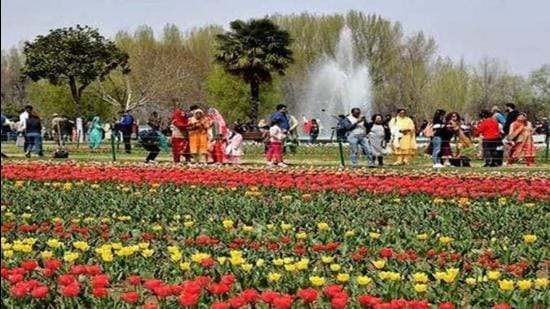
“When all tourist spots are open, it’s illogical to close down schools. Is there no coronavirus in parks and public spaces?” says Khursheed Ahmed, the president of the Parents Association of Private Schools.
Also read: Tourists coming to Kashmir by road will undergo Covid tests
Digital divide divides parents
Most parents of children studying in private schools have backed the administration’s decision to close schools to break the chain of the infection, but parents of government school students expressed disapproval.
“Children of private schools have access to online classes and their parents are educated enough to teach them at home, but what does a vegetable vendor like me who can’t afford a smartphone do?” says Fayaz, who enrolled his son in a government school this year.
Besides parents, teachers have also questioned the administration’s move. Shabir, a teacher from South Kashmir, says, “If you ask me as a parent of a private school child, I support closing institutions in the interest of health but as a government schoolteacher, I find this a mockery. They say school students are silent carriers but does the transmission not take place at crowded government events?”
While the Private School Parents Association has filed a representation to the J&K administration to start online classes, Shabir finds it undemocratic. “Access to education is everybody’s right. In the school where I’m posted, there are 90 students. Of them, only four students have access to a smartphone and that too stays with their parents through the day when they are at work. It’s an unworkable model in a region like Kashmir. Largely, children from government schools and their parents don’t have digital access. Most of these families are digitally illiterate,” he says.
Adil Rashid, another parent, says closing schools is inevitable because it’s not just about children getting infected but also about institutions becoming hotspots from where the infection can reach every home. “My seven-year-old and nine-year-old sons could bring the infection home to my 75-year-old father, who is immuno-compromised. Closure was the only way out,” he says, urging teachers to include creative indoor activities for students apart from the syllabus. “Children are becoming dull at home,” he adds.
Schools follow SOPs unlike public places
Saheka Shah, a teacher, says schools have been following complete standard operating procedures (SOPs) unlike public places. Some schools that don’t have enough space are ensuring social distancing by taking classes in shifts. “We used to conduct classes for primary students one day and for the middle and higher classes on the other day to ensure social distancing. There’s no such caution being maintained at any public office. There are no masks worn by people in banks. There is no social distance there. Why are they not closing them, too?” she said.
While the government says that it ordered the closure of schools in the wake of the likelihood of children getting infected and transmitting infection in large numbers, medical experts say it is irrelevant given the fact that public places remain bustling.
Nissar Ul Hassan, the president of the Doctors’ Association of Kashmir, says that reopening schools may not the only reason for the surge in cases. Hassan, who is also a flu expert, says, “Closing down schools may be a wise step but keeping tourist places open is illogical. All kinds of gatherings should be banned.”
Ban gatherings at weddings, funerals
Hassan says hospitals have allocated general ward beds to Covid patients to cope with the surge. “If the rise continues, we may soon be out of beds,” he says.
Hassan says most patients hospitalised have been infected in gatherings at weddings or funerals. “Why aren’t they banning them as well?’ he says.
On Sunday, the UT government passed an order that allows up to 200 people to gather for “any social and customary function”.
While the figures shared by the UT administration suggests that 200 students tested positive, leading to the closure of schools, while 900 travellers tested positive in March alone.
Make negative RT-PCR report must for tourists
On April 6, a 60-year-old tourist from Gujarat died of Covid-19 at a Srinagar hospital. Earlier, another tourist from Pune breathed his last in Kashmir after he was infected with the virus. He had tested negative on arrival.
Tourism agencies in Kashmir have urged the administration to make a negative RT-PCR certificate mandatory for travellers. However, there has been no response from the government yet.
Farooq Kuthloo, the president of the Travel Agents Association of Kashmir, says the government should allow tourists to move out of the airport only if the rapid antigen test is negative. Tourism in Kashmir has shown growth after a two-year lull and closing it down is not an option.
Kashmir divisional commissioner PK Pole was not available for comment.


