
 E-Paper



Wildbuzz | A case of mistaken identity
In past years, two Parrahs have been similarly rescued from canals originating from Roopnagar; this Parrah could possibly have been swept by monsoonal surge into the canal from Ghaghar grasslands


Gurpreet Singh looked askance at the Banur canal that goes past his lands at Shambu Khurd village in Patiala district. He wanted to water his fields but there was a dribbling flow. Just then his eye glimpsed upon a young animal stranded in the cemented canal which he initially thought was a calf. His farm hand corrected him to point out it was a deer.
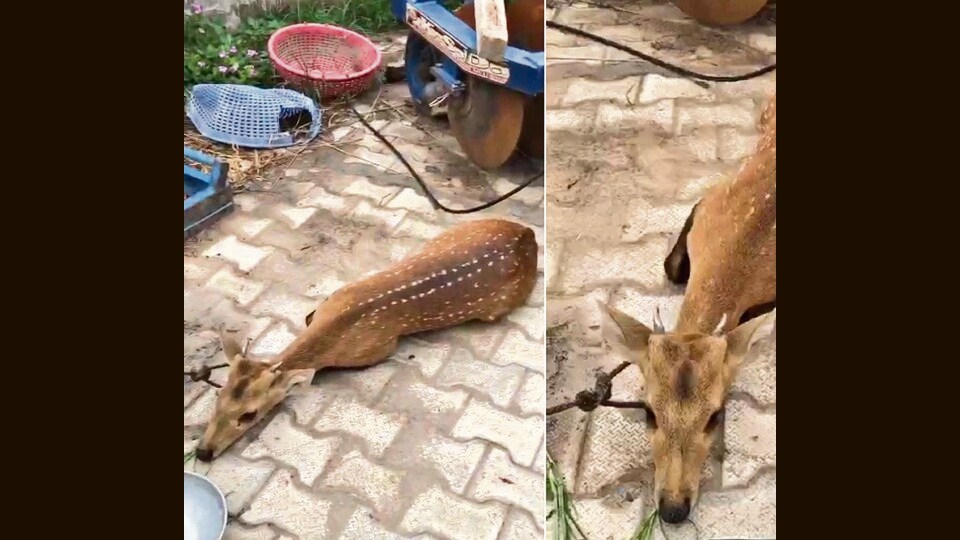
“I was concerned that stray dogs may attack it, so I got my farm hand to enter the canal and rescue it after following it for 1.5 km. I took the deer to my home in Pilkhani village on the Rajpura bypass and kept it in safety after contacting the wildlife department, whose team came promptly and took it away. The deer was scared of humans and did not eat the fodder we offered,” Singh told this writer.
After this fortuitous rescue, there was more drama in store. Wildlife officials mistook it for the Chital (Spotted deer) owing to the white spots. However, Punjab is not part of the known geographical range of the Chital. That apart, a young Hog deer (Parrah) is also known to bear white spots. So, the specimen rescued by Singh was actually a Parrah, a very rare record for Patiala and the deeper Punjab plains. Parrah is otherwise recorded in the Gurdaspur riverine belt and river plains emerging from Shivaliks. In past years, two Parrahs have been similarly rescued from canals originating from Roopnagar. This Parrah could possibly have been swept by monsoonal surge into the canal from Ghaghar grasslands.
Based on their incorrect identification (Chital), wildlife officials released it in Bir Moti Bagh sanctuary, Patiala. However, that is not a conducive habitat as Parrah is a grassland and river specialist, and inhabits grass-covered delta plains or open grass plains where grass is not too high.
Though Punjab government claims that Parrahs are also present in minuscule numbers at Bir Moti Bagh, a more considered choice of habitat could have been exercised by officialdom for the rescued Parrah given its age, traumatised condition and grassland preferences.
The beast’s beauteous tongue
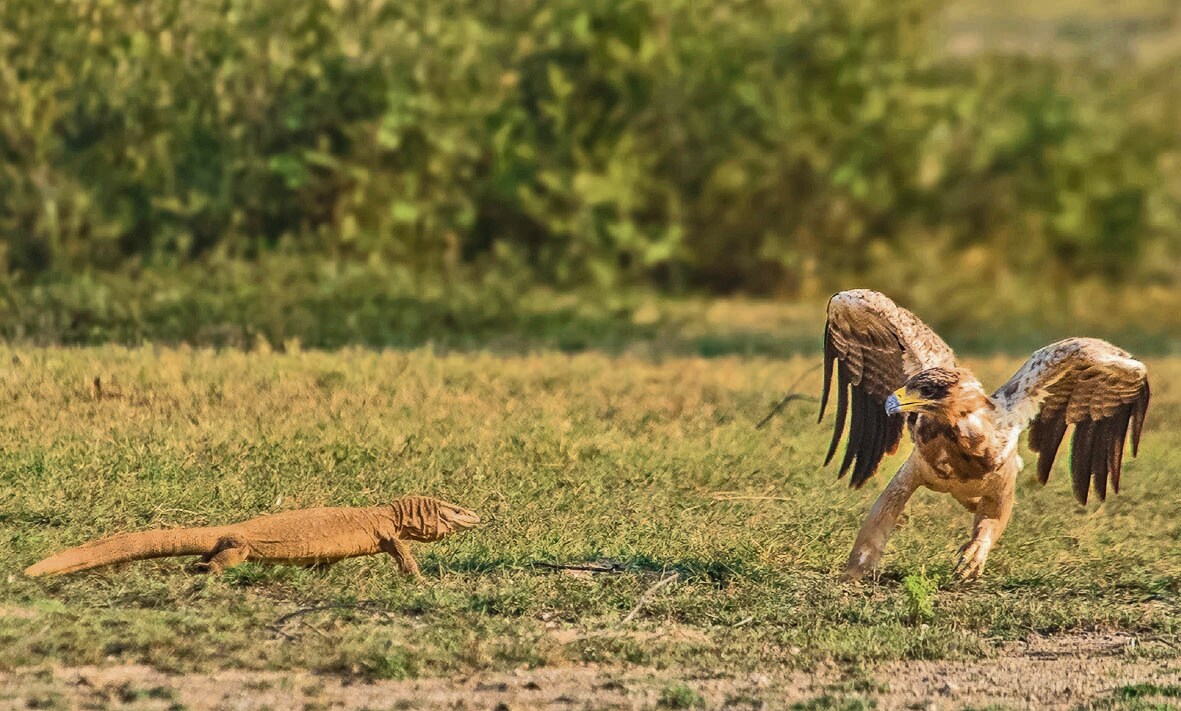
I do not share the beholder’s view that the Common Monitor lizard (Goh) is not a beautiful creature, as say the peacock. But even if this giant lizzie is viewed with a jaundiced human eye, there is a small part of her that would, by unanimous opinion, behold as beauteous. I stumbled upon this reticent beauty on a rainy day while rambling along the ridges of the Shivaliks rising to Siswan dam’s east.
Drenched with rain and sweat, I was resting on a low rock along a game trail and admiring the leaves sparkling in lime-green wash. As I took out my cell phone from a waterproof plastic cover, its crackle caught the ears of a Goh coming along the trail 20 yards from me. Gohs are hyper-active during monsoons, gobbling insects galore, climbing trees to eat bird chicks/eggs and laying ambushes outside termite mounds to snack emerging flights.
A tactically-sound hunter, the Goh did not come directly at me. Having heard that unusual plastic sound and assuming it for potential prey, she took a detour, went a few yards down the hillside and then manoeuvred towards my location. I sat still, hoping to get her to virtually climb into my lap for an intimate look at ‘Liz’! My statuesque posture, which I had absorbed first-hand from large ‘lifeless’ owls perched in trees during daytime, beguiled her.
With her characteristic swagger anchored in sinewy limbs, a thumper of a tail and raking claws, she inched her way. Out drooped a long tongue, flicking in an out, from side to side, and forked. The tongue is radar-like --- a sensory organ used for prey/predator detection (and also for attraction of the opposite sex). The tongue transfers odours to sensory organs (Jacobson’s organs) in the lizard’s skull.
The tongue colours dazzled: pinkish to salmon pink at the base and thence, a Persian blue or that royal blue one would expect only on peacock neck. The hues conjured an iridescence in post-rain’s soft light, contrasting starkly with Liz’s bleached-grey skin tones.
The Goh kept coming at a statued me, unperturbed and sure-footed, but when three-feet short, she froze, horrified. She turned tail, scampered down a hilly gully, jettisoning her gait, grace and swagger. She did not look back for the next 100 yards downhill!
vjswild2@gmail.com


